Over the years I’ve made an experiment of trying out new plants to overwinter on my windowsills. These experiments keep me amused over the winter months and provide the first-hand experience with specific varieties required to make solid suggestions. I generally experiment with herbs since they’re the plants we all want on hand most during the winter to take a clipping from now and again. They’re also the plants that most gardening literature tends to lump together. I mean, how many kits have you seen promoting a windowsill herb garden with herbs that have no hope in hell of surviving the best conditions and most diligent gardeners? There are times when I see someone pick up that kind of impossible gardening kit in a store and it takes all my willpower not to run over like a crazy person and stage an intervention. Those kinds of disappointments have a way of turning would-be gardeners off forever. No, it’s not you. It’s the stupid kit.
My windowsills have got to be the best examples of where not to grow going. My feeling is that if I can make a reasonable go of it with a specific plant than just about anyone can. On the one hand they are south-facing so they have light in their favor; however, it’s often either too cold and draughty or extremely dry and hot from the electric baseboard heaters that sit directly below. My poor overwintered plants are forced to contend with a constant shift in extremes. When it’s chilly the soil takes a while to dry out. When the heat is pumping they can get dry and dessicated overnight.
Naturally, only the most forgiving plants and varieties come away unscathed. Any plant that looks half-alive in time to transition outdoors for the summer is a winner.
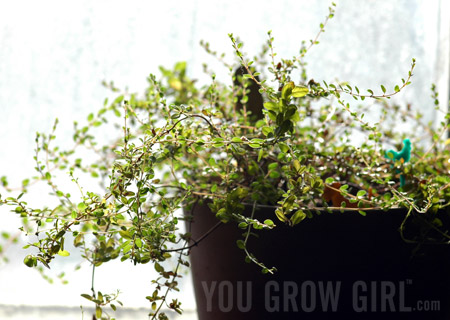
One of my current experiments is with a thyme variety called ‘Oregano’. Confusing, I know. Is it a thyme? Yes? Is it oregano? No, but it does have a hint of oregano smell and flavor.
In general I find that thyme, oregano, and marjoram are very forgiving windowsill herbs — possibly the easiest of the popular culinary herbs. Thyme tends to do the best. Some new growth can get a little leggy if there are too many dark days in a row, but it’s as simple as snipping those bits back slightly. Thyme is a tough and hardy plant that doesn’t mind a chill now-and-again. It overwinters well in my climate (zone 5b-6b? I never know. It only gets more confusing depending on where you are in the city.) and I’ve even had success growing it in large bins left outside through months of deep freezing and fluke thaws. The low creepers tend to do better than the taller plants but I am often surprised by just how many manage to survive, period. Thyme also doesn’t mind periods of dry heat, which is why it is one of my go-to herbs on my extremely hot and sunny rooftop.
‘Oregano’ thyme is a low creeper, which is why I think it is doing exceptionally well this winter. We went away for a week recently and while some of the leaves dried out in my absence it really doesn’t look like it suffered much at all.
My French lavender topiary on the other hand… I am only just beginning to accept that the thing is dead and gone. I’m permanently stuck in the denial stage of grief. Perhaps saying it out loud is the first step.
Related

Thyme, eh? I’ll have to give that a shot next year with one of my thymes, basil and the like I’ve given up on indoors unless under lights (we have too many mountains in the way and the sun isn’t up long enough during the winter to compensate), but thyme I just never thought of bringing in!
Ciao Gayla-
How do you prevent nasties like aphids on your over-wintered plants brought in from the “outdoor woods”? That has been the bane of my over-wintering efforts.
I second Sorellina’s question, aphids and whitefly are nemesis to the herbs I try to overwinter. I have had some success with overwintering a rosemary plant (knock wood). The powdery mildew got to it last year, which I remedied with a water, milk and baking soda water, and putting it in the absolute draftiest part of the house. This year it dried out too much (I went from a plastic pot to a teracotta) so I have been trying to stay on top of that. But I gave up on any aphid-plagued herbs.
I LOVE some of the pots that those herb kits come in. Like buzzy’s herb kit, (http://www.buzzyseeds.com/store/index.php?_a=viewProd&productId=81) I could just replace whatever crappy soil comes with it with my good potting soil, and the cute pot is definitely worth it. Look at those outlets for different herbs! I love them! and its ceramic, so its reuseable. Theyve got it for strawberries, too, though I might start that using crowns instead of seeds.
Personally, I have this blue elf aloe that I grow in winter indoors. I need to repot it, but that requires acquiring another pot, and its a delicate process, you see, finding or making just the right pot for Elfy.
LOL @ It’s the stupid kit. That should be bumper sticker’d or tattoo’d or something, somewhere. Potted herbs are hard here (VT) in our — paraphrase Jimmy Stewart — drafty old farmhouse. When in doubt: forced bulbs. :-)
And as for the little flies- Parks has these little fly sticks that you can put in the pots that work for me. Well, I don’t use this brand, but here’s an example: (http://www.parkseed.com/webapp/wcs/stores/servlet/StoreCatalogDisplay?storeId=10101&catalogId=10101&langId=-1&mainPage=prod2working&ItemId=6399&PrevMainPage=advsearchresults&scChannel=Supplies%20Gifts%20AS&SearchText=p16.v222;p10.v77&OfferCode=W1H) It claims to get rid of aphids and moths as well as the catchflies that I am plagued by. The idea, I think, is to make the buggers suffer for as long as possible. They can’t fly anymore, you see, and because the adhesive isn’t poisoned, they must spend the rest of their short little lives staring at their food source (your plants). I think they’re attracted to the bright coloring, because just as soon as I put up my sticky traps, flies started landing. Make them suffer!
This is a hard question because so much depends on the growing conditions indoors in your area during the winter. Here it is dry but the windows get very cold on the really freezing days and the sun can be gone entirely for stretches… so inadequate light even in a south-facing window.
A lot of it really comes down to doing the best you can to provide the growing conditions that plant needs. Some plants may be impossible for you. That’s why I mentioned thyme because it is particularly resilient.
Insects have a field day on weakened plants. The stronger the plant, the better their chances. Of course, the trouble with bringing plants in is that the insect predators don’t often come with them… just the pests. When I first bring the herbs indoors I check them everyday for aphids. Some do get them early on and I just shower them to get the bugs off. The key if you do find any is diligence since they can multiply exponentially in one day.
And what I said about cultural problems…. Inadequate light is a big one during the winter months. But so are other problems I mentioned like a cold chill, cold and wet feet (the soil is cold and stays soggy for long periods), overwatering in general….
Aphids especially love thin, leggy, weak, and tender new growth. I have a light that I can use during particularly long, dark periods.
The other thing I do is cut off fertilization almost entirely during the winter. I add maybe a bit of vermicompost since the nutrients are absorbed more slowly… but the combination of a nutrient boost + a lack of light is what causes that leggy, weak growth that aphids love.
But I should add that i have another strategy which is to coax some plants into going dormant. I achieve that by keeping the plant in a window in our cold hallway. Sheds and garages with windows work too. You may need to wrap the pot depending on the cold. These plants still need to be watered on occasion. You won’t get any new growth to harvest but these plants spring back come spring.
Aww but that’s no fun! Go hydroponic. Then you get new growth and you get to harvest year round. There really isn’t any chemical waste because the plants eat it all. It can’t be too bad for them because they certainly gobble it up. I’m trying it for the first time this year. We’ll see how it goes. As my one of my teachers once said, “If you can grow pot, you can grow tomatoes. Hydroponic.”
This is very curious. I’ve tried wintering oregano and rosemary with no luck, only tried it once though, perhaps that’s a project for next winter. I wonder about those self watering pots. Is it a good idea because the plants won’t dry out? Or a bad idea because the plants get too much water?
This is interesting and thank you for the link to some of the related posts. I am interested in checking overwintering hot pepper. This year just for fun, I dug up one of my parsley plants and planted it in a container and brought that inside. I wanted to see if it will survive. It is still a live but it’s not exactly growing. I water it when needed.
I’ve never had much luck with anything in the house. However, thanks to this site, I attempted bringing in a jalapeno and it is doing well. Now, I’m inspired to give thyme a try too!
Jennifer: I never really understood Rosemary until I went to Portland in the winter and saw how it grew there and got a sense of the conditions… cold but not the long hard freezes like we get here and very rainy… then I got it.
Rosemary needs to be nipped by a light frost before bringing them indoors. Thyme and oregano are cold hardy perennials that can take freezing temperatures and benefit from the same treatment.
I keep a lemon thyme by my back door, not south facing. It gets leggy but I keep the growth cut back by using it often in cooking. I also keep a rosemary which does quite well by the cold back door, even though it gets only a little sun.
I’m hoping to grow a few more herbs and plants in the house next winter.
I recently discovered that ants LOVE to eat aphids. I had a plant that was covered with aphids and I noticed one day a team of ants slaying the aphids as if they were the only food in my house! I think they completley wiped out the aphid colony that set up a township on my bagonia.
I love your site and visit it often for info. I have a hard time growing tomatoes, but finally last October (Mississippi Gulf Coast), I had some green ones, so I brought the plant inside, and they turned red, and the plant has since grown 1-1/2 feet taller and I now have five new green ones and flowers on the new growth! They are in a south window, but the temp this morning was 27! My mint and basil are doing great too; however, my rosemary didn’t make it.
Keith: Don’t want to freak you out but generally ants don’t eat or kill aphids, they actually protect them from other predators. They milk the honeydew-like secretion that aphids emit from their behinds (like cows) and in exchange protect the herd from predatory insects.