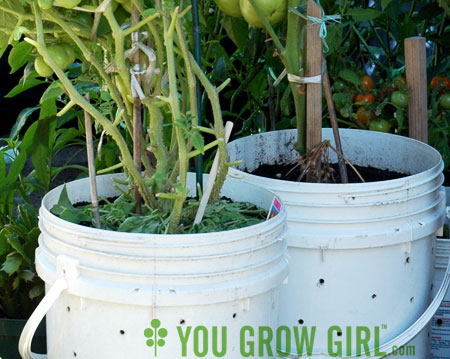
I’ve got a question on tomatoes. I’ve recently ordered about nine tomato plants. They’re still kind of babies, but it turns out that they’re indeterminates, not determinates like was expected. In the book it says that garbage bins work well, but if I chose the cheapest ones I found (they’re 13 bucks) that would be 117 dollars. What else could I stick them in that might be cheaper and easy? – Emily
Hi Emily,
Before I answer your question I’m just going to fill-in beginners on the terminology you used. For those just starting out in tomato growing, tomatoes come in two types that determine their growth habits and in turn, the needs you will have to meet to grow them successfully. Determinates are tomato plants that grow in a bush habit. This means they are likely to stay short and probably won’t require staking. Determinates are the best tomato varieties for container growing. Indeterminates on the other hand are the really big varieties that grow into tall vines and are traditionally trained to grow upwards using cages or stakes. The root systems on these plants can get to be quite large and demanding requiring ample space and water. It is hard to meet the needs of a large plant in a small space. This accounts for a lot of the difficulty and frustration experienced by gardeners who are new to container-growing. Container soil dries out much faster than in-ground gardens and tomatoes drink a lot of water, especially when they are producing fruit. Dry soil can put a lot of stress on the plant causing disease and unproductive plants.
That said, indeterminates can be grown in containers. The trick is to give them lots of room, keep them watered, and make sure that the pot is appropriately sized for the plant. Do not put more than one tomato plant in the same container!
When it comes to purchased containers, garbage bins are about as cheap as you’re gonna get. The lowest price I have come across for a good-sized bin (about 25 inches tall by 14 inches wide) was $10. Generally, containers of the same size purchased in the garden section of any department or hardware store is going to run you almost double that price.
Thrift stores can be good for containers however they generally don’t carry containers that large — I suppose this is because when garbage bins are put to their intended use they are used until they are no longer fit for reuse.
I think your best bet in this situation is to look for your containers along the curb on garbage day. No, I don’t mean steal your neighbor’s garbage bin! Instead look for large buckets and tubs that are being thrown out. Just because it can’t hold water anymore doesn’t mean it can’t hold soil. Look outside restaurants and laundry mats where oil and detergents are kept in bulk sizes. Better yet, go inside and ask if there are any empty buckets that you can have. Growing really large indeterminates in buckets can be tricky since the buckets aren’t as big as garbage bins, but I have seen it done many times.
To ensure success in a smaller container I would recommend spending some money on a good container soil that holds water but is also light enough to allow for good air circulation — you don’t want those roots to get crushed and compacted in such a tight space. If air circulation seems like an issue try drilling holes in the sides of the containers (and the bottoms). This means more water runs out but what you lose in water you gain in air circulation. And finally make sure to keep the soil moist. Monitor the moisture levels of the soil, watering everyday during the hot months if not twice daily when the heat gets intense.
If all of this seems a bit overwhelming you could try trading some of your indeterminates for less demanding determinate varieties with someone who has the space. That way you don’t lose any money but gain less hassle.

Emily (or anyone else interested) – where do you live? Madison Wisconsin by by any chance? I have two extra garbage cans if you are interested. Send me a note if you are!!!
I forgot to mention a great resource FREECYCLE.
Family members in New Mexico (dry climate) just bought a few large bags of potting soil, plopped them on the ground, cut an X in the top side of the bags and planted one tomato plant in each bag. They had more fruit than they could eat. Don’t know if that is thrifty or not, but they did have the potting mix to add to their borders later.
the containers in the photo look like the 5-gallon buckets that pickles come in. you might see if a school or cafeteria nearby gets food from sysco or aramark or one of those companies and has buckets they want to get rid of. i don’t know if those buckets would be big enough for indeterminates but they’d be free!
large kitchens such as restaurants and cafeterias that buy bulk dry food often have ~25 gallon buckets which are food grade plastic. They might not be UV-resistant though, so if you can get those you should paint or cover them somehow to keep them going for many years.
Flowershops usually get cut flowers delivered several times a week in tall buckets. The buckets accumulate quite readily and are either recycled back to the dealer or thrown away. If you ask, the florist may be willing to share (especially if you also buy a bouquet). They are not terribly strong, but they could probably hold a tomato plant for a season if placed in a temperate location and watered often. Since it’s tomatoes you are growing, you definitely don’t want anything that may have had chemicals in it… it’s much better to spend money for safe containers if it comes to that!
Mine are growing in wine boxes that I scavenged from the local wine retailer; there they were, piled next to the dumpster! One of my neighbors grew some kind of tomato on his balcony in a cardboard dishwasher box wrapped in plastic trash bags and duct tape. He poked holes for drainage and it lasted as long as the plants (which were gorgeous) did. It doensn’t have to be pretty and perfect; the tomatoes are pretty and perfect enough on their own.
All right! Finally found a use for the buckets the kitty litter comes in!
Gayla, I gotta question…I have these gigantic tubs, like 100 gallons big, (3 and a half ft long by 3 ft deep). So can I put more than one plant in those? Or is there another reason other than space restrictions, that you are not supposed to put more than one tomato in a container…?
Jessica: You might be able to do two tomatoes in that size but I’m hesitant to give an absolute yes answer because it depends on the type… some indeterminates are a bit overbearing. The thing is, you can grow indeterminates closer together in-ground than in containers. Containers dry out much faster than in-ground gardens. Two tomatoes together in a container tend to fight each other for root space.
I have done two tomatoes that close if they weren’t enormous plants. But as a general rule I stick to one plant per container and use the extra space for plants that compliment rather than compete. Basil is always a great example and you can find so many interesting colours and varieties. Shiso looks nice. So do the gem series marigolds.
Hi there. A good resource for 5 gallon buckets is a bakery. Most of the fillings and icings come in these buckets and they usually get thrown away. I have worked in many bakeries over the years and we always tossed them unless someone asked for them.
Ciao Gayla-
I’m growing 18 dwarfs and 9 determinates this year. Once again, I’ll be using wading pools as saucers underneath the plants, but instead of forking out more money for containers, I think we’re going with grow bags this year. They’re made of a durable plastic with pre-made holes in the bottom specifically for growing plants and they’re very inexpensive.
I guess it’s time I tried out grow bags. They’ve been popular in Britain for a long, long time but I just can’t wrap my mind around them. They’re shallow so I imagine they dry out faster than a large container… and boy are they ever ugly!
I’m a first-time vegetable gardener doing (indeterminate) tomatoes in a raised bed square foot garden, and after reading this I’m really worried that I haven’t allotted enough space for them, even though I’ve done exactly what the book recommends: one per square foot. Will I have to prune them like crazy to keep the growth back?
Rebecca: Don’t worry, you’re golden. In-ground gardens are more forgiving than containers… I give about that (a foot squared) as a minimum in my raised bed with maybe a bit more space if I know the variety is a real space-hog. I do prune a lot of the bottom portion out but that’s my style preference.
Whew! Thanks for the quick response; I feel better now! :)
In-ground definitely allows the plants to develop deeper and stronger roots. I’ve grown tomatoes “too close” in the ground, and they didn’t seem to mind as long as they were well-watered and fed. At first I thought they might have lower yields, but they were really productive. Though in a pot, I doubt this would succeed.
One may try asking a local restaurant for free containers. I usually get pickle and veg. oil buckets from two in my area. They are not pretty…but they get the job done. Also, if you are creative I suppose one could decorate the outside with either paint (made for plastic) or something to disguise the bucket. Just a thought.
I’ve been scouring yard sales the past few weeks and have managed to spend a total of $4 for 3 huge containers for my tomatoes – giant plastic work buckets (my husband calls them keg buckets). And I have to agree with Gayla on Freecycle. I’ve seen all sorts of great garden resources flying around there lately in my area.
Thanks for the info Gayla! I joined the Basil Grow-a-Long and am excited to do some companion planting now!
orangepekoe: That is an awesome score.
I just went through my recycling bin and pulled out 2 giant kitty litter plastic bins! Score! And I have another one that’s almost empty! I’m going to sanitize them and drill some holes in them ASAP. I shall name my tomato garden “The Fresh Step Garden.”
Hey you could try freecycle, through yahoo groups for extra large containers there a group that recycles and gives things back and forth that are no longer being used in an effort to keep things out of landfills.
Linda: I’ve got a great, easy, and thrifty creative solution for hiding the ugly buckets that I’m going to post later this week.
Try Ikea. A few of their mid-size pots are cheaper (5.99 for 12” terra cotta). Or they havea a $1.99 trashcan… (look in bathroom or office).
molly, those kitty litter bins are perfect, I see people plant in them a lot. Another great place to look is in dumpsters outside of construction sites. I’ve got about 10 or 15 of those 5 gallon joint-compound buckets on my roof already. Sometimes they have concrete in the bottom, but so many of those get thrown out that you’re bound to find a couple good ones.
Gayla, those happy pairs you listed are really helpful. My garden is all containers, and I have some big stuff, sunflowers and such, so space is tight. I’d love to know more about smaller plants that work along side bigger ones.
Got a great idea from friends on freecycle- leftovers from a local Pepsi bottling plant. 30-55 gallon containers for $5. See here http://dc.metblogs.com/2008/04/07/my-barrels-let-me-show-you-them/. Enjoy!
My neighborhood health food grocer had a local organic farm stand set up outside today with seedlings for sale, and I bought 3 heirloom tomato seedlings (among other things), which are all indeterminates. Later on, while at Home Depot a few hours later buying potting soil, I noticed they sell huge orange buckets for mixing paint for under $5! Score! I’ll drill some holes into that for the Mark Twain tomato plant that promises to be huge!
Ok, so this is what happens when you jump right in to a project without any research…
I planted 4 (yes, 4!) tomato plants in a 5-gallon planter. All determinates, as recommended by those helpful souls in the Wal-Mart garden center. So, as anyone with apparently _any_ experience gardening knows, the plants are a little smushed. And yet, they’re doing lovely so far… As in, I planted them about a month ago, they’ve doubled in size, I have a lot of green tomatoes on each plant, and two of my cherry tomatoes are red already (I live in Florida). I water them twice a day to make sure the soil doesn’t dry out.
So my question is — should I leave them as-is, or should I try (very carefully) transplanting them each into a separate container?
Any ideas? I think you can’t get any more newbie at this than I am…
Thanks!
I have had success with planting directly into the bags of potting soil. By standing the bag on end and poking drainage holes in the bag periodically I have the soil and an instant free container. I have done this with tomatoes, flowers and herbs with a pretty good success rate. Just a thought.
Another great tip for those buckets from restaurants and flower shops: You can turn them into self watering containers. All you need is two buckets, a funnel and a drill with a door knob hole bit. About two to three inches up the side of one bucket using the drill and a basic drill bit, drill 6-8 holes in a rectangular pattern and cut inbetween the hols so that you have a rectangle cut out in the side of the bucket. This will be where you add water. Drill a hole in the bottom of the other bucket with the door knob hole bit and place the funnel in it. Place the second bucket into the first and fill with dirt and your beautiful tomato plant. Water after transplanting. After the initial watering only ad water to the bottom bucket. Tada…self watering container.
BEST solution I’ve found- the $5.99 Ikea terra cotta pot. It’s huge! The saucer is $4 if you need it. Plus, you’re not buying plastic (I like to stick to natural, biodegradable materials) AND it looks pretty! This thing is great. http://www.ikea.com/us/en/catalog/products/50118846
A little off the subject… but how big of a container do you need for determinate plants? I have mine in a 10″ – and I am wondering if that is too small. Thanks!
Anna: It depends on the variety. Some determinates are really small and compact and others are often refered to as “mid-sized.” The small ones are usually called miniatures or dwarfs and have names like ‘Toy Boy’ or ‘Tiny Tom.’ But mid-sized determinates do need a bit of space. 10″ isn’t bad but a foot or more is better.
Emily: That pot is a good deal for the size. However, I still think it’s a bit too small for an indeterminate. You’re right that terracotta is better environmentally, but it will dry out faster which is why bigger is better. That’s a great size for a mid-sized determinate though!
I have two tips to share:
– if you have any local Mediterranean delis or food shops nearby, ask if they have any empty olive buckets. They’re the perfect size, come in great colours and have cool logos and greek writing on them
– if you go for big plastic painter’s buckets ($3-4 at home depot or free from the curb) but can’t stand the sight of the ugly white plastic, pick up a piece of bamboo “privacy screen” at the hardware store (in the gardening section), wrap it around the bottom of the bucket up to the lip, cut it to length and then wrap a piece of binder twine or baling wire around the body of the bucket a few times in a spiral shape to hold it on. It’s cheap, easy and gives the plastic bucket a nice organic, bamboo look for your deck!