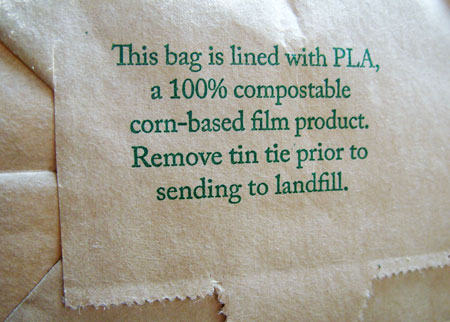
I discovered this message on the bottom of the 1lb bag of coffee beans I purchased about a month ago and thought I would look into PLA and try my hand at composting the bag to see how easily it could be done. The issue here isn’t the paper itself (although that is an issue all its own) but the plastic coating used to line coffee bags. I often save my coffee bags to be reused for storing dried sea kelp for the garden, dried herbs, or flower petals. I’m not a heavy coffee drinker but one can only use so many coffee bags — composting had never occurred to me as an option.
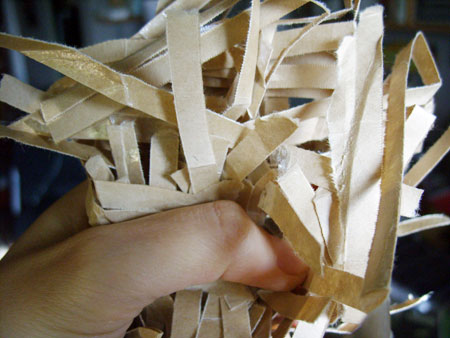
To compost I simply removed the metal tie, ripped the bag into 4 pieces and put it through our shredder before adding it to our kitchen scraps bin (the bin that sits in our kitchen before being dumped into the outdoor composter). We’ve been stuffing the small rooftop cold composter with greens all winter and could really use some browns* in there! This process was easy enough although our as-cheap-as-they-come shredder that is constantly blocked up with stuck bits of paper pulp in the corners, did not appreciate the corn plastic, refusing to shred some of the pieces completely.
It’s been about a month since I put the scraps in the bin and while they aren’t completely composted (because it is winter and our bin is shallow) the “plastic” corn part seems to be dissolved and I have not noticed any sticky residue, unusual growth, or general weirdness inside. I have written on at least one occasion about compostable products, and my thought is that in the end, while it is great that we now have more environmentally responsible items to replace plastic, what I should be thinking about is how to reduce or replace consuming the item in the first place. This exercise in composting a bag is a good reminder that rather than buying my coffee in a bag, albeit a compostable one, I could be bringing a container with me on the days I know I will be stopping in for a lb of beans, saving the paper, the growing of the corn, and the production of corn plastic completely.
*Browns are the dry, carbon-rich ingredients like dry leaves, hay, or newspaper that are added to the bin to balance out the process and keep your bin from becoming too wet and stinky.

Oh, awesome idea. I have been thinking about buying a shredder so we could compost our old bills and junk mail. Do you make a habit of composting regular paper like that as well?
-Renee
Depends on the paper, ink, etc. Shredded paper can make a good bedding in a worm bin.
Another way to cut down on the use of plastics and styrofoam — carry a small tupperware (or other type of container) in your purse/bag when you go out to eat. That way you have something to put leftovers in.
I can’t say I always remember to do this, but it really is a good idea because nothing bugs me more than asking for “a box” to take something home and seeing the server arrive with styrofoam.
KJ: Agreed. I am looking for a collapsible container because I’m constantly carrying around an arsenal of bags and containers which is getting to be a bit ridiculous… and heavy.
I saw a collapsible container a few months ago — I should look for the link. I know what you mean about the arsenal of bags and containers. I had now have 4 reusable grocery bags in my shoulder bag, and another 3 in the car. :-)
I just went to a seminar about sustainable packaging. When they refer to compostability on a package that is for industrial composting, not meant for your backyard pile. I had always wondered about that stuff. Also, PLA makes me nervous. While the concept of a renewable resource for plastic is awesome, most of the corn seed comes from companies like Monsanto or Cargil and they have genetically engineered the seed to only be usable for one season and you can’t reuse the seed from the plants that are grown.
Stacia: Interesting about the term “compostability.” Although I have tried a few products and they have worked just fine. I’m not composting in large quantities and I break the items up first so no issue there.
But again with the coffee bag it comes down to the PLA coating more than the paper and compostability of the paper.
You make a really good point about the corn. As an example, some companies that are making shopping bags from corn are very clear about where their corn is derived from in the first place. Obviously this coffee bag package isn’t forthcoming about that info.
Which is why in the end it comes down to, How can I just eliminate acquiring this item in the first place?
I guess you can’t really grow your own coffee. Even in the book, Animal, Vegetable, Miracle, they had to compromise and buy fair trade coffee. I don’t think elimination is possible, I think, as you are doing, it is about making the best choice possible.
Ha! I can try to grow my own coffee indoors but I’d probably get one bean at most!
I do buy Fair Trade beans… Organic and Fair Trade Kamikazee Espresso from Cherry Bomb on Roncessvalles if anyone cares. Good stuff!
Hi Gayla and Lori. Regarding “collapsible container,” I use these. The small one fits in my purse and it fits any restaurant leftovers perfectly!