Hardy Opuntia Flower

Photo by Gayla Trail  All Rights Reserved

One of my pal Barry’s hardy opuntia plants was flowering today and I was lucky enough to be there to catch it. And with my new lens in tow. Iiieeeeee…….

This plant comes with a fun story — Barry got it free from the compost bin of a gardener that was throwing it out.

I just happen to have a new, and free hardy opuntia myself. It was a gift from a gardener we visited last week. He just plucked a paddle from the parent plant and stuck it in a roll of newspaper for the ride home. When I got back I laid the cutting on the surface of a pot filled with sandy soil. Eventually the plant will root itself and I’ll have a new plant that I can break up and give away to friends that visit my garden.

Most plants are easy to propagate and in my experience gardeners are generous people who are always eager to share a bit of their wealth with those that show interest. For that reason alone I have no idea why some people feel the need to steal plants from gardens.

Leave a comment

Calibrachoa ‘Double Lemon’

Photo by Gayla Trail  All Rights Reserved

I don’t know what it is about this year, but not only am I branching out into plants I’ve always wanted but didn’t think I had the space to keep, but it seems I am also turning to plants I have never shown past interest in. In fact, I have previously held my nose up at some of these plants.

I am scaring myself just a little bit.

This spring, my eyes fell upon this double calibrachoa hidden among petunias and single calibrachoas at one of the garden centres I frequent. The next thing I know I have bought it and am growing it on the roof where I can visit it most often. I went back and bought one for a friend, too.

What is happening? Nearly halfway into 2010 and my Year of the ID, is devolving into the Year of WTF?

————–

p.s. I was just about to hit post when I received an email from Derek Powazek about his newest piece about gardening: They Don’t Complain and They Die Quietly. Great story that made me tear up.

Leave a comment

Rue Flower (Ruta graveolens)

Photo by Gayla Trail  All Rights Reserved

Leave a comment

Oxalis vulcanicola ‘Zinfandel’

Photo by Gayla Trail  All Rights Reserved

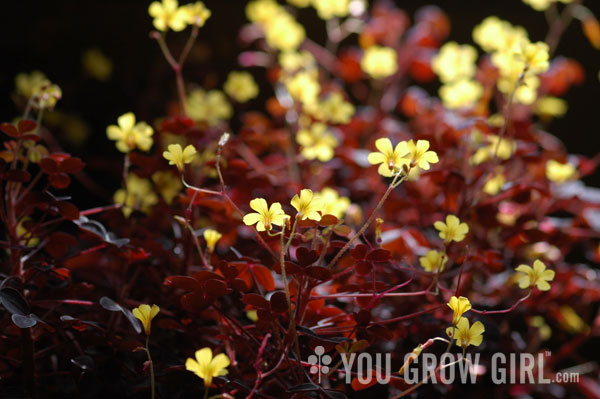
Since announcing a new obsession with oxalis late last year, my devotion to this genus of small, clover-like plants has expanded. I failed to grow a package of bulbs given to me by a friend but have since purchased three new plants that are all doing well. So far I can keep oxalis alive with little effort — even under lights — the tricky part is bringing the bulbs out of dormancy.

Try, try again. Eventually I will get this right.

Leave a comment

Grow a Mixed Strawberry and Herb Container

Photo by Gayla Trail  All Rights Reserved

When I was in the West Indies, I was surprised to see how much people coveted strawberries. While I was salivating over golden apple and fresh bananas, West Indians were paying through the nose for a basket of pathetic, well-traveled berry-like objects. I don’t think strawberries grow very well in extreme tropical heat. That didn’t stop one gardener I visited in Dominica from trying. As my own strawberries begin to set fruit and ripen I wonder if her little plant has made it and if she was able to savor a few homegrown berries this year.

Here in Toronto, it’s not too late to start strawberries. My first article of the season for the Globe & Mail explains how, but did not include this photo of a mixed planting I put together using an old honey tin I bought at a yard sale. If you are going to use something like this, don’t forget to add drainage holes. I made several in the bottom using a large nail I keep on hand for this purpose. Everything in this pot is edible, including the flowers.

One Each of: An unknown hybrid strawberry (the berries are ripening now!), ‘Golden’ sage (it is not hardy here and does not grow very big), ‘Gem Apricot Antique’ viola (may soon have to be replace for something more heat tolerant as the summer kicks in, or you can just pull it out when it kicks it and let the strawberry and sage spread.)

Leave a comment