Accidental Tomatoes in My Office

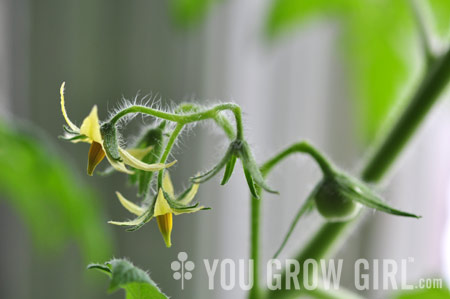
Back in January I introduced you to my office tomato, a mystery volunteer plant that I began nurturing for its delicious tomato leaf smell. Well, it looks like Mystery Tomato is about to offer up something else that is delicious — it’s making fruit!

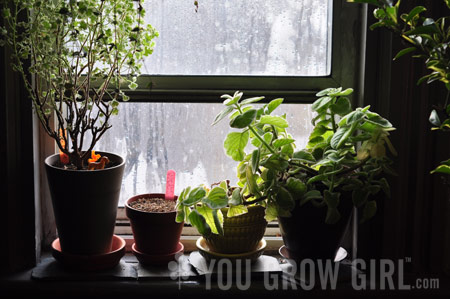
Here is a photograph of my plant in the window it lives in, taken just this morning. The plant is over 2 feet tall now. I have steadily upgraded it into bigger pots as it has grown. It could have been taller, but I buried a large portion of the stem when I last upgraded it as a way to ensure a more stable root system. Its current pot is 9″ deep and 10″ wide at the top.

Surprisingly, the plant isn’t leggy. It’s growing in a south-facing window and it seems to be getting just enough light to keep it happy. Any less and I’d be concerned. One of the biggest challenges around growing tomatoes indoors through the winter is the lack of sunlight. For the most part, the sun isn’t bright enough and the days are too short. Tomatoes need a lot of sunlight to produce fruit. If you want to try growing your own, I’d recommend growing dwarf varieties that are less demanding and will fit underneath supplemental artificial lights. My plant is much too large for that so the most I can do is turn it regularly so that it receives an even amount of light on all sides, and hope for sunny days.
Read more…

Leave a comment

What’s on Your Windowsill? (Plus Giveaway)

Photo by Gayla Trail  All Rights Reserved

A visit to Erika’s apartment a month back has inspired a new sense of excitement about my own windowsills. The morning after the tour, we experienced a rare winter treat here in Toronto: sunshine! While my windowsill has been transformed several times since, here’s what it looked like on that first morning of sun.

In the photo above you can see [left to right]: ‘French Lace’ scented geranium, Chilean oxalis bulbs that I recently planted, another oxalis that has gone dormant, variegated Cuban oregano (that thing does not stop growing. I have cut it back hard, several times), and the edge of a ‘Centennial’ kumquat tree.

Photo by Gayla Trail  All Rights Reserved

This is the other windowsill in my office [left to right]: Microgreens freshly sown in a recycled salad container (behind), spineless blue agave (front), lithops, another dormant oxalis, donkey’s tail sedum (Sedum morganianum) (hanging).

Photo by Gayla Trail  All Rights Reserved

And here’s what it looked like yesterday afternoon when the sun was shining once again [left to right]: Pelargonium ‘Fair Ellen’, yet unidentified echeveria I bought a few days ago, pelargonium ‘Mabel Grey’, another unidentified echeveria from the same purchase, sea onion (Ornithogalum caudatum).

What are you growing on your windowsill?

Please post a link to a photo or post on your blog about what’s on your windowsill. We can inspire one another and beat the winter is almost over blahs.

Next Friday, March 19 at 5pm EST I’ll randomly select two people from the comments below to win one of the following price packs:

prizes_mar2010.jpg

  1. One of our “I Heart Dirt” tees, six packs of organic vegetable and herb seeds from Cubit’s Organics, a package of assorted garden buttons and magnets (also designed and produced by us), and one of the few remaining Grow Great Grub book launch party door prizes that includes a specially made “Grow Great Grub” button and a pack of organic vegetable seeds by Urban Harvest.
  2. Six packs of organic vegetable and herb seeds from Cubit’s Organics, a package of assorted garden buttons and magnets (also designed and produced by us), and one of the few remaining Grow Great Grub book launch party door prizes that includes a specially made “Grow Great Grub” button and a pack of organic vegetable seeds by Urban Harvest.
Leave a comment

Growing Food on a Windowsill – Microgreens

Photo by Gayla Trail  All Rights Reserved

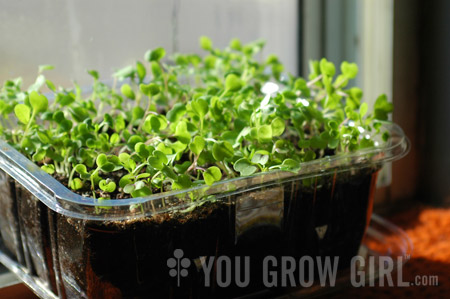
Winter is slowly coming to an end around here and it is nearly time to start lettuce outdoors. Until then I’ve been growing and harvesting small batches of micro-sized greens on my windowsill as a way to keep some salad fixings coming through the darkest and longest days of winter.

Microgreens are tender and tangy lettuce and mustard greens that are chopped off young, usually when they are only an inch or so high at the most and barely a few weeks old. They’re smaller and younger than baby greens, which tend to be harvested later when the plants have grown a good three inches tall or more.

It is this short growth span that makes microgreens possible to produce on even the darkest windowsills through the dingiest months of the year. Even the most beginner seed starter can take this growing project on since the plants only need to be kept alive for a few weeks tops. Unlike growing full-sized plants, it’s not the end of the world if they grow a little leggy (thin and stretchy) in the process.

Lettuce Greens to Try

Give yourself a break on the first time out by growing readymade storebought mixes that come in mild or spicy combinations. Some companies sell mixes that include the word microgreen on the package but any salad or mesclun mix can be grown this way. I like Urban Harvest’s Oriental Salad Mix (has a slight kick) and the Mild Mix prepared by Botanical Interests. Once you’ve got a taste for what you like try making your own mixes. It’s more cost effective and you can tailor make mixes that leave out any greens that don’t suit your taste buds.

Spicy: Peppergrass cress, ‘Giant Red’ mustard, radish, arugula, daikon radish, and ‘Wrinkled Crinkled’ cress.

Mild and Tangy: Tatsoi, mizuna, kale, lettuce, miner’s lettuce, and minutina.

Photo by Gayla Trail  All Rights Reserved

How to Grow

They’re not particularly attractive, but I grow mine in recycled plastic takeaway containers and clamshell packaging. They’re always on hand and tend to be the right size for the windowsill. To prepare, simply punch 5 or 7 drainage holes (I always go for odd numbers) into the bottom of a 9″ x 7″ package using an awl, sharp pair of scissors, or knife. Fill ‘er up with well-moistened container mix, potting soil, or seed-starting mix to within an inch or so from the top. Evenly distribute a thin layer of seeds, sprinkling them over the soil surface with about 1/8″ to 1/4″ of space between them. Cover the seeds with a thin layer of soil, about 1/8″ deep. Set it in the sunniest window you’ve got with the lid of the clamshell placed underneath as a drip tray. Water in well to get them germinating.

Photo by Gayla Trail  All Rights Reserved

Sprouts at about the one week mark.

Keep the soil moist like a wrung-out sponge but not soaking wet. To avoid over-watering, dunk out any water that is still in the drip tray within an hour of watering. Microgreens can be harvested with a pair of scissors in 1 1/2-2 weeks depending on how large you want to grow them. I generally let mine grow until the moment their first set of “true leaves” begin to peek out. The first leaves you see are called “seed leaves” since they are actually a part of the seed. “True leaves” are the second set to appear and often look very different than the seed leaves.

Starting Again

Unfortunately, unlike when growing baby-sized and mature greens, you can not grow a second crop from the same stems. This is because the plants you are harvesting are essentially sprouts. Second crops grow from the upper part of the stem above the leaves, and these are harvested on the lower part of the stem below the leaves. The bad news is that you will have to start over with fresh seeds to produce another crop. The good news is that you can reuse the pot and soil if there were no problems with disease or pests on the first go-around.

To prepare for another crop, simply yank the remaining roots and stems out of the soil, toss them in the compost bin, and till the remaining soil with a fork. Sprinkle on a fresh layer of seeds, top it with a thin layer of soil and the process is begun anew.

Start a second crop of microgreens a few days to one week after the first set and you’ll have continuous crops ready for harvest through the winter.

Leave a comment

Lee Valley Windowsill Seed Starter

Last spring the world aligned in such a way leading to what I can only describe as a collapse in judgement wherein I purchased an actual device to start my seeds in. Firstly, I am a gluttonous gardener and had compiled a frightening collection of seeds to grow, and then Lee Valley had the gall to open a store in downtown Toronto, luring me into their crack den of nearly useless gadgetry and fancy door locks.

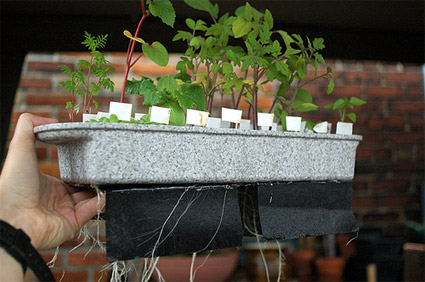
I broke down and purchased Lee Valley’s Styrofoam Windowsill Seed Starter last season knowing it would be problematic but having been sold on a few key features: it’s just the right size to fit my narrow old-school window ledge, and it’s self-watering. While you can get your seeds started in just about any old yoghurt container or milk carton, gardeners who are short on space will empathize with my dilemma, How do I grow the maximum number of seedlings in the tiniest amount of space? The answer, like most quandaries in life comes down to finding a system that presents the least number of problems… or growing less seeds. Not going to happen. In fact my list for this year has increased!

Here’s what I wrote last year:

    I pay $20 for Styrofoam so you don’t have to. [ed. Here's where I convince myself I am doing this all for you.] The first problem I noticed was no tagging system. I fixed that by fashioning tiny tags that don’t interfere with the dome using toothpicks, sticker paper, and an indelible marker. So far I don’t mind it as it fits perfectly on my narrow windowsill and I haven’t had to even think about watering for days. However, seedlings are only just starting to emerge and my suspicion is that the real challenge will come as they near transplant size.

The challenge I am referring to is the starter’s tiny cell size. Sure you can start a lot of seeds in a small space but what happens when those tiny seedlings start to grow? Lee Valley’s write-up on their website suggests using the starter for slow-growing plants such as broccoli and lettuce. Now, lettuce is a cold crop that does not require a start indoors, and I don’t know about you but I would hedge a bet that people with small indoor spaces often have small outdoor spaces. What percentage of those people intend to grow more broccoli in that small space than tomatoes? Just saying.

So here’s what my plants looked like about three-quarters of the way to planting time:

seedstarter1.jpg

    You can see that the plants are a bit leggy (tall and thin). This is the reality of windowsill growing. My window is south-facing and gets good light but it’s just not as ideal as an artificial lighting set-up.

seedstarter2.jpg

    A massive tangle of roots was created causing some stress on transplant. You know, what with all of the ripping and the tearing. Hint: Seedlings hate that.

seedstarter3.jpg

    Purple colour on the underside of tomato leaves is a sign of potassium deficiency. I transplanted these seedlings to recycled transplant containers shortly after taking this photo. The seedlings came around and lost that purple tinge once they had some room to spread their roots and take up nutrients. I watered regularly with sea kelp and added a bit of vermicompost to each pot at transplant time.

In the end is all of the fuss worth it? The advice I always give and stick by is to save your pennies and employ transplant-sized, reusable containers to get the job done. Starting with appropriately-sized containers that will take you from seed to transplant means less work in the long-run and prevents any desperate late-spring juggling acts to find enough light for all of your much-larger-than-anticipated seedlings. But of course if you’re like me and you’ve got bigger dreams than seed-starting space I would suggest saving your tomatoes for regular-sized containers and trying hot peppers, annual flowers, and just about anything else in the windowsill starter. Or if you’ve got to have those extra tomatoes you can do what I will probably do, give it a go now, panic later.

Leave a comment