The Secret to Growing Happy Thyme


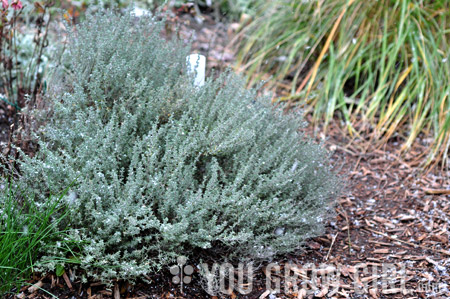
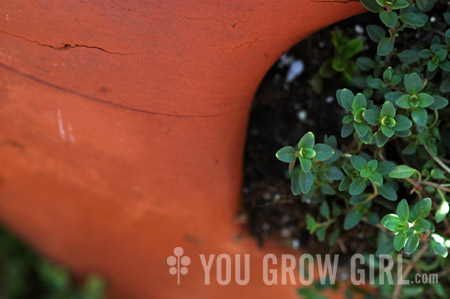
‘Doone Valley,’ a variegated creeping thyme with a lemon scent/flavour is seen here growing in my Dry Bed in and around red semperivum and a Silver Brocade Artemisia (Artemisia stelleriana).

I’ve been growing thyme (Thymus spp.) for about as long as I’ve been gardening and I over that time I have tried every variety you can think of and in a multitude of widely varying growing conditions. From raised beds to hard, clay soil, and from big planter boxes to the tiniest pots, I have put this plant through its paces to see what it will withstand. I have grown it out in the blazing sun and tucked it underneath the shade of rose bushes. I have crammed it into tight spots between rocks, and pampered it with rich, nutritious compost.

I have never had thyme as full, bushy, and glorious as I do in this garden.

Read more…

Leave a comment

Herbaria (June 8, 2012)

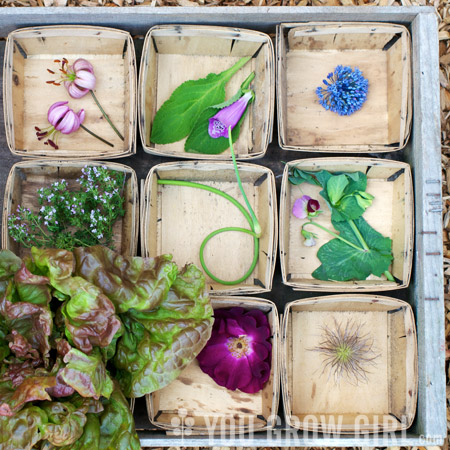
This week’s herbaria is a little late as we had a few rain showers that prevented me from putting it together earlier. I try to avoid creating colour themes when I choose these, but it was inevitable as many of these plants were chosen because their current state is fleeting and probably won’t be around next week.

Read more…

Leave a comment

It’s About Thyme

I’m way behind on posting past articles from my Globe & Mail column. This profile of thyme was published on July 19, 2010. I thought I’d go with it first since the article set to be published this coming Saturday is a profile of another favourite garden herb: sage.

—————–

Most of the country, including Toronto, has just now survived a heat wave. It was hot, especially out on the roof garden, my little piece of heaven turned to hell by the scorching sun. It was only inhabitable after dark – we spent the week offering emergency critical plant care by flashlight.

In that heat, some containers required watering three times per day! The lettuces, violas (miraculously still alive), and even typically resilient basil and tomatoes growing in larger pots put up a fuss of dramatic fainting, fretting, and impromptu wilting when the heat was at its worst. My once lush and healthy lemon tree mysteriously dropped all of its leaves on one side. But trusty, tough-as-nails thyme never once complained. I simply shifted a few pots into slightly less intense sun and it was business as usual.

For a tiny plant, thyme has got it all – looks, an easy going nature, a deliciously warm aroma, a pungent, complicated flavour, and it makes an impact in a cramped space. It is one of only a few edibles that can survive a full growing season in the 4” transplant pot it came home in. In fact, thyme will grow just about anywhere and in anything. In the wild, thyme grows among rocks in very free-draining and poor, often sandy soil.

It’s a very hardy plant that can survive a cold zone 4 winter, as long as the soil is not dense or soggy. I inexplicably lost several plants in my community garden’s premium soil, until I finally hit on the key – thyme simply will not tolerant life in wet soil through a wet winter. This plant doesn’t do nutrient rich, gorgeous soil well. To keep it alive, add lots of rock, sand or grit to increase your soil drainage in-ground. I recently visited a garden filled with happy thyme, all grown directly on top of driveway gravel!

Soil drainage is generally easier to achieve in pots. Most thyme varieties will adapt to pots too small or difficult for anything but cacti and succulents as long as there are lots of holes for water to flow straight out. Potted plants won’t survive outside year-round throughout most parts of Canada but a little pot in a sunny window can provide some fresh greenery here and there until it is warm enough to go back out in the early spring. Otherwise it is new transplants each year. Don’t bother growing from seed unless you intend to grow a lot of any one variety.

Speaking of variety, thyme is an incredibly versatile herb and far beyond the woody and pungent common type (Thymus vulgaris) available at most grocery stores. I’ve got about 12 varieties in a surprising breadth of flavours, smells, colours, and growth forms growing on my roof right now, yet my collection if far from complete.

Next to the common English thyme, deliciously fragrant lemon and lime citrus types (Thymus x citrodorus) are probably most popular and widely available in garden shops and corner markets. There are several varieties that qualify in this category – they come in shades of green, gold, variegated gold ‘Aureus’, and variegated silver ‘Silver Lemon Queen’. ‘Doone Valley’ is very low growing, with round, green leaves spattered with pale gold and cream. ‘Orange Balsam’ and ‘Orange Spice’ have a sweet and spicy orange peel smell and pointy leaves that strike me as a bit conifer-like.

Next up are the creepers: Mother-of-thyme (Thymus serphyllum), Thymus ‘Coccineus’, and woolly thyme (Thymus psuedolanuginosus). They aren’t particularly edible, but they make an aromatic, drought tolerant lawn alternative that you can actually walk on. There are also very diminutive types that form a soft, plush carpet over and between cracks in cement and stone walls. If you’re going to go this route, be sure to grow several varieties together so that you have different textures, smells, and flower colours in bloom together and at varying intervals.

The most compelling are the mimics; thyme plants that smell convincingly like other herbs. I’m currently growing ‘Lavender’, ‘Nutmeg’, ‘Oregano’, ‘Caraway’ (Thymus herba-barona), and ‘Rose Petal’. While I am still finding culinary uses for some of the more unusual flavours, I’ve found that all types seem to pair well with onions. Roast a couple of summer onions in the oven along with thyme leaves and stems, and a splash of olive oil. Don’t forget to dry a few sprigs at the season’s end so you can enjoy this warming dish through the winter.

Leave a comment

Roof Garden Tour (Back Wall, June 2010)

Photo by Gayla Trail  All Rights Reserved

Click the image to see full-size.

As I begin to get the gardens sorted, I figured it was time to start showing what I’ve been up to all of these months. I’ve been growing on the roof since March; however, in a small space I don’t have a hidden area to put the in progress stuff or the plants that are still sitting in their plastic pots. Things have been simply too chaotic to get out a camera and document.

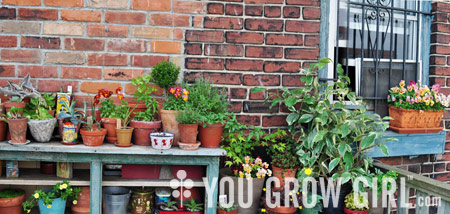
The back wall is looking nice right now so I thought I would begin with that. As I mentioned yesterday, this is the shadiest part of the roof. It’s where I put the plants that require partial shade or are in the process of being hardened off. I like the old brick, it provides a nice backdrop for the greenery. Of course, this brick also absorbs heat during the day and releases it at night. This can be a positive in the early spring when the night temperatures sometimes drop very low. In the summer it means that while the spot is shadier, it can get too warm for plants that are sensitive heat. I learned my lesson about this the hard way about a decade ago when I bought a coleus specifically because it matched the brick. The poor plant couldn’t take the heat and kept wilting.

The other negative are the starlings that nest directly above that shelving unit. While I like their cheerful songs (and this year they have learned to mimic cat meowing), they often drop items from the nest onto the plants, including their poo. It’s not the best place to keep culinary herbs.

Be sure to open the image full size to get a better view of what’s there. Starting from the top left are a number of succulents, agave, and auricula. I’ve acquired three more since that last post. Next to the agave in the tin can is a small pot of curly chives (Allium spirale) I bought at Richters Herbs back in February. It took a while but I’ve finally determined that this plant can’t take full sun like regular chives (Allium schoenoprasum). It’s been much happier since I moved it to the wall.

Photo by Gayla Trail  All Rights Reserved

Next to that (behind) is ‘Mulberry’ viola and the plant in front is Eucomis aka pineapple lily. Moving on, we have a variegated scented geranium ‘Charity’ (Pelargonium) against the wall, ‘Variegated Peppermint’ in front of that, and a diminutive little rusty/chocolate coloured geranium whose name I can’t recall in the foreground growing in an enamel bowl. I punched holes into the bottom with a nail.

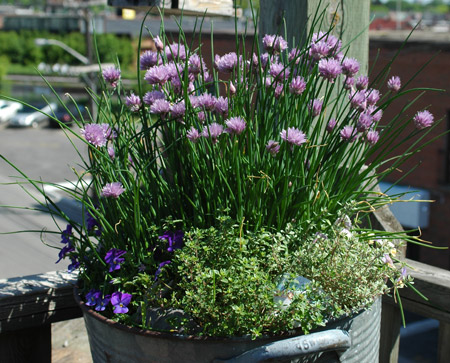
Next to the scented geranium (along the wall) is a myrtle (Myrtus communis) topiary. The trick to keeping it happy is to keep the soil moist. In front of that is another ‘Mulberry’ viola with a little ‘Citrus’ thyme (Thymus x citriodorus) in the foreground. Returning to the back wall, I’ve got a tender little lavender that I have learned through trial and error does not like it out in the hot sun. It’s been much happier against the wall but it’s needs are confusing and seem to go against the grain of so many lavenders I have grown. I bought it on impulse at a corner store about a month ago on a dreary, wet day when I must have needed some cheer. And in front of that plant is ‘Rau Ram’ aka Vietnamese coriander.

As you can see, I’ve got a few plants sitting on lower shelves. Those plants are in transition and need even more protection right now. On the left is ‘Corsican’ mint. I am watching it like a hawk right now because I failed to keep one alive last year over at my community garden. I think my failing there was in soil drainage so I’m keeping this one in a pot. Next to it is Calibrachoa ‘Double Lemon’, a flowering plant so close to petunia that I never thought I would grow one, let alone buy it with my own money. It turns out I could not resist the soft yellow of this double form flower. Who knew? I will post a close up photo of this later in the season. Over to the right are two new baby agaves that I got from Barry. I’m sure they can go out in a sunnier spot now, I just haven’t had a chance to repot. He actually grew these plants from seed!

Phew. Okay, that finishes the shelving unit. Phew. Now do you see why I am so overwhelmed? This list represents one small corner of one garden. So many plants! I both love it and freak myself out about it.

Moving on. My new Japanese Maple is in the beige pot just to the right of the shelving until. It is under-planted with little ‘Gem Antique Shades’ violas, one of my favourite varieties. There is a tiny Oxalis squamata located just in front of it and two oxalis plants to the right, ‘Burgundy Gold’ and ‘Zinfandel’. The plant with yellow flowers in the green pot is a spotted hawkweed (Hieracium). Next to that is a variegated ‘Pink Lemonade’ lemon tree. It is very happy outdoors and producing new little lemons. In front of that in a red pot is ANOTHER oxalis siliquosa ‘Sunset Velvet’, and at the end white sage (Salvia alpiana) that is flanked with little yellow-flowered oxalis that came up as volunteers. White sage is not hardy here — I been overwintering this one indoors for a few years now.

Finally, sitting on the window ledge is a terracotta box filled with pansies and violas. I believe they are also ‘Gem Antique Shades,’ but I specifically chose to plant only the lighter colours of the bunch. That’s why you can see much darker reds in the flowers growing underneath the Japanese Maple.

See also: Roof Tour 2009

Leave a comment

Broadleaf Thyme: The Confusion Continues

Photo by Gayla Trail All Rights Reserved

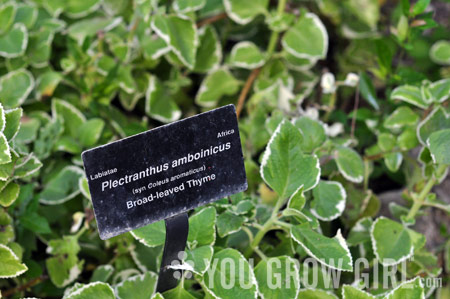
Way back when, I wrote about Broadleaf Thyme and Cuban Oregano (Coleus amboinicus) and (Plectranthus amboinicus) and wondered about the proper identification for the different plants. At the time I concluded that Broadleaf thyme was the one with smaller leaves, and Cuban Oregano is the one with bigger leaves. And within that there is also the variegated variety. Well, this botanical garden here in the Caribbean is identifying the big leaved type as Broad-leaved Thyme, blowing my identification.

Yesterday, I also saw the small-leaved type in person for the first time but it did not have any identifying marks. It smelled heavenly, by-the-way. Deliciously sweet and pungent. I think I prefer it.

Photo by Gayla Trail All Rights Reserved
I also saw this interesting variety, that I would really like to have.

Leave a comment