Roof Garden Tour (Back Wall, June 2010)

Photo by Gayla Trail  All Rights Reserved

Click the image to see full-size.

As I begin to get the gardens sorted, I figured it was time to start showing what I’ve been up to all of these months. I’ve been growing on the roof since March; however, in a small space I don’t have a hidden area to put the in progress stuff or the plants that are still sitting in their plastic pots. Things have been simply too chaotic to get out a camera and document.

The back wall is looking nice right now so I thought I would begin with that. As I mentioned yesterday, this is the shadiest part of the roof. It’s where I put the plants that require partial shade or are in the process of being hardened off. I like the old brick, it provides a nice backdrop for the greenery. Of course, this brick also absorbs heat during the day and releases it at night. This can be a positive in the early spring when the night temperatures sometimes drop very low. In the summer it means that while the spot is shadier, it can get too warm for plants that are sensitive heat. I learned my lesson about this the hard way about a decade ago when I bought a coleus specifically because it matched the brick. The poor plant couldn’t take the heat and kept wilting.

The other negative are the starlings that nest directly above that shelving unit. While I like their cheerful songs (and this year they have learned to mimic cat meowing), they often drop items from the nest onto the plants, including their poo. It’s not the best place to keep culinary herbs.

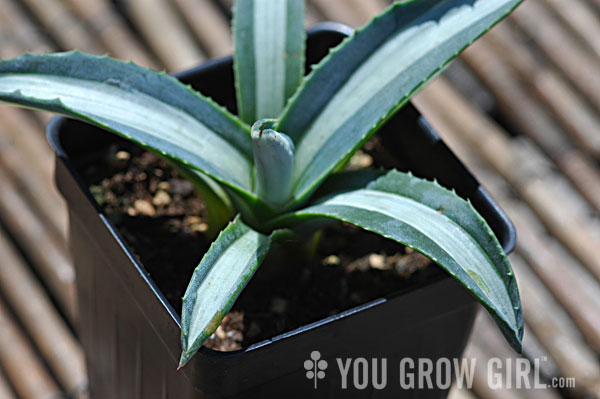
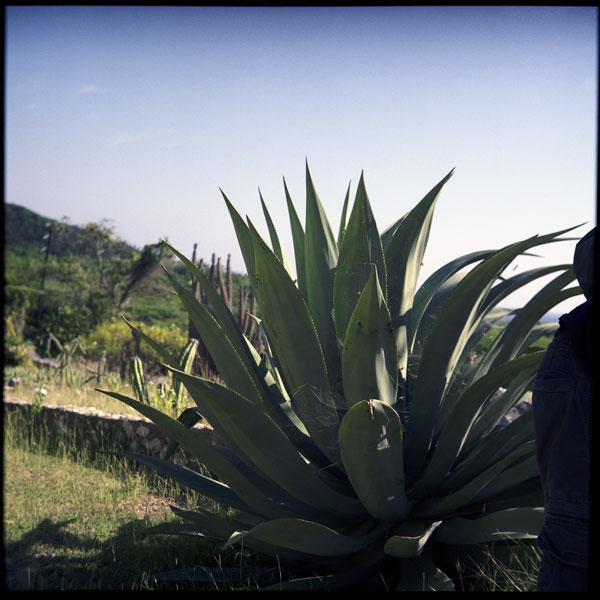
Be sure to open the image full size to get a better view of what’s there. Starting from the top left are a number of succulents, agave, and auricula. I’ve acquired three more since that last post. Next to the agave in the tin can is a small pot of curly chives (Allium spirale) I bought at Richters Herbs back in February. It took a while but I’ve finally determined that this plant can’t take full sun like regular chives (Allium schoenoprasum). It’s been much happier since I moved it to the wall.

Photo by Gayla Trail  All Rights Reserved

Next to that (behind) is ‘Mulberry’ viola and the plant in front is Eucomis aka pineapple lily. Moving on, we have a variegated scented geranium ‘Charity’ (Pelargonium) against the wall, ‘Variegated Peppermint’ in front of that, and a diminutive little rusty/chocolate coloured geranium whose name I can’t recall in the foreground growing in an enamel bowl. I punched holes into the bottom with a nail.

Next to the scented geranium (along the wall) is a myrtle (Myrtus communis) topiary. The trick to keeping it happy is to keep the soil moist. In front of that is another ‘Mulberry’ viola with a little ‘Citrus’ thyme (Thymus x citriodorus) in the foreground. Returning to the back wall, I’ve got a tender little lavender that I have learned through trial and error does not like it out in the hot sun. It’s been much happier against the wall but it’s needs are confusing and seem to go against the grain of so many lavenders I have grown. I bought it on impulse at a corner store about a month ago on a dreary, wet day when I must have needed some cheer. And in front of that plant is ‘Rau Ram’ aka Vietnamese coriander.

As you can see, I’ve got a few plants sitting on lower shelves. Those plants are in transition and need even more protection right now. On the left is ‘Corsican’ mint. I am watching it like a hawk right now because I failed to keep one alive last year over at my community garden. I think my failing there was in soil drainage so I’m keeping this one in a pot. Next to it is Calibrachoa ‘Double Lemon’, a flowering plant so close to petunia that I never thought I would grow one, let alone buy it with my own money. It turns out I could not resist the soft yellow of this double form flower. Who knew? I will post a close up photo of this later in the season. Over to the right are two new baby agaves that I got from Barry. I’m sure they can go out in a sunnier spot now, I just haven’t had a chance to repot. He actually grew these plants from seed!

Phew. Okay, that finishes the shelving unit. Phew. Now do you see why I am so overwhelmed? This list represents one small corner of one garden. So many plants! I both love it and freak myself out about it.

Moving on. My new Japanese Maple is in the beige pot just to the right of the shelving until. It is under-planted with little ‘Gem Antique Shades’ violas, one of my favourite varieties. There is a tiny Oxalis squamata located just in front of it and two oxalis plants to the right, ‘Burgundy Gold’ and ‘Zinfandel’. The plant with yellow flowers in the green pot is a spotted hawkweed (Hieracium). Next to that is a variegated ‘Pink Lemonade’ lemon tree. It is very happy outdoors and producing new little lemons. In front of that in a red pot is ANOTHER oxalis siliquosa ‘Sunset Velvet’, and at the end white sage (Salvia alpiana) that is flanked with little yellow-flowered oxalis that came up as volunteers. White sage is not hardy here — I been overwintering this one indoors for a few years now.

Finally, sitting on the window ledge is a terracotta box filled with pansies and violas. I believe they are also ‘Gem Antique Shades,’ but I specifically chose to plant only the lighter colours of the bunch. That’s why you can see much darker reds in the flowers growing underneath the Japanese Maple.

See also: Roof Tour 2009

Leave a comment

Grow an Orostachys Pot

Photo by Gayla Trail  All Rights Reserved

This year, for a myriad of reasons, I have rapidly expanded my succulent collection, most especially sempervivums, which I just can’t seem to stop myself from buying. I bought and/or acquired by other means 25 new semps this year alone in addition to a few other related succulents, many of which are hardy and some that aren’t.

Despite the sudden influx of plants I have been growing semps (aka hens and chicks) for years. They are most likely one of the very first non-edibles I grew. Just about everyone starts with them and for good reason: the plants are virtually unkillable and require almost no care. Every beginner gardener should begin here.

What’s different this year is that I have begun to collect orostachys and rosalaria, two closely related, hardy succulents that I have never grown before. Both plants look a lot like sempervivums and are grown under very similar conditions. Most literature says they can tolerate very cold conditions but I am not convinced that some of these stranger varieties are as hardy as semps. The plants come in paler colours and have a slightly softer look about them. As a result, I didn’t want to throw them in among the semps but instead had decided to give them their own space to be showcased. I had a sudden brain wave one afternoon last week when I realized that I had just the perfect pot, a vintage, emerald green dish that I have never had much luck with. Having begun life as a dish meant to hold candy or trinkets it is shallow and only suited to diminutive plants with shallow roots that can also take a bit of drought.

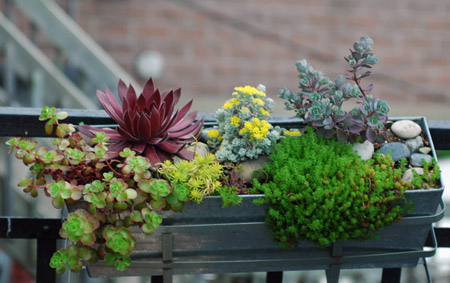
Top Photo from Left to Right: Orostachys minuta, Rosularia rechingeri (turkestanica), Orostachys ‘Jade Mountain’, Orostachys ‘NYBG’.


Photo by Gayla Trail  All Rights Reserved

To prepare the pot for growing, I drilled a couple of 1/2″ holes in the bottom with a masonry bit meant for drilling into terracotta or brick. I used very sandy, gritty soil — a potting mix meant for growing cactus is perfect. I top-dressed after planting with tufa chips, a very light-weight rock that is often used in growing alpine plants. I got a big ziploc baggie for $5 from Wrightman’s Alpines.

Photo by Gayla Trail  All Rights Reserved

This is a sempervivum I potted up at the same time in a bonsai pot that has always been too shallow to grow anything else. I love this variety’s tight rosettes and mounding form. I can’t tell from the tag if it is called ‘Granide’ or ‘Grande.’ ‘Grande’ seems all wrong given that the plant is teeny, tiny.

Leave a comment

Planting a Sempervivum Trough

Photo by Gayla Trail  All Rights Reserved

Sempervivums or Hens and Chicks as they are commonly called, are an incredibly hardy, and drought tolerant succulent that can take a fair amount of abuse, yet when I was starting out on my roof, they were the last plant I wanted to grow. I’d come to associate them with the few that had been slapped into the tiny front garden of my childhood home. And while I had fond memories of playing with my dolls on the pretend Martian landscape they created, my overall impression as an adult was that they lacked a certain luster.

Photo by Gayla Trail  All Rights Reserved

I don’t recall how it happened, perhaps nostalgia won out, but I eventually came around to growing a few. That summer they bloomed, creating exotic, alien-like flower stalks. I was hooked and decided I would never be without them again.

Read more…

Leave a comment

Skirt Aloe (Aloe alooides)

Photo by Gayla Trail  All Rights Reserved

Read more…

Leave a comment

Garden Tour: Erika’s Small Apartment of Small Plants

Photo by Gayla Trail  All Rights Reserved

Yesterday afternoon I was invited into the apartment of a fellow Parkdale resident to check out her collection of fascinating and unusual plants. The visit brought the plant junky in me out in full force. I went home conspiring to get my hands on a few of those amazing plants myself and then spent the remainder of the afternoon rearranging and caring for the gazillions of houseplants I do have. Visits to other peoples’ gardens never fail to motivate me to do better by my own plants.

Photo by Gayla Trail  All Rights Reserved

Mesembs in the front window.

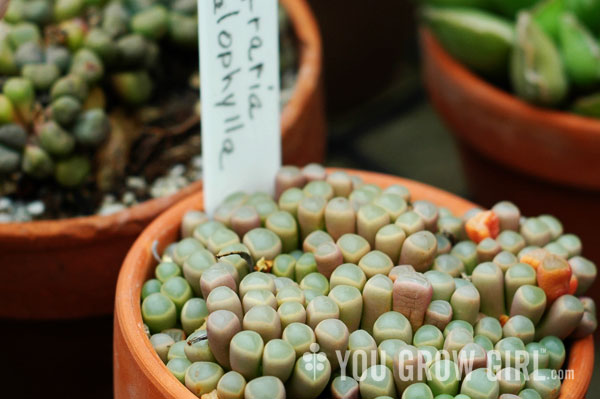
Erika collects alpines, Mesembs (conophytum & lithops aka living stones are examples), Gesneriads (not African violets), orchids, and euphorbias. Looking back on our conversation, I’m not completely certain that she is exclusive to those plant families. Most of her collection just seems to fall within those categories. When I asked her what inspired her collection, she replied that she has always loved diminutive plants. The perfect-sized plants for an apartment dweller.

Photo by Gayla Trail  All Rights Reserved

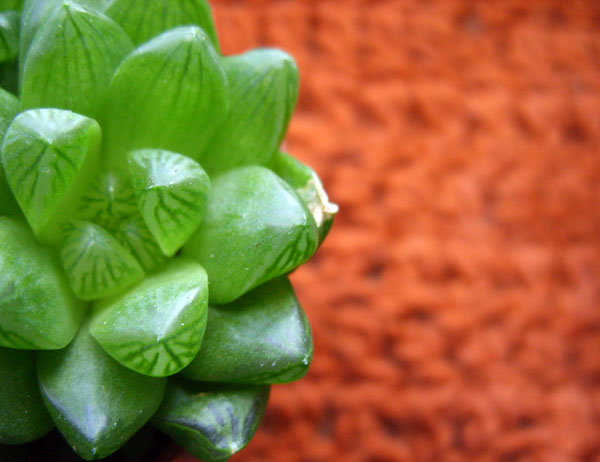
Conophytums are a South African plant that consist of two fused leaves. That’s pretty much it. They’re some of the most simplified and reduced plants I have ever seen.

Photo by Gayla Trail  All Rights Reserved

They kind of look like doughy buns. Or really cute anatomical models of the cervix. Apologies for putting that image into your head, but frankly, that’s what I see when I look at one.

Photo by Gayla Trail  All Rights Reserved

Conophytum bergerii (red) and Conophytum ratum (green).

Say what? These freakish things remind me of jelly candies or those stinky jelly air fresheners everyone had in their bathrooms in the late 70s. When I was a kid, I could never help opening up the plastic cover and poking them. I REALLY wanted to poke these too but that would have been very rude. The flower (yes they do flower) comes up between the two “leaves.” I can barely distinguish where that is on the red one.

Read more…

Leave a comment