I wrote this piece back in February for The Guardian UK, and am now posting it here in its entirety as promised. You can read my preface to it here.
——————
My gardener’s story is atypical. There were no childhood summers frolicking in the garden of a rosy-cheeked matriarch eager to pass on a passion for growing things; however, there was, in fact, a grandmother — a woman who for better or worse certainly left an impression. A woman who taught me about gardening without meaning to, possibly even in spite of herself.
I had a precarious relationship with my maternal grandmother, Scylla Trail. There were some small moments of affection but for the most part I would describe our relationship as confusing. There are complicated issues here, problems too intricate to properly address in a short gardening article. It would take a dissertation to unravel the complex recipe of class, race, sociopolitical, and personal psychology that forged the logic of our relationship. I bring it up only as a way to make it clear that while my grandmother was a gardener of sorts and helped shape who I am as a gardener today, what existed between us was not an intentional passing of the gardening torch from one generation to the next.
And yet, while the lessons Scylla taught me may have been articulated in a passive way, they are still meaningful.

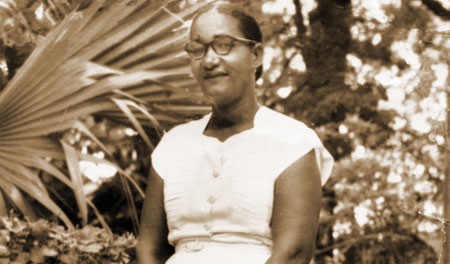
This is the only photo I have of my grandmother and I together. I don’t know where it was taken or why there is a black nanny doll in the background. Ugh. I think I am somewhere between 3 and 4 years old here. That would make Scylla approximately 65.
I don’t know what growing plants meant to my grandmother — she never spoke of it. I was born around the time Scylla moved to Canada, riding the wave of newly changed immigration laws that supported an influx of black West Indians intended to work as laborers and domestic servants. The woman I knew lived alone in a single occupant apartment in a senior’s hi-rise. Scylla frequently babysat my brother and I while we were growing up and we clocked a lot of overnighters there.
Her small apartment was well appointed for an elderly woman with an aggressive sense of religion, but not exactly hospitable to kids. There were religious plaques and photos of a white Jesus on every wall, a coffee table piled with houseplants, a compact stereo system that housed an assortment of religious albums, and piles of pamphlets illustrated with the toothy grins of popular televangelists (tucked underneath the couch cushions). There were no toys or games and we were only allowed to watch back-to-back broadcasts of The 700 Club, although we did find ways to turn the rocking chairs into racehorses and the small balcony served as a good place to launch bits and bobs from. I got some of my start as a gardener by turning my attentions to her houseplants in an effort to break up the boredom between hours of religious programming, bible reading, and praying for sinners (us). I killed time pruning back dead leaves and plucking them from pots, dusting foliage, and watering. One of my favorite memories of Scylla’s apartment was the way she liked to arrange her houseplants into an Xmas tree shape during the Holidays — a pyramid of assorted houseplants that were decorated in lieu of an actual tree. As a kid I thought it was completely mad (it was) but as an adult I can appreciate Scylla’s ingenuity, brilliance, and utter disregard for Canadian social norms.
The first thing my grandmother taught me (unintentionally) about gardening was how to make something out of nothing.
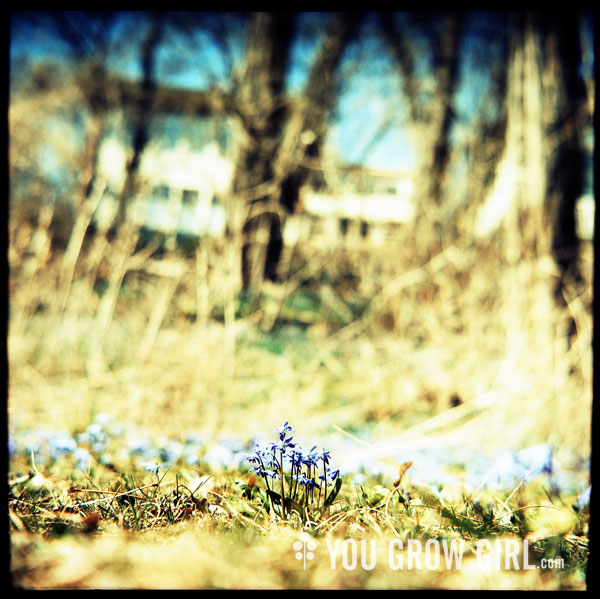
One day, while playing on the small balcony, I noticed a plant with tiny blue flowers growing in a recycled, econo-sized laundry soap bucket. When I went in to ask my grandmother what it was, she answered (like it was the most mundane thing in the world) that she was growing potatoes. The idea that someone could grow their own potatoes, let alone in a bucket on the concrete balcony of a senior’s apartment building, completely blew my mind! I was already a gardener when the memory of Scylla’s potatoes came back to me, yet I am sure that they subconsciously served as the example I needed as an urban apartment dweller with the desire to make a garden and nowhere to grow.
The second thing my grandmother taught me (unintentionally) about gardening is that a garden can happen anywhere.
In the West Indies, my grandmother grew food and raised chickens and goats. I know this for certain, having gleaned little pieces of family history from anecdotes overheard while growing up, although I do not know the details. What did she grow? I know there was fruit, but I do not know who grew or cared for the trees. Perhaps no one did. I recall stories that mentioned paw paws (papaya), sour sop, and mangoes in the yard. Eggs were collected, the goat was milked, and the chickens lost their heads from time to time.
Despite these bits and pieces, I can’t really guess at Scylla’s relationship to gardening and it seems unfair to try to speculate or put words in her mouth. She’s long dead now. She can’t tell me herself and there is no one left to ask. Did she grow plants for pleasure, for purpose (food), or simply because it was second nature? After all, my grandmother came from a place where growing food (especially among poor people like herself) is just what people did. There was no fuss. It wasn’t a big deal or a greatly considered act, you just did it as a way to make use of what you had available and improve your quality of life.
The third thing my grandmother taught me (unintentionally) about gardening is that gardening is for all of us.
Here in the first world we think too much about whether or not we can or should garden. We mull and fret over what we don’t have, always certain that there is never enough space, knowledge, or gear. We talk ourselves out of gardening and wonder endlessly whether we have what it takes to be a gardener, even after we’ve started one.
Everyone can garden. You don’t even have to call yourself a gardener. You can grow a potato in a bucket on a concrete balcony. You can raise chickens in your backyard, grow and harvest your own fruit, and fashion your houseplants into a Holiday tree. You might never speak a word about gardening or being a gardener to anyone, and still be one anyway.
At least that’s what Scylla accidentally taught me.