Elderberries

Photo by Gayla Trail  All Rights Reserved

My friend Barry has an elderberry tree in his yard. Last summer he offered up the harvest in exchange for a sampling of the end product. I collected a lot of berries and was a bit unsure about what to do with them. Raw elderberries have a somewhat unpleasant scent and are not edible so it was difficult to commit to a usage without a clear understanding of what I was getting into.

Photo by Gayla Trail  All Rights Reserved

[Please note that while there are elderberries leaves shown in this photo, you should not eat them. They are poisonous!]

In the end, I made cordial. It was pretty good. The berries have an earthy taste. That’s all I can come up with as a descriptor. Earthy. Perhaps a bit pungent. It does taste like berries, I just can’t place a finger on which berries exactly. We dripped it on pancakes, poured a little onto granola and yogurt, and added it to sparkling water on occasion. Elderberries are very high in vitamin C and potassium. Many people use the cordial as a cold and flu elixir, instead of store-bought pharmaceutical cough remedies.

Photo by Gayla Trail  All Rights Reserved

This year I wanted to try using the flowers so I harvested about two thirds of the tree back in June, when the flowers were in season, and left the remainder to develop berries. I had enough to make two batches, so I tried two different methods. Unfortunately, I no longer remember the second (preferred) method nor can I recall what it was that I did or didn’t do that made it better. However, if you’re interested, the first, less preferred method came from the River Cottage Handbook No.2: Preserves, by Pam Corbin.

Photo by Gayla Trail  All Rights Reserved

Photo by Gayla Trail  All Rights Reserved

This year, with only 1/3 the harvest, I made a much smaller batch of cordial, which is fine by me because I think we prefer the elderflower flavor. I have no memory of how I made it last year, but this year I used this recipe from David Lebovitz’s website. Within the notes he makes a remark about straining the cordial a second time through a fine sieve. I’ve found that step to be essential and not overly attentive. Otherwise you end up with a very seedy, crunchy syrup. I didn’t have enough to can so I just sterilized two jars on a low heat in the oven before filling, gave one to Barry, and refrigerated the other.

I also made a quick, single jar batch of mixed berry jam last weekend (pictured). But that’s another story.

———

p.s. The site will be down this weekend while we switch over to a new design and work out all of the inevitable kinks. It’s going to be a bit manic, but I’m so excited! A big change has been a long time coming.

Leave a comment

Tradescantia

Photo by Gayla Trail  All Rights Reserved

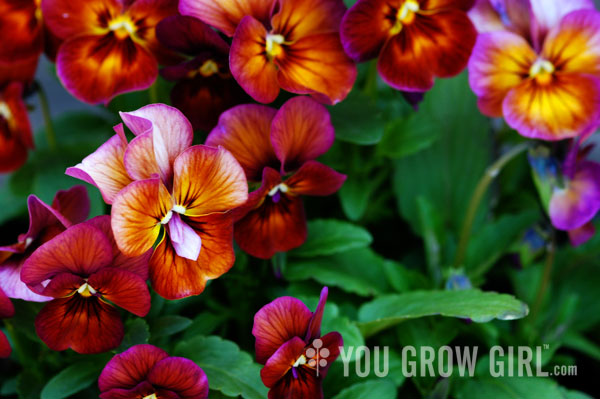
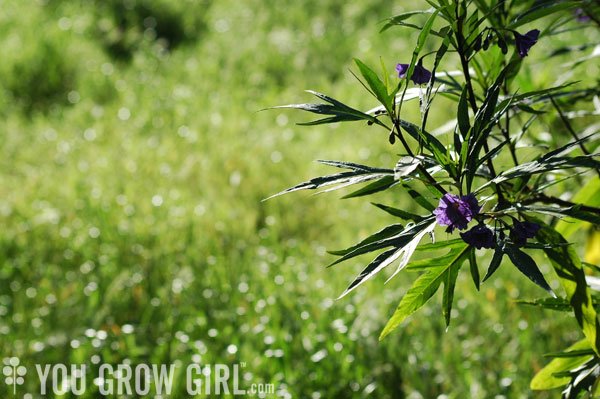
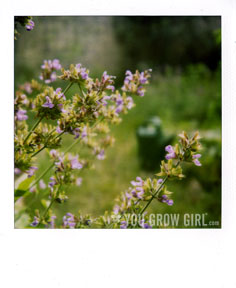
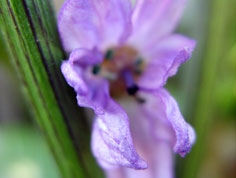
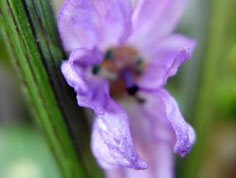
My favourite thing about this flower is the smell. Sometimes floral, and other times reminiscent of grape Popsicle.

Leave a comment

Episcia (Dominica)

Photo by Gayla Trail  All Rights Reserved

One of the things I brought back with me from our month-long Caribbean trip (did that really happen?) was a renewed enthusiasm for some of the tropicals we grow here at home as houseplants and annuals. Seeing them in their natural habitat provided new, helpful insights into their growth habits and needs, and an appreciation for what they are capable of.

I returned home eager to grow cosmos again, with a respect for caladium (although I will never grow them), and a wish to expand beyond African violets and into growing other Gesneriads (African violet family plants).

The first gesneriad that caught my interest was the episcia shown above. I spotted it growing out of a wall at Papillote Gardens in Dominica. I recently acquired a little cutting of a different episcia and boy do I wish I could grow it in the crack of an old wall like this one. But alas, while our summers are sometimes hot and steamy like the tropics, the rest of the year is not. Mine will be living life in a pot.

Leave a comment

Blue Hepatica

Photo by Gayla Trail  All Rights Reserved

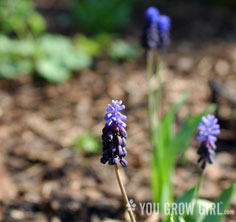
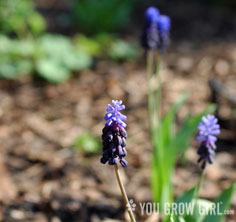
Hepatica nobolis is a tiny early blooming woodland plant that does well as an under-planting and doesn’t seem to mind a bit of dryness now and again. I rarely see it in use — it seems to be overlooked in favor of the larger, more colorful bulbs that flower around the same time. Or perhaps it is because there is a general (and wrong) belief that woodland plants are boring?

I’ve posted here about a similar white-flowered hepatica (Hepatica acutiloba) previously, but have to admit I prefer the more colorful species like the one above.

Leave a comment

Purple ‘Holy’ Basil

Photo by Gayla Trail  All Rights Reserved

Last fall my friend Barry put me onto pots of green and purple ‘Holy’ basil (Ocimum tenuiflorum) for sale at a neighbourhood Indian food store. ‘Holy’ basil, also known as Tulsi, is a beautiful herb that brightens a dull spot in the garden. It’s a tough, woody plant with textured leaves that can take a lot of heat and a little bit of drought, but I don’t recommend it if you’re looking to grow a culinary basil. It has a very potent smell and flavour and is more commonly used as a medicinal remedy than a meal enhancer.

I intended to post about the plant here months back, but as sometimes happens, I neglected to get a good photo before the frost hit and to top it off I left the plant outside to die rather than overwintering it indoors. And even though I wasn’t going to tell this part of the story, now that I’ve exposed my neglect, I feel a guilt-ridden need to explain that the reason I didn’t bring it inside was because we were going away for a month and I didn’t want to overburden my friends with millions of plants to keep alive on top of the thousands I already have.

Passively allowing tender plants to die outdoors at the end of the season is a gardeners’ dirty little secret. Just about everyone does it, but few admit it. Many of us feel guilty about it, although in my case I suspect it has more to do with throwing away money than intentionally killing a plant.

But I digress. What I really intended to say was that as luck might have it, a month or so after the “killing frost”, I came upon the plant in this photo, growing on a farm in St. Lucia. It may not have been my plant, but I got the photo I had hoped for. And like most basil plants grown in a tropical climate, the thing was huge, much larger than any basil I could grow here in Toronto.

Leave a comment