Recently in My Garden

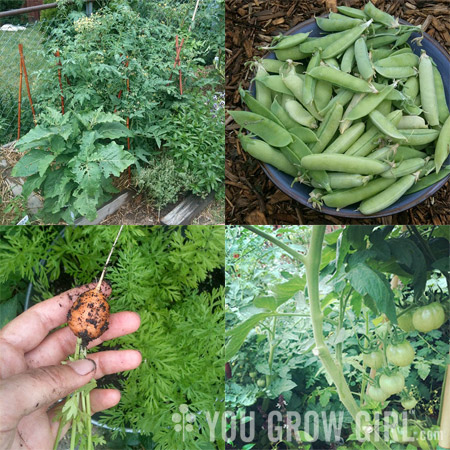
Clockwise from Top Left: 1. This is a view of half of one of the raised beds, situated about midway down the garden on the west side. This bed housed an assortment of crops last year, but this year it holds several determinate (bush) and dwarf tomato varieties that have quickly turned into a jungle of foliage, flowers, and now some fruit are on the way. The stake at the back is empty as that variety was mangled by the squirrels and has never recouped. I haven’t claimed the space for something else because I was so determined that it would bounce back. The poor thing is clinically dead and here I am still rooting it on.

There is a ‘Turkish Orange’ eggplant at the front of the bed (already full of adorable little fruit), and in front of the actual bed is peppermint and thyme. I have since planted a dwarf tomato variety in the open spot next to the thyme. It was floundering in its pot so I decided to give it some space in the ground. I’m completely out of pots now, and potting soil, too for that matter. I don’t suggest transplanting tomatoes once they’re making flowers (as mine was), but it can be done if you are careful not to disturb the roots.

Read more…

Leave a comment

Herbaria (June 22, 2012)

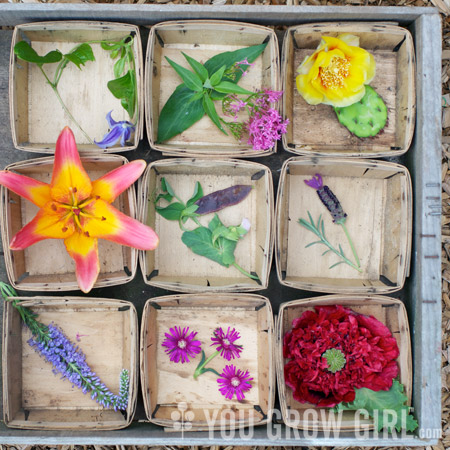
The highlights of this week are my breadbox poppies, which are treating me every day to a new colour and form, and the cold hardy opuntia that have made me so very, very happy to have chanced into the good fortune of exceptionally well-draining soil that is on the sandy side. This garden is an absolute pain in the butt to water, but the growing possibilities are mind-blowing for someone like me who has a longstanding fixation/fascination with dry land flora. It’s going to be unreal next year when all of the new opuntias I have added are abloom. I may pass out from the sheer joy of it.

The plants…

Read more…

Leave a comment

Herbaria (June 8, 2012)

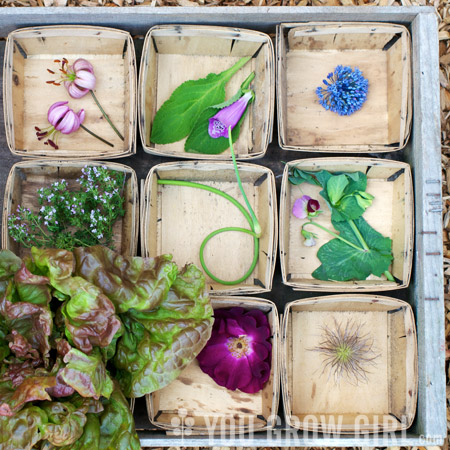
This week’s herbaria is a little late as we had a few rain showers that prevented me from putting it together earlier. I try to avoid creating colour themes when I choose these, but it was inevitable as many of these plants were chosen because their current state is fleeting and probably won’t be around next week.

Read more…

Leave a comment

Vegetable Smile

I know. Cheese-y. I couldn’t help myself, although I think it aptly reflects the gleeful delight I feel each morning when I go out to collect the day’s garden offerings.

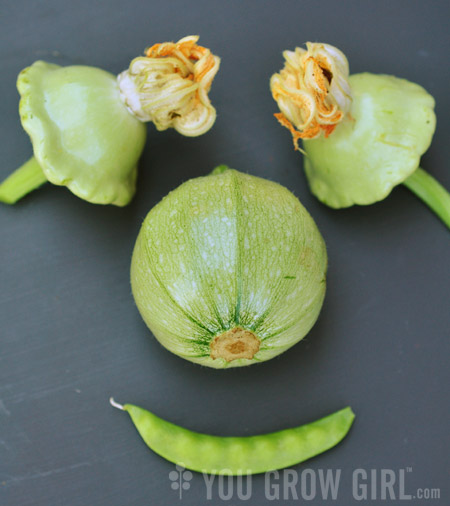
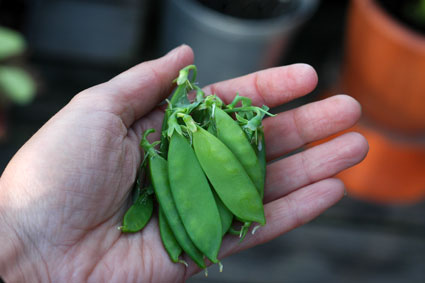
The top two squashes are Benning’s Green Tint Patty Pan from the Hudson Valley Seed Library. This is my first time growing it. The middle zucchini is ‘Nice de Rond’, a French heirloom that I have grown on and off for years. The pea pod is ‘Dwarf Grey Sugar’, a short-ish variety with pretty flowers. I tried that one in one of the raised beds this year, after years growing it in pots. To be honest I didn’t notice a difference. The sign of a truly good container plant.

The Hudson Valley Seed Library website describes ‘Benning’s Green Tint’ as a “compact bush”, but that hasn’t been my experience. Mine is absolutely mammoth — possibly the largest bushing zucchini I have ever grown both in size and productivity! I did not provide well for its aggressive expansion and it is beginning to take over the space that was meant to be shared with two other zucchini plants. It has also spilled well over into the walking path. The plant keeps growing and has taken on what is close to a trailing habit!

Meanwhile, the ‘Nice de Rond’ remains as compact in the ground as it has been in pots. I love this one in small spaces and the round, cue ball fruits are tender and unique.

Leave a comment

Tripod and Pea Staking

Photo by Gayla Trail  All Rights Reserved

Staking is one of those topics that I was sadly unable to cover in the Grow Great Grub book due to space considerations. I covered it pretty thoroughly in You Grow Girl and I have to say that years later, and having experimented with other methods, my go-to cheap and cheerful method both in the ground and in containers is still the tripod. I find it exceptionally stable, especially on my roof where the spring and later fall winds can turn epic. It is also the cheapest and most accessible — most of us can find a source of long bamboo poles close to home for less than a dollar per pole. I have even found the occasional multi-pack at the dollar store for even less.

    The tripod method is simply 3 or 4, or sometimes more, bamboo poles (branches work well too) set into the ground at an equal distance around a plant or within a container and then pulled together at the top and held in place with a strong piece of string or wire.

1cg_aug25.jpg

I have fashioned riffs on the tripod for tall plants and climbers including tomatoes, sweet pea, morning glory, pole beans, peas, and cucumbers. I add string or other supports depending on the type of plant I am growing. In 2007 I grew 16 tomato plants and several cucumbers by building 4 sets of 4 tripod stakes supported by 4 poles around the top as cross beams. The added support proved to be unnecessary and drove us nuts all season long as we continuously (and painfully) ran into those stupid cross poles with our necks and heads. A single indeterminate (vining) tomato plant was supported by each pole and I strung mesh along one side that supported the cucumbers and gherkins. You can read more about that over here.

p.s. That’s the ‘Variegated’ tomato in the foreground/left. You can just make out the white splashes in this small photo.

I have even made smaller versions using shorter poles to prop up heavily laden bush beans.

But I didn’t intend to talk about tripod staking today so I’m not sure why I am preambling with that. Today’s topic is pea staking. Of all of the easy, or what I coined “artfully lazy” methods in You Grow Girl, I like pea staking best, most especially when it comes to propping up it’s namesake: peas.

    Pea staking is as simple as locating a bunch of twiggy branches (messy end growth with plenty of small twigs and branches) and then setting them into the soil with the solid end down. Next, plant your seeds in and around where you have set them into the soil and wait for the climbing plants to hitch on and eventually cover the branches in greenery.

This method works both in the ground and in pots. While bare, it appears orderly and decorative in pots, but can just look like a bunch of branches stuck in the ground if used in a large, empty garden bed.

Photo by Gayla Trail  All Rights Reserved

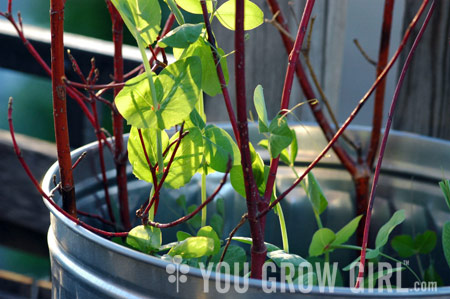
Last year, while walking home from the greenhouse, I came upon a large bundle of bright red, freshly cut dogwood branches. I had about a minute to brainstorm projects I could make with them and whether or not it seemed worth the effort to drag that bundle all the way home. In the end I decided that the dogwood was beautiful and chances were good that I might never come across sidewalk gold like that again. I walked a treacherous gauntlet back to my abode, and despite nearly poking the eyes out of hundreds of hipsters and small children, I was right, they were worth it. I haven’t seen a bundle of any branches, let alone dogwood branches that nice since.

I used all of the branches up; some in big pots as below and smaller branches in smaller pots. They made the pots look like something was happening while they were empty, and the red provided a beautiful contrast with pale green pea plants as they entwined themselves in the branches.

Here’s how it looked when the peas were fully mature. I believe this pea variety is ‘Carouby de Maussane.’

Photo by Gayla Trail  All Rights Reserved

Leave a comment