Release the Kraken

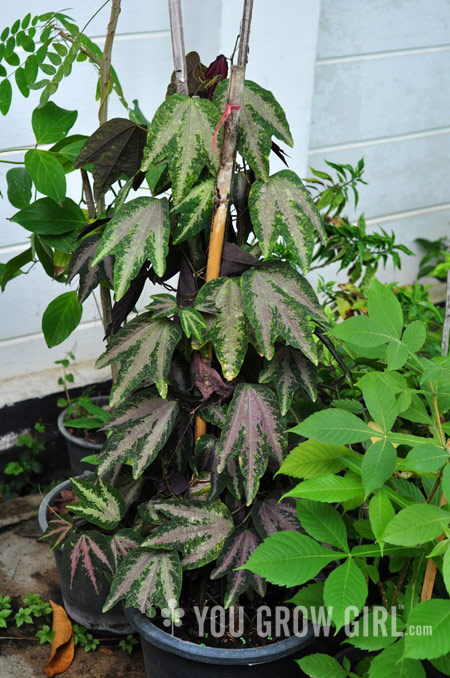
I came upon this gorgeous Passiflora trifasciata on my first day in Thailand and was completely floored by it. I had no idea that such a gem existed. The leaves look like big bird feet!

Passiflora is known primarily for its gorgeous flowers and deliciously exotic fruit. The leaves have a nice shape, but I find them to be a bit boring overall. I had never seen one before this that is clearly all about the foliage. When given a choice, I tend to favour foliage over flowers. Flowers come and go, but interesting foliage holds your interest almost indefinitely, depending on the plant (and your climate). Being short on space, I prefer to keep plants that give me something to look at for longer periods of time. Ugly, ragged stages of plant development don’t hide well when there is no behind-the-scenes area in which to hide them.

Of course, being a plantoholic through and through, I want one. Immediately. I figure if I can tolerate the inconvenience required to overwinter a very large passionfruit vine with pretty flowers but boring leaves in the hallway outside the door of a cramped apartment for three years running, then surely I can keep this one now that I’ve got more space.

And yet another door is opened. Over the weekend I was chatting with a fellow gardener and thrifting friend about how you can find interest in certain collectibles, but you stay away from buying even one because you don’t want to open the floodgates to a new obsession. It’s okay to admire that jug, bowl, or plant from a distance with a certain amount of interested detachment, but inviting one into your home and life is a dangerous first step towards an appearance on the show Hoarders.

Having more space and an evolving mindset has unleashed the Kraken inside of me, so-to-speak. There are so many plants that I am either going back to with a renewed passion, or am allowing myself to try for the first time ever. Friends, these are interesting, albeit dangerous times.

Leave a comment

Giant Granadilla Flower

Photo by Gayla Trail  All Rights Reserved

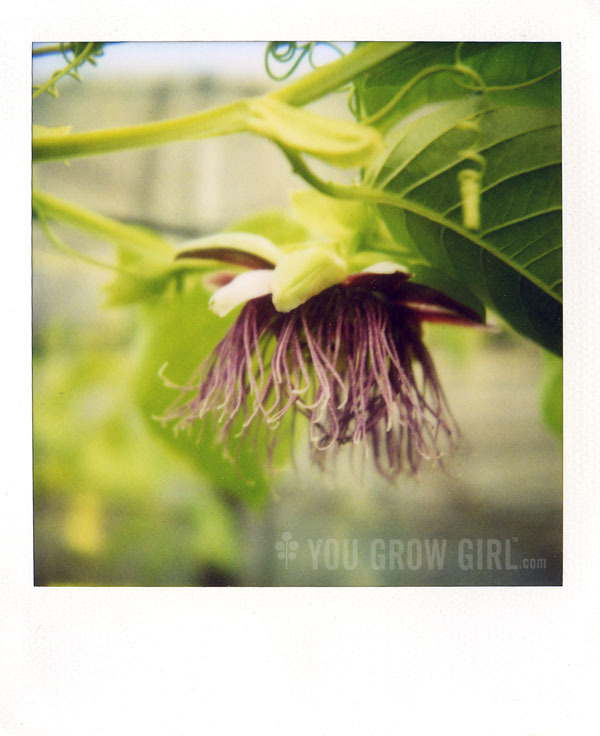
One of these days I will sit down and put together a longer post about the giant granadilla (Passiflora quadrangularis), a passionfruit that is as large as a small melon! We were treated to one on our first night in St. Lucia and I have been thinking about it ever since and pondering when i will get a chance to taste one again.

This is a Polaroid I took of one of the flowers the morning it opened on the vine. We had the good fortunate of staying on an organic farm in St. Lucia (that’s another story) and were able to get up close and experience all sorts of wonderful edibles, but the giant granadilla was probably my favourite, and certainly the most exotic.

Leave a comment

Fruits of Passion

Photo by Gayla Trail  All Rights Reserved

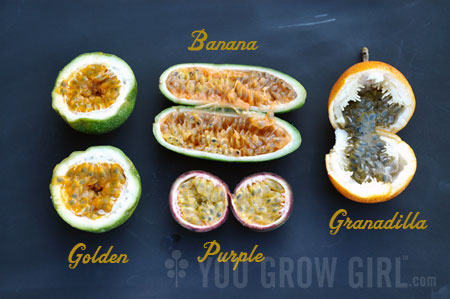
The other day I happened upon a store that was selling four different types of passion fruit (passiflora) simultaneously. While I have tried some of these types separately before, finding four at once posed an excellent opportunity to judge them against each other.

Photo by Gayla Trail  All Rights Reserved

Then I figured why not try to collect the seeds and grow them while I’m at it? I have grown passion fruit vine in the past but have never tried to start them from seed. This will be an interesting experiment. The trick seems to be to start the seeds fresh, straight out of the fruit so I’d better get on it quickly. Dried, older seeds can take ages to germinate, although I figure it’s worth the experiment to try the seeds in either state for the heck of it just to see what happens.

The other negative I expect to come up is that the fruit I bought are probably commercially grown hybrids. As a result I can’t be sure of how the plants will turn out. However, I’m not worried about it since I’m growing for the flowers, not the fruit. If they germinate, great. If not, oh well.

The Results of the Taste Test:

Photo by Gayla Trail  All Rights Reserved
Golden Passion Fruit (Passiflora edulis var. flavicarpa)

Apparently this belongs to the same species as purple passion fruit but the taste is very different. In a word, yuck. However, I am reticent to leave that as my definitive judgment. When imported, these kinds of tropical fruit are often tasteless and horrible compared to those picked fresh off the vine. Based on online photos, I’d hazard a guess that ours was simply not ripe yet. I’d like to try this type again under different circumstances.

Photo by Gayla Trail  All Rights Reserved

Banana Passion Fruit (Passiflora tripartita var. mollissima) or (Passiflora tarminiana) aka Curuba

I did not care for the fruit to be honest, but I’m willing to chalk it up to produce picking error on my part. Chances are it just wasn’t a good sample. Regardless, this is the variety I am most excited about growing. The powdery soft, pink flowers dangle from the vine and remind me of plastic caps that covered the string of lights on the Xmas tree when I was a kid.

Photo by Gayla Trail  All Rights Reserved

Purple Passion Fruit (Passiflora edulis)

I’ve tasted this type of passion fruit both here and purchased from a farmers’ market for mere pennies in Mexico where I am sure it was ripe and straight off the vine. The taste was comparable and very good in both conditions. It’s sweet with a sour kick. The seeds are crunchy and edible so you might as well just eat it all since they are difficult to separate from the gelatinous fruit.

The flowers of this species are your prototypical passiflora, at least in my region. I say this not to suggest that they are dull, simply that this is the vine most commonly seen for sale at corner shops and garden centres here in Toronto. For many years this was the only species I could find locally, until the demand rose and other varieties started to appear.

Photo by Gayla Trail  All Rights Reserved

Granadilla (Passiflora ligularis)

I often see this type sold in Latin American food stores. It is the best tasting of the lot as far as I’m concerned. It has the sweetest and least sour taste and the seeds have a very satisfying crunch. Its droopy, purple and white flowers are very unusual and remind me of a of sea creature.

Growing Passion Fruit

Passion fruit vines aren’t hardy to colder, northern regions of the world, but with a few measures you can keep them alive for years and years. I grew one in a very large container (about 14″ deep) for several years consecutively and even managed to produce a tiny, inedible fruit from another variety during one particularly warm summer. It may have been tasteless and almost empty inside, but I sure was proud of it. Passion fruit vines requires a longer summer to produce real fruit, but it is still worth growing for the flowers.

Oh, the flowers. There are so many incredible flowers in interesting shapes, colours, and intoxicating smells. One could devote their entire growing life to this genus alone since there are hundreds of different species kicking about across the world.

Passion flower vines grow big and lush very quickly. As a result they need rich, fertile soil to flourish. I have found small, straggly plants growing in horribly dry, nearly dead soil in vacant lots in Mexico. These plants were alive, just not very nice to look at and the fruit were impossibly tiny. Passion flowers also need a lot of sun and decent moisture and humidity. If you plan to grow these indoors in a really dry apartment or electric-heated house I would suggest giving them a spray now and again through the winter months when the air is driest.

Overwintering

In the past, I overwintered my passiflora plants by bringing their containers inside just before the first frost. I forced them into dormancy by cutting the vine back hard down to the lower branches and placing the pots in our cool (but not freezing) hallway where there is dim north facing light. Basements and cold mudrooms also make a good location. I watered the soil every once and a while to be sure the plants didn’t go dry, but tried to keep them on the dryer side of moist. The plants went back outside in the spring once all fear of frost was behind us.

I know others who have simply grown passiflora indoors year round in a very sunny window. When it got to be too big and unruly they would cut it back hard and start again.

Leave a comment

Passionfruit

Miniature Passionfruit

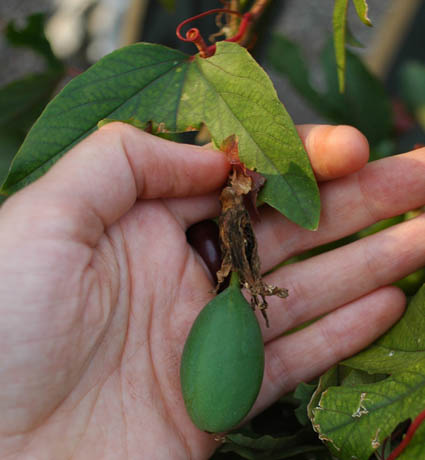
My passionflower vine grew a passionfruit! This may seem like small hat (or other small things) to those of you living in the warm, Southern regions of the world, but it’s a BIG deal to a Northern gardener like me. I have grown passionflower vine many times in the past. In fact I grew one plant for many years, cutting it back and bringing it inside every winter until I grew tired of tripping over it in the hallway and let it succumb to the cold outdoors one fall. That vine grew large and abundant with flowers every summer but it NEVER once even toyed with the idea of making fruit.

I first discovered the tiny passionfruit back in July and watched it eagerly for about a month hoping against hope that it would grow into a brag-worthy fruit. Today, on my daily plant inspection I noticed that the tiny fruit — a fruit that has not grown a millimeter since July — has changed colour from dark green to light green. I cut it open to find that it is mostly hollow inside with six, small but mature seeds. I ate two of the seeds. They are completely tasteless.

But so what. I successfully nurtured a tiny, tasteless, passionfruit. My garden kicks boatloads of ass-kicking ass!

Passionflower

    Passionflower. Grown in a container I garbage picked in one of Toronto’s “finer” neighbourhoods.
Leave a comment