Grow Great Grub

Photo by Gayla Trail  All Rights Reserved

As I mentioned earlier today it’s been a L O N G year. Actually, it’s been a long year and a half. Or two years. Where am I?

I’ve mentioned it briefly here and there but was finally given the go-ahead today to speak freely(ish) about the main project that has been taking up so much time over the last… very long while.

A NEW BOOK!

I’ve been busy making a new book and this time it is all about my biggest gardening love, growing food in small spaces. The book is called “Grow Great Grub: Organic Food from Small Spaces” and is published by Random House/Clarkson Potter.

I’m really excited about this one. Not just because the topic is so specifically near to my heart and where I most find joy in my own small garden spaces, but because I’ve changed and grown in the years since I made “You Grow Girl” and I think this book reflects that.

This new book has lots of pictures, most especially lots of BIG pictures, all taken by me with a few exceptions. It also has a much more gender-neutral design, which I think will take away the small embarrassment some felt in carrying book number one out with them in public. HA! As a funny aside, when the first book came out many people asked if that was me illustrated on the cover. I replied many times that while the woman sort of looks like me back when I had long hair, it wasn’t really meant to be me.

Besides, I would never garden in a crop top. EVER. The end.

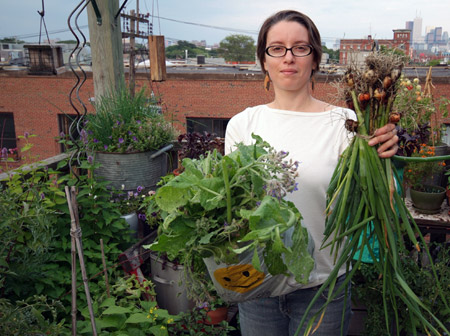
This time it really is me on the cover. And my real plants. And my pickles. Delicious pickles. I can’t wait for you to make those pickles. Why is this suddenly reading like a euphemism? I swear, sometimes pickles are just pickles.

Unfortunately, the wait is long. Grow Great Grub will be officially released in February 2, 2010 (I keep joking that the aliens will have arrived by the time this thing sees the light of day), but it is available for pre-order from several online booksellers (and at sale prices too!) in the meantime. Once I’ve had some time to decompress from the long and harried writing/making portion of this endeavor, we’ll begin work on rolling out the details. My sweet, patient, and also very exhausted partner Davin (also my partner in designing and illustrating the book) has put together a quick micro-site and will be helping me build a bigger site soon.

Serendipitously, the book launch will coincide with You Grow Girl’s 10th anniversary so I’ve also got some fun events and whatnot in the works for next spring. Stay tuned and thanks for riding it out with me!

Leave a comment

A Word to the Water-wise: Irrigate Well

Photo by Gayla Trail  All Rights Reserved

The following article was printed over the weekend as a part of my food gardening series in The Globe & Mail. Summer has been a late arrival around these parts — heavy rains and thunderstorms have been in the forecast regularly since spring. It’s been great in some ways since many of my plants are lush, and the cool season crops are continuing to produce well past their season.

On the other hand, the basil is a lot smaller than usual and even the indeterminate (vining) tomatoes appear to be slightly shorter than I remember them around this time in other years. My biggest worry is the ‘West Indian Sour Gherkin’. It is alarmingly tiny and appears to be laying in wait for some real heat to make it grow.

Despite the fact that today’s forecast is calling for rain, we are beginning to experience a shift towards higher temperatures with a reduction in wind. And as you’ll read, containers dry out quickly regardless of how much rain is in the forecast. A couple of days of intense sun can put the roof garden on high alert for drought conditions.

And as for the pepper plant that I mention in the second paragraph? I found it in a similarly withered state yesterday afternoon (it was very hot on the roof) and have since repotted it into a much larger container.

I do try and take my own advice, sometimes.

———————————–

Nature has been minding the gardens for me this spring. Cool, wet conditions have significantly reduced my usual watering routine, even on the roof where a trifecta of sun, heat, and wind conspire to create a sometimes-punishing state of affairs.

It’s been easy, too easy really — I’d nearly forgotten what it is supposed to be like at this time of year until I plodded outside one afternoon and discovered my most prized variegated hot pepper plant completely collapsed and withered in its pot.

With some fast action on my part and the plant was standing upright again within the hour. Crisis averted. But that’s not to say that it wasn’t affected.

On the whole, food gardens tend to be more vulnerable to drought than their ornamental cousins. If the soil is too dry, too often, plants stress out and become susceptible to insects and disease.

Fruit producers including tomatoes, cucumbers and squash require more water, especially when they start to set fruit. They’ll grow dry, hard, undersized, or not at all without adequate moisture to sustain the watery fruit. Herbs and leafy greens rush to produce seed too quickly, and grow tough and bitter tasting.

Newly planted seedlings and seeds are even more demanding than mature plants. This is one reason why most vegetable planting comes to a halt during the hottest part of the summer. If you do need to plant during a drought, dig a hole and fill it up with water. Wait for the water to sink in and fill the hole again before planting as usual. Saturating the soil beforehand will keep the soil moist longer and support the seedling as it gets established.

Photo by Gayla Trail  All Rights Reserved

‘Red Rubin’ basil planted in a big pot with a thick layer of mulch on top.

Container gardens are notoriously water hungry, sometimes requiring a good drink as much as twice a day during a heat wave. Gardening in plastic pots instead of terracotta and using big pots instead of small will prevent the kind of catastrophe my pepper endured. Add a thick layer of mulch using straw, grass, or shredded paper to the top of pots to create a cooling, protective barrier against the drying effects of the sun and wind.

In-ground gardens don’t dry out as quickly as containers and will reap the same benefits from a mulch blanket. You can further reduce your need to water by adding lots of compost to the garden since loamy, crumbly, soil retains water well.

Photo by Gayla Trail  All Rights Reserved

This determinate (bush) tomato is planted in a big pot with a drip irrigation system and mulch applied to the surface.

How you water can actually impact how often you need to do it. Drip and slow-flow irrigation systems such as soaker hoses distribute water slowly, allowing the soil and plants to soak everything in right at the roots where moisture is needed most. Lee Valley sells affordable watering spikes that slowly release water deep in the soil from an attached water bottle reservoir. These are handy for weekends away! You can make your own by drilling tiny holes into the cap and sides of a used water bottle. Cut off the top (like a funnel) and bury it cap-side down right next to the roots of your water-hungry tomatoes.

Photo by Gayla Trail  All Rights Reserved

This device also serves as a great reminder to direct the stream of water at the soil and not up into the air or on the leaves of your plants. Watering this way creates excess humidity around dense foliage — the perfect breeding ground for fungus and blight. It also means that while the foliage is damp, the soil may be too dry.

When you do water, always give the soil and roots a good, deep drink. Your plant (including the roots) will grow healthier and more productive for it and will inevitably be more disease, pest, and drought resistant as a result.

Leave a comment

Roof Garden Tour (June 2009)

Photo by Gayla Trail  All Rights Reserved

Click the image to see full-size.

I’m long overdue to present a mini roof garden tour this year, let alone a garden tour of any kind. As always I’m behind, which inevitably leads to thoughts that things aren’t just right yet. Or the light is wrong. Then of course there is the classic, “But wait until August when the tomatoes are like trees.”

But then August comes and I rarely post a photo, or take photos of the whole thing for that matter. And then winter comes and I am asked for photos or am putting together speaking presentations and I find there are no photos to show. So instead I spike the water bottles with LSD and ask the audience to use their imaginations.

Kidding.

And then spring comes and I proclaim that, This will be the year of hyper documentation! And then June rolls around and it turns out that I missed the pea plants when they were a vibrant green and covered in delicate pink flowers, and the lettuce boxes when they were in their prime. They will never be just like that ever again and there are no photos to prove it. Gardens are in a perpetual state of change and you can’t make it turn back in time. And you can never make it be exactly what you want, exactly when you want it.

So with that preamble I give you the roof garden as it is right now, not just right and not exactly what I want when I want it.

Photo by Gayla Trail  All Rights Reserved

Containers on the west side of the roof. Pictured are 4 tomatoes, potatoes, lemon basil, assorted lettuce greens, ‘Tom Thumb’ peas (they’re on the way out, hence the yellowing), bok choy, broccoli (we just harvested the first head), and mizuna.

Photo by Gayla Trail  All Rights Reserved

The mizuna that ate Manhattan. I had planned to pull this out and replace it with peanuts but it’s so big and happy, I just haven’t had the heart to do it yet. As you can see, I mulch most of my containers with straw. Works like a charm to keep the soil moist for a longer length of time. I also discovered that the starlings (birds that nest in the wall of our building) are less likely to snip pieces of living plants and instead go for the straw during early season nest building.

Photo by Gayla Trail  All Rights Reserved

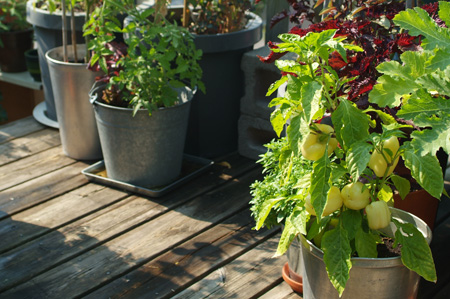
One of my favourite tomatoes of the varieties I am growing for the first time this year, ‘Mountain Princess Dwarf’ ‘Yellow Pygmy’ [edit: I got it wrong! Oops.] It’s so pretty and delicate. I almost hate using those words with “princess” in the name (am I perpetuating a stereotype?). It already has a few tomatoes and a ton of little flowers. I’m thinking this might be the variety that parents can use to get their princess-crazy children interested in gardening.

Photo by Gayla Trail  All Rights Reserved

This photo (facing east) makes me cringe for all sorts of reasons but I wanted to show you a couple of elements. The first is the tent we put up this year, very different from the gazebo we typically hang to protect ourselves and some plants from the intense heat.

The roof is completely uninhabitable without some sort of shade cover, and a small umbrella does not cut it. We could not find a gazebo this year, so opted for a wedge gazebo from Ikea. It cost $30 CDN. Unfortunately, it was a bit large for the width of our wall so we had to improvise. I didn’t like it at first and miss having somewhere to hang baskets, but its free-form nature is growing on me.

The other element is the colourful striped rug. I got that for $4 from the as-is section of Ikea. There were no tags or info with it but it looks to be made from something like plastic rope. I like the feeling of it underneath my bare feet. I’m not sure how I feel about it aesthetically, but am giving it time.

Photo by Gayla Trail  All Rights Reserved

I already showed you part of the wall. This is the other part. Here you can see a tuberous begonia (needs a bigger pot), my alpine trough, violas in a rusted paint bucket, and lettuce.

Photo by Gayla Trail  All Rights Reserved

This is how I grow my indeterminate tomatoes on the roof. I pot them up in large garbage pails (one tomato per pot only!) with holes drilled in the bottom for drainage. I then surround them with lettuce plants early in the season. As the summer heat picks up I pull out the lettuce and replace them with basil. All of these heads are on their last legs and will be eaten soon. Again you can see the straw mulch in effect.

Photo by Gayla Trail  All Rights Reserved

A nice colour combination: ‘Australian Yellow Leaf’ lettuce and purple violas (unknown variety but they have a thin line of silver around the margins.)

Photo by Gayla Trail  All Rights Reserved
This is my other favourite tomato plant right now, ‘Dwarf Medium Ruffled Pink Oblate.’ Look at those thick, ruffly leaves! Tomatoes are on the way.

There’s lots more in the details but I’d rather reveal those slowly over time.

Leave a comment

The Dirt on Soil

Photo by Gayla Trail  All Rights Reserved

My most recent Globe & Mail food gardening article is up on the website. This week’s topic was on how to get good soil whether you’re growing in-ground or in containers.

It looks like the previous week’s article is also still available online. That one was on seeds that you can start late in the season.

And while I’m on the topic of published articles: if you’re in the Southeast and Mid-Atlantic United States I have an article and photograph on green gardening in the current (Summer 2009) issue of Breathe Magazine.

Leave a comment

Spring Ramps

Photo by Gayla Trail  All Rights Reserved

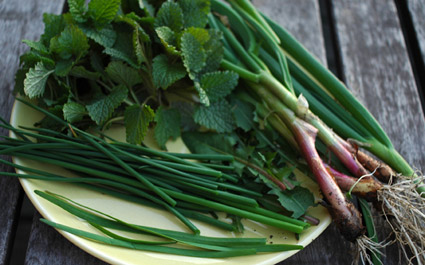
Ramps, aka wild leeks, are a wild North American onion-like plant that pop up in forested areas in early-mid spring. The season for ramps is short, typically no more than a few weeks between April and May depending on your location.

Believe me when I say that they are GOOD. Ramps resemble scallions except that the leaves are large and flat at the top rather than tubular. I’d describe the taste as an earthy onion or leek with the flavor of tender young garlic dominating. The garlic smell is strong with this one — our entire apartment reeks of it when we’re preparing them as does anyone who consumes them raw.

Ramps are best used in place of leeks or onions. Look for recipes in which either ingredient is the star of the show such as potato and ramp soup, ramp pesto, ramp butter, or ramp pizza. I’m considering this Fiddlehead Ramp Risotto since we currently have both on hand.

If you happen upon a seller at a farmers’ market this weekend I suggest snatching a big bundle up as fast as you can — I arrived too late at my local market last week and missed out completely. This week I made sure to get there early and grabbed up 2 lbs so we would have enough to preserve and enjoy in the coming months. There was no way I was going to go without this year. We concocted a homemade spelt gnocchi with fresh pea and ramp pesto dish last spring that quickly became our favourite way to use them up. And then we each gained 10 lbs. I’ve been salivating over day dreams of that dish for an entire year. Of course I did not write it down as I made it, but will write it up here when I’ve got it figured out, again.

Preserving Ramps

There are lots of ways to preserve ramps, from canning to pickling to kimchi, but I prefer freezing. The leaves turn mushy and a little bit gross after freezing but the bulbs are fine. To get around the problem, I freeze the bulbs whole but turn the leaves into pesto.

  1. Slice off the roots and discard. Chop the bulb off and separate from the green leaves.
  2. Wash and dry the bulbs and freeze them whole, packed into freezable containers or baggies.
  3. Loosely chop the remaining green leaves and wash. Dry them thoroughly using a salad spinner or a towel.
  4. Finely chop the leaves in a food processor with a dash of salt and a few splashes of olive oil (about 3-4 cups leaves to a 1/2 cup of oil). The goal is to create a moist, spreadable paste. It shouldn’t be dripping, but it shouldn’t be dry either.
  5. You can add cheese and nuts to make a true pesto paste but I prefer to leave mine plain to keep it flexible for all sorts of uses.
  6. Pack into small baggies or small freezable containers and freeze. You can also portion it out by freezing in ice cube trays and later popping them into long term storage containers once they’ve formed into hardened cubes.

Cook small amounts of the bulbs and leaves together, or use separately as you see fit. The leaves tend to have a milder flavour than the bulbs, but are less flexible because of the added olive oil.

Leave a comment