On Daffodils

Yesterday afternoon I was offered some bulbs for free, but I had to pass. I had a deadline for my next book to-be today, and I have a much bigger one in two weeks. When would I have time to plant bulbs? Never-mind the fact that it is already December and the top crust of the soil is already a little bit frozen.

Adding to these excuses is the fact that I have not had a chance to make plans for the space. Chances are good that I will have to dig up anything we put in. Oh, and have I mentioned that our yard slopes significantly? Once we dig the whole thing up in the spring, we will also have to shift the soil around in an attempt to level it out a bit. Raised beds might be in order to make up for the steepest slopes.

I told Davin about the bulbs and that I was going to have to turn them down. He was disappointed. I had introduced the prospect of spring flowers to enjoy 3 or 4 months from now, and he couldn’t let the dream go.

Thirty minutes later I found myself pressing the “ORDER” button on $88 dollars worth of assorted spring bulbs with the promise that he will do most of the planting. Planting that will probably happen while snow is falling from the sky.

A few of those bulbs were daffodils. Not the daffodils in these pictures, but still daffodils. Pretty little daffodils. I don’t know who I am sometimes anymore. Not in a bad way. But more in a “I could not have predicted this, kind of way. I’ve become a person who likes begonias. And daffodils.

Read more…

Leave a comment

Narcissus ‘Avalon’ ‘Dickcissel’

Photo by Gayla Trail  All Rights Reserved

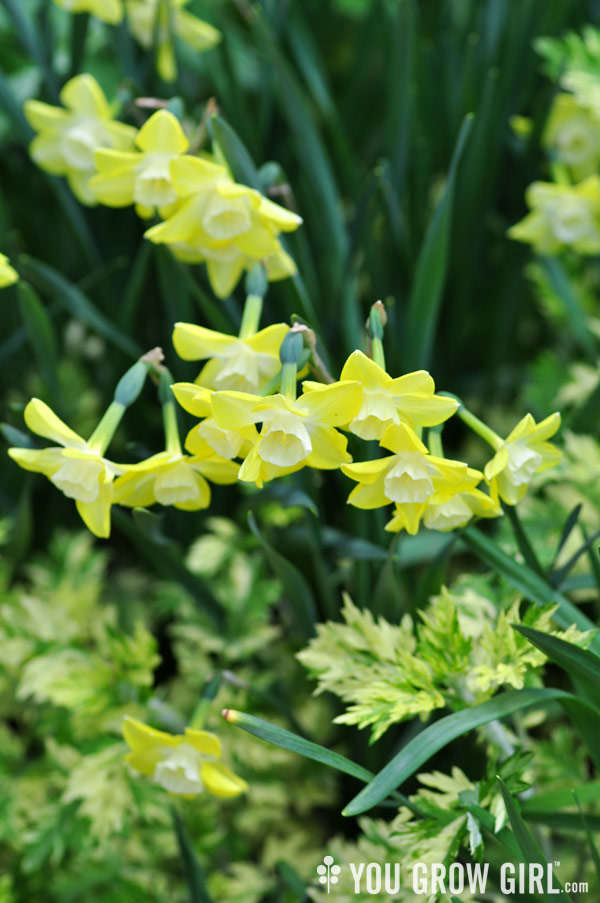
You want a food post today. I can feel it. I had every intention to post a photo of something edible that I am growing this year but then photos of this creamy, soft daffodil came up, and how much longer can I talk about daffodils when they are so very nearly on the way out?

The daffodils are fleeting. I have found myself jumping between favorites as they have rolled out their blooms. This is the one I currently favor.

Photo by Gayla Trail  All Rights Reserved

I love it here, paired with Artemisia vulgaris ‘Oriental Limelight’.

Well done Mr. Parker. Well done.

Update: You’ll notice that I got the variety wrong. I don’t believe ‘Avalon’ is a miniature, and I didn’t realize these qualified as a miniature. Time passes since a picture is taken and you forget about size unless they’re really tiny like these guys.

Leave a comment

Miniature Daffodils

Photo by Gayla Trail  All Rights Reserved

I wandered lonely as a Cloud
That floats on high o’er Vales and Hills,
When all at once I saw a crowd
A host of dancing Daffodils

- William Wordsworth

I’m getting quite an education in narcissus this year. Although, not just in the botanical sense, come to think of it. Har har.

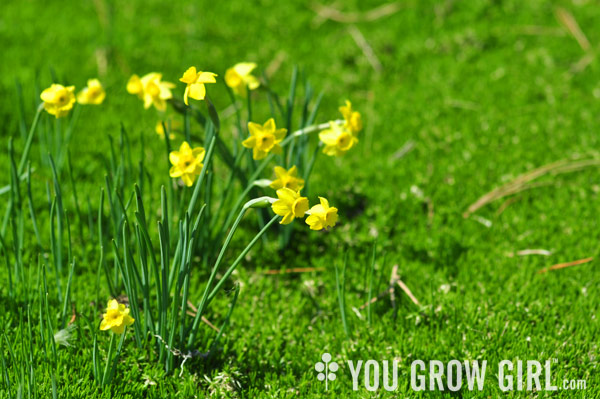
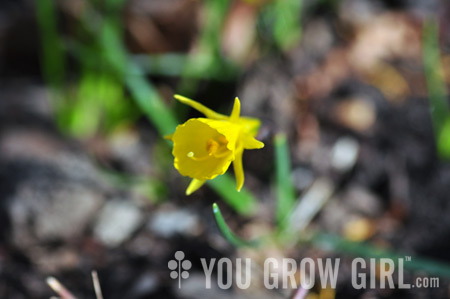
It seems that as I familiarize myself with the various types, sizes, shapes, and colours that are out there, my attentions have been turning more towards the teeny, tiny, diorama-sized daffodils, like this Narcissus juncifolius I came upon the other day growing in the rock garden section of the Montreal Botanical Gardens. These bright little flowers were one of the highlights of my trip and I spent quite a lot of time documenting them with various cameras.

According to “Gardener’s Latin,” the species name juncifolius refers to the leaves, which are thin and cylindrical like the a grassy rush, aka juncus.

Photo by Gayla Trail  All Rights Reserved

I offer you this photo of one of the flowers next to Davin’s thumb so that you can get a better gauge of their scale.

Tiny but eye-catching.

Leave a comment

Pretty Little Daffodils

Photo by Gayla Trail  All Rights Reserved

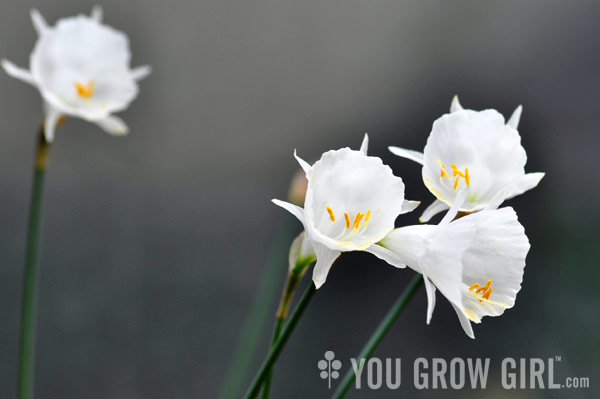
My friend Barry is growing these sweet and simple daffodils (Narcissus cantabricus) in his greenhouse and they’re currently in bloom.

I enjoy daffodils in a general way, much like I enjoy most flowers. However, I tend to be underwhelmed by their arrival as they come late when spring has already been around for a spell.

So over it.

It’s typically the early bloomers like snowdrops and crocus that perhaps get more hype from me than they’re worth since they are some of the first flowers to make an appearance. By the end of winter I am so gleefully giddy to see that spot of colour peering out from underneath the melting snow, I could throw myself onto the ground and cry with thankfulness.

We’re going to make it out ALIVE!

That grateful enthusiasm is a bit how I feel about these minute greenhouse daffodils. And they’re cuter than the big fluted type to boot.

Leave a comment

What Do I Do With These Daffodils?

Guest post by Debbie Van Bourgondien “The Bulb Lady”

(Or tulips, or other spring bulbs?) It’s a sure sign that spring is here – my mailbox is full of spring bulb questions. Some of you have just discovered bulbs that you have forgotten to plant. Others have bulbs that they planted and now want to know what to do with them. Some of you have ones you planted a few years ago – and this year you didn’t get any flowers. And some of you lucky people in warmer climates are now staring at the yellowing foliage of your spring bulbs and wondering what to do about that. So this seems like a perfect time to cover some spring bulb basics. So I’m going to try to answer all of your questions here.

I forgot to plant these bulbs last fall! Now what do I do?

Don’t panic. Check your forgotten bulbs and see if they are still firm. Discard any that seem mushy or damaged. Then go plant the rest – right now!

OK – so you probably won’t get a spring display from them this year. They will be much happier in the ground than sitting in a bag, because in the ground they can be soaking up nutrients from the soil, and when they send up foliage they will benefit from the energy the sun gives them.

And if you’ve had them stored in a good, cool place all this time, they could surprise you. I’ve had reports of a daffodil, stored in the refrigerator and planted in early spring, then popping up and blooming in July.

My bulbs are up and almost finished flowering. Now what do I do?

Pick the flowers. And if the flowers are all shriveled up, remove the flowers and stems. If you leave the flowers on your tulips and daffodils after they are done blooming, they will spend a lot of time and energy creating seed. You would much rather have the plants send that energy back into the bulb to give you some great flowers for next year. So deadheading the spent blooms on your spring blooming bulbs not only makes for a tidier garden, but a healthier bulb.

When you remove the flower heads, leave the foliage right where it is. The foliage absorbs nutrients from the sun and air which feed the bulb. So even if they start to turn yellow and unsightly, you want those leaves to absorb all the sun and energy they can. Don’t braid it; don’t shove it under the mulch. Just leave it and plant things that will help to disguise them. Hostas and daylilies are very effective at this.

I planted bulbs last fall. They came up but they didn’t flower. What happened?

If those non-flowering bulbs were planted last fall, you probably have a soil (or added fertilizer) with too much nitrogen in it. Nitrogen encourages leafy growth at the expense of flowering. Have your soil tested – your agricultural agent can usually do this for a reasonable fee. And make sure that any bulb fertilizers you use has a higher second and third number (the P and K) that it does nitrogen (N). Numbers like 5-10-10 are good.

Another possibility is that your bulbs are in too much shade. Shade from deciduous trees is good, because the leaves won’t come out until the bulb is well into its flowering cycle. But bulbs planted near evergreen trees or in the shade of a house may not be giving the bulbs enough light.

And don’t forget that deer and rabbits sometimes like to snack on tulip buds – which are quite edible. Check to see if your bulb didn’t TRY to flower before it was devoured.

My bulbs have flowered beautifully for several years, but this year I had only a few blooms.

This means your bulbs are getting too crowded for optimal growing. Underground many spring bulbs are reproducing, creating new bulblets that then mature to blooming size. Pretty soon they are sitting in a mass of bulbs all trying to share a little bit of soil. So they need dividing.

Wait until the foliage has yellowed and withered completely. When it is pretty shriveled, in summer, is the time to dig up the bulbs and divide them. You’ll be amazed at how many more you have. Go ahead and plant them now – either spacing them out more evenly in their current spot, or spreading more around the property. Or share a few with neighbors and make them happy too.

If I deadhead my daffodils and tulips will I get more blooms?

A bulb is a wonderful package. It already holds the complete flower in it, just waiting for sun and warmth to call it out of the bulb. But that bulb can only hold that single flowering stem. So deadheading them will not get you more flowers next year. However, it will help you to have a stronger bulb for next year.

I received a potted tulip (or daffodil) as a gift. I’ve heard that once they have been forced I may as well throw them out. Is this true?

If your potted bulb is a paperwhite narcissus and you live in a cold climate, the answer is yes. Once forced a bulb exhausts itself and it is very difficult to get it to bloom again under forced conditions. In a warm climate, you can plant them outside and they may live to perform again. But this bulb is an exception.

With daffodils, tulips and hyacinths, your chances are quite good of getting that plant to live and bloom another year. Just plant the bulbs outdoors when they are finished and their foliage has died back. While they may not bloom next spring, you should see results the following year.

My tulips didn’t come back this year. I thought they were perennials.

Ah yes – but some tulips are more perennial than others. Many people grow tulips strictly as annuals. Others routinely dig them up when the foliage has died back and store them in a cool, dark place until fall in order to get a couple more seasons out of them. But some types of tulips, especially species tulips, (Fosteriana. Kaufmanniana, Greigii, Praestans and others) and Darwin Hybrids will come back for many years in succession if given proper planting at the proper depth (the Holland Bulb Council recommends 8 inches) in a well drained soil. In other tulip classes a few will perennialize, such as the lily flowered tulips ‘Ballade’ and ‘White Triumphator’ and the fringed tulips ‘Burgundy Lace’.

Another possible reason for tulips failing to return is that they have been eaten by underground burrowing creatures. Tulips are related to onions and are actually quite tasty. This is another good reason for the deep planting – it is below the depth to which most creatures will tunnel. Daffodils, on the other hand, are fairly foolproof, as they are poisonous and few animals will bother with them.

My bulbs came up – but some of them are not where I planted them.

See above. Critters often like to think of themselves as garden designers, and in their travels beneath your garden may move bulbs around if they get in their way.

Debbie Van Bourgondien and “The Bulb Lady” are one and the same. For over 95 years, the Van Bourgondien family has specialized in providing high quality Dutch bulbs and perennials to discerning gardeners. Visit www.dutchbulbs.com to get a FREE subscription to their catalog.

Comments Off