Community Plot Update (May 18, 2008)

This was going to be a much better post wherein I was going to tell you all about the goings-on in my little community garden plot, however I started writing it ten days ago and then…. well… clearly that ball was dropped. But I didn’t want to leave it, stuck forever in the drafts folder with 20 other half-written posts that are so far past their due date that they will never see the light of day. Obviously much has changed in ten days but regardless, here’s what was happening just over a week ago.

Photo by Gayla Trail  All Rights Reserved

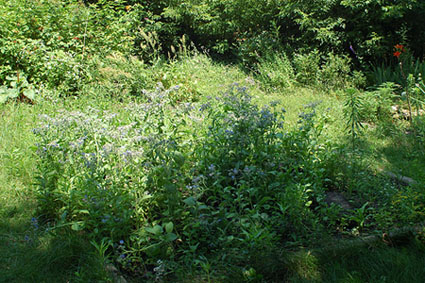
Parkdale Community Beer Garden (facing north). My plot is the one to the forward right of the frame. The big leafy thing in front is my ever-expanding patch of white valerian (Valeriana officinalis). This is a gorgeous plant that grows to be taller than me producing massive sprays of fragrant white flowers. Some cats like valerian and go crazy for it like catnip. Mine does not so the only personal use I get from it are the flowers that I snip to put in vases on occasion. But the real reason I keep valerian in the garden is because the plant is known to be an immune system boost to the plants that live around it and it makes a good addition to the compost heap. It also attracts a lot of beneficial insects becoming a little microcosm onto itself by mid-summer.

may1808_3.jpg

My plot (facing west). I keep an assortment of perennial herbs in that corner leaning towards a mix of bright green and chartreuse plants. I added some black pansies to the mix this year which made a nice colour combination.

may1808_2.jpg

Most of plot (view facing north)

may1808_1.jpg

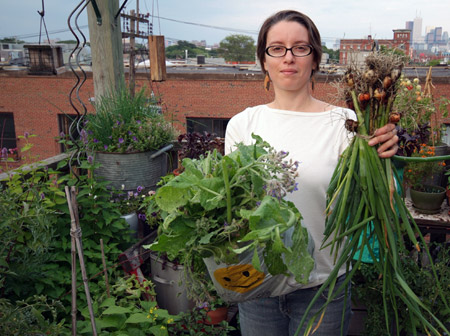
Harvested that day. Lots of herbs, onions, and garlic mustard roots (later made into horseradish).

may1808_5.jpg

Plot (Facing north east). There’s that valerian again. The spiky leaves sticking up all over the place are mostly garlic and onions.

may1808_6mint.jpg

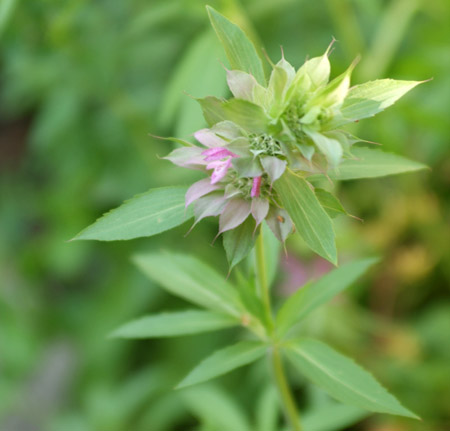
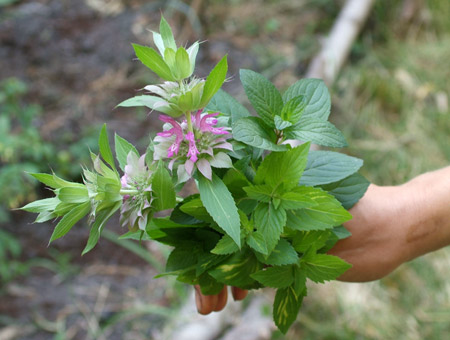
The mint corner. They’re coming up strong including last year’s over-priced purchase, Mojito mint. This is one of the mints I intend to propagate this year. They say growing an assortment of mints together is a bad idea as it can dilute the quality of each variety over time. But I’ve only got so much space and there are too many interesting mint varieties to grow so what can one do except break some rules.

may1808_7_pansy.jpg

Pansies amongst the onions. I’ve got violas and pansies all over the place as spots of colour until the self-seeding calendula, borage and other edible flowers mature.

may1808_8_sage.jpg

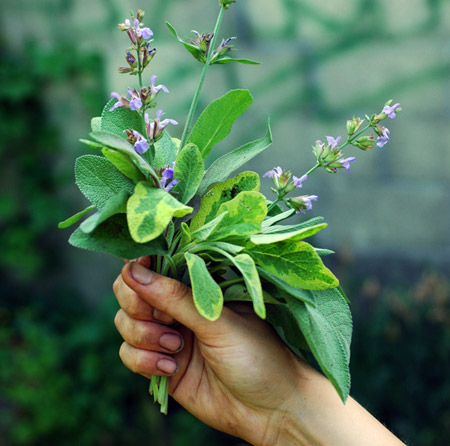
The sage corner. I’ve got 4 different varieties living here. I think we’re pretty much set for sage into the next millennium. Since I took this picture the plants have EXPLODED with buds forming that will soon bring that corner alive with colour. Thankfully there are lots of interesting things to be done with sage and it dries very well. Here’s a yummy sage and walnut pesto recipe. I’m also growing white sage on the roof.

may1808_9_onion.jpg

The onion sets I planted 2 weeks prior are already growing. How’s that for fast service?

Leave a comment

Garlic Mustard (Alliaria petiolata)

Photo by Davin Risk All Rights Reserved

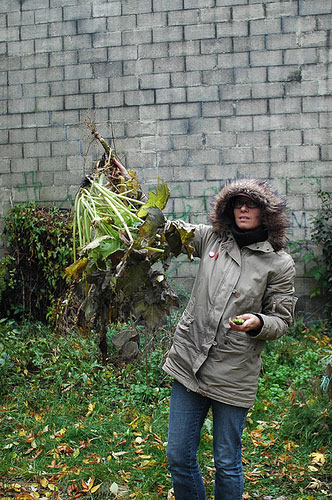
The garlic mustard population is really getting out-of-hand at the community garden this year. I’ve discovered loads of it in unused areas of disturbed, lousy soil and it is expanding rapidly into the edges around plot beds. I was diligent in removing much of it last year so the population isn’t big enough yet to really get under my skin, but this plant is so prolific, and such an evil overlord taking over wherever it sets roots that I’m going to have to get at it with due diligence to avoid disaster next year.

For those who’ve had the good fortune of avoiding it, garlic mustard is an extremely invasive, biennial plant that was probably brought to North America by European settlers, most likely to be cultivated for food and medicine. And I can see why. It’s delicious stuff and the herb books are filed with useful garlic mustard-based remedies. The plant also over-winters nicely under snow, even in my region, which for settlers probably meant something green in the cold months. Unfortunately the plant got loose and has since become a bit of a botanical menace, encroaching on native woodland plants in many parts of the Eastern United States and southern parts of Ontario, Canada (where I live). In fact it’s become such a pain that local communities are starting to band together on special garlic mustard eradication days, going out into woodland areas in groups with the sole purpose of removing the plant.

But like I said, there is a bright side to this — we can use our mouths and stomachs to help keep this bad ass botanical in check. The leaves have a strong garlic flavor and the roots have a bit of a kick making them a good substitute for horseradish (incidentally also a menace). When pockets of it started to turn up in my own gardens last year I figured I might as well figure out some use for it while going through the pains of pulling it out. We’ve tried a few recipes but I am finding that I am as sensitive to this plant as I am to garlic itself. We’ve enjoyed it, but in much smaller quantities than are harvested. The other key to use that I have found is to mix it up with other ingredients. This tempers the bitterness, and in my case prevents digestive upset.

Photo by Gayla Trail  All Rights Reserved

While the leaves are bitter, young leaves can be eaten fresh in salads if you remember to harvest in the early spring. The plant is generally tastier BEFORE the flowers and seeds appear which is a good thing because it’s advised to get them out of the ground before the seeds have a chance to spread. It can also be sautéed or wilted like spinach. The garlic flavor goes nicely with butter. And mushrooms. Maybe with a pinch of salt and a splash of lemon. Yum. Pesto is a popular use since the bitter garlic flavor works nicely on pasta, no additional garlic required. Making pesto is also a good way to use up and store the plant for long term use. Just package it up and keep it in the freezer. Don’t worry about running out, for better or worse there will be plenty more next year.

Related:

Leave a comment

First Harvest at the Community Garden

Photo by Gayla Trail  All Rights Reserved

We popped over for a quick mini-visit to the community garden yesterday afternoon. I wanted to bring some kitchen scraps to add to the compost bin on our way to have lunch and run errands. We left the container at the garden with a mind to return to pick it up on our way back home and do more garden inspection.

It’s only been a few weeks since my first trip of the season to the garden and already so much has grown. Before going on I should state for the record that the reason growth is so quick in my garden is because I never, ever leave it empty. I grow a lot of edible perennials like herbs, flowers, garlic, fruit, and onions that take up residence in the plot year-round, holding down the soil and preventing erosion. It also means that even in a cold climate like Toronto we manage to get very early and very late season crops.

But I digress. Just look at the growth in just nine days! Some of the peas I planted around the trellis have emerged at least a few inches above the soil line. The gooseberry bush I planted early last fall has full leaves and lots of teeny tiny flower buds. We’re going to have a pretty reasonable first gooseberry harvest this summer!

And speaking of harvests, I made my first real harvest of the season yesterday. I took home clippings from a variety of perennial herbs (garlic chives, marjoram, oregano, sage, and thyme) in addition to handfuls of onions. Looking at a photo of the full community plot (actually the sage section is cut off) you can see that there are an awful lot of onions (some are garlic too). They are always one of the first edibles to come up in the spring and one of the last harvested in the late fall. Most of the onions are ‘Egyptian Walking’ onions (aka “Egyptian Clumping’ onions) a type that come up very early and reproduce by developing a topset of bulbs later in the season. Their name is derived from their unique growth habit; the heavy topsets literally fall over and take root in the soil, giving the impression that the onions are creeping about and reproducing themselves throughout the garden. I like to control their placement slightly by collecting the topsets in the summer, tossing them into bare spots as I harvest mature plants throughout the season. They are a particularly rich-flavored onion, reminiscent of garlic. You can eat the topsets as well as replant them, their taste even more like garlic than the mature bulbs.

Photo by Gayla Trail  All Rights Reserved
‘Egyptian Walking’ onions with topsets.

We get a continuous harvest of onions throughout the growing season through this perpetual reproduction but, I’ve been itching to grow some varieties that produce larger bulbs. I bought seeds for a variety called ‘Red Torpedo’ for this purpose but was seduced by the possibility of an even earlier harvest when I came upon a bin of red onion sets for sale later yesterday afternoon. This is why I can’t make solid garden plans — I am too easily swayed to make impulsive decisions! You should see the purple fingerling potatoes I impulse-bought for planting from the local organic produce store only a few minutes prior to my run-in with the onion sets.

Photo by Gayla Trail  All Rights Reserved
Red onion sets waiting to be planted.

And so I bought a handful of red onion sets of unknown origin, which I took back and planted at the community garden. I had no plan for their placement so I basically pulled out a few bunches of mature ‘Egyptian Walking’ onions and replaced them with the new sets. They say the rough and tough cultivation of onion sets make them more prone to disease and a little risky to grow, but I figure the ‘Egyptian Walking’ onions can handle it and I kept them a bit of a distance away from the others to be safe.

Photo by Davin Risk All Rights Reserved

I left the garden with my bundle of onions in hand and an overwhelming sense of pride knowing I will be supplementing our meals with them over the coming week. It was quite a shock to realize that this sense of pride doesn’t diminish with time. I’ve been growing food for quite some time now, you’d think it would become a commonplace part of my life but instead every new harvest, especially the first one of the year, is filled with that original sense of amazement and awe. I’m so glad the growing season is back in full swing!

Leave a comment

Early Days at the Community Garden Plot

Photo by Gayla Trail  All Rights Reserved

Last fall I decided to participate in a national growing experiment called, The Great Canadian Garlic Collection, wherein hundreds, possibly thousands of gardening nerds are growing garlic, recording their results, and then pooling the data so we can all find out which varieties grow best under varying conditions. Believe me when I say that it is all VERY important work and I have taken my role as a participant very seriously. In fact I am taking it all so seriously that it has forced me to change my evil, too-open-to-suggestion-and-last-minute-changes ways by making a garden plan.

Last fall, when the garlic arrived in the mail, I knew I would not be able to do what I usually do which is just stick it wherever it will grow and forget about it until spring. I had to keep track of the garlic, the varieties I am growing, and then record my observations over the span of two years. For the first time ever I needed a serious plan. A plan that can’t be changed on a whim. A plan committed to paper.

And so I decided to make an experiment out of this experiment. I decided to try growing a slightly more formal garden at my community plot than is my way. My way is generally one based on informal companion planting. I grow plants in groupings that work, share, look gorgeous, and love together but I don’t get hung up on formally arranging things. I enjoy a bit of organization and try to keep chaos at bay in other areas of my life, but since the gardens aren’t so much my spaces anymore as they are work spaces, I try to leave a little space for serendipity to take hold. I do not use rulers or string. I do not mark space. I do not make a design on paper that can then be implemented in the earth.

But like I said all of that had to change with the introduction of the very important garlic. And so I set about making a plan last fall. I came up with a design and I set to blocking off the garden using sticks and string as markers. I planted the garlic, recorded its locations, drew in the herbs and perennials, finishing off with carefully marked blobs for spring plantings.

Photo by Gayla Trail  All Rights Reserved

And then in a telling Freudian slip, at the very moment I needed to place my early spring seed orders, I lost the plan. My subconscious did not want to be told it can only grow 4 tomato varieties. My subconscious was gonna grow those ‘Chocolate Cherry’ sunflowers formal plan be damned! I searched high and low but it was gone for good. I went ahead and ordered the seeds without the plan.

In the end it wasn’t a big deal, although as always I have far more seeds than I can grow. The overall layout was still marked off with string at the garden. Garlic sprouts have emerged from the soil with accompanying tags indicating the varieties. The perennials are marking their space, leaving me with empty pockets to fill with the seedlings I started under lights a month or so ago.

Photo by Gayla Trail  All Rights Reserved

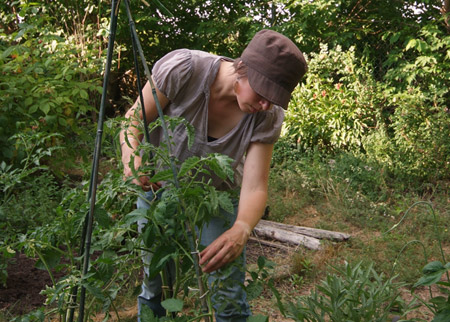
And despite the formality there is still plenty of space for serendipity and last minute inspiration. When I went to do clean up on the garden last week I had the impulse to build a sculptural trellis to grow peas and beans on. I am overstocked on attractive pea varieties and thought it would be nice to grow them in the community plot this year. The community garden is surrounded by weed trees that require aggressive pruning every year less we lose sunlight to the garden entirely. I used some of those prunings to build a gnarly tripod trellis, reinforcing it with woven branches at the base. I’m rather fond of it. It is going to look gorgeous covered in peas, if the groundhog doesn’t get to them first!

Photo by Gayla Trail  All Rights Reserved

Leave a comment

Planting and Growing Garlic (Allium sativum)

garlic_hardneck.jpg
Garlic Shown: Stiff-neck which tends to be hardy and stores well over the long term.

Sitting down to write this, my first thoughts are to apologize for the slow down in updates recently. I consider writing to assure you that the slow down is merely a glitch in workload and I will not stop writing here during the winter season because gardening is a daily thing for me that does not stop it merely shifts with the seasons. While I’m at it I want to apologize for the header that still says “early Fall” when we all know it is proper Fall now. As I sit here a list of assorted lagging details run through my mind and I entertain the idea of apologizing for each one like something in the room that needs to be acknowledged before our relationship can move on. Or a clearing of my throat. “Ahem. Hi. Is this thing on?”

I wonder what it is about internet writing that brings that out? Is it the feeling of an informal and personable context? Is it the assumption that I am sitting down to speak directly to you and you back to me? When I sit down to write an article for a printed magazine I don’t think to begin with apologies and casual shout-outs. “So… Uh, sorry this is my first time writing for this magazine but you know how it goes, I had other stuff going on and insert excuse here. Before I kick this off I just want to say hey what’s up to so and so whom I met last week at such and such event.”

Okay, enough banter. Let’s talk about garlic.

I should preface these instructions by stating that I am not a garlic eater however I love to grow the plant. I think it is a beautiful plant worth growing regardless of personal taste, requires little effort to produce a good crop, is self-perpetuating (you can use this year’s harvest to produce next year’s crop) and it is especially useful as a pest repellent crop warding off insects like aphids and Japanese beetles. You can also crush garlic cloves in water and make an organic pest spray. Because garlic is easy to grow it also makes a good crop for trading with other food gardeners and friends.

Read more…

Leave a comment