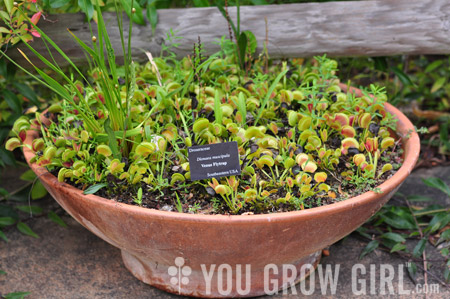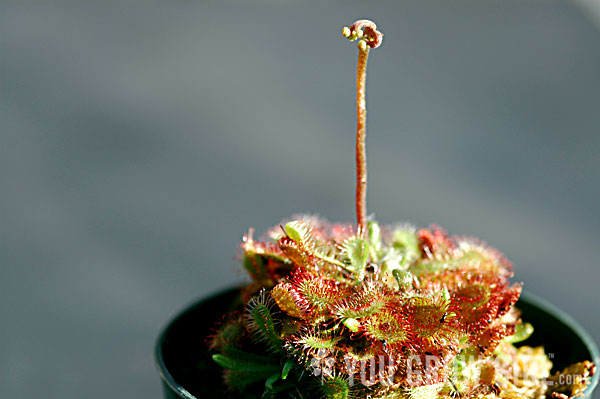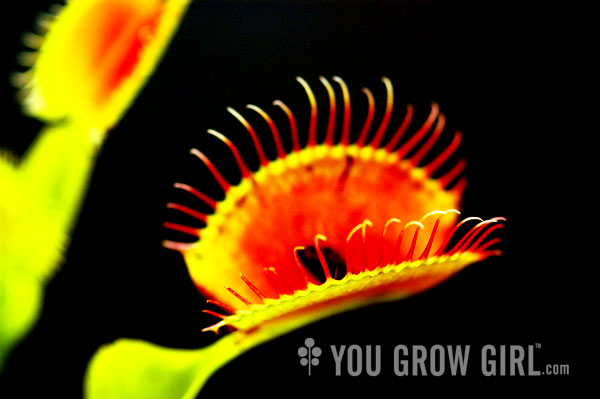
Venus Fly Trap Bowl

Every botanical garden has their forte, their special something that sets them apart from the others. Prior to any trip that includes a stop at a botanical garden, I tend to scour websites in anticipation of the sort of plantings I will see. However, before my trip to speak at the Atlanta Botanical Gardens last month, I decided not to do any research before hand. I thought it might be more fun to be surprised and wowed without the anticipation that comes with knowing what to expect.

Sure enough, I was absolutely giddy to discover that one of the garden’s claim to fame is their carnivorous collection! I have lots more to share with you, but first is a project that can be achieved at home.

Venus fly traps (Dioneae muscipula) are probably the most well-known carnivorous plant, and are widely available as impulse buys in big box stores and supermarkets. Yet, few of us get to really experience them beyond one small plastic shell packet in a cardboard counter display. The plants are marketed as an enigma, tend not to last long in our dry winter-heated homes and are a little bit intimidating as a result.

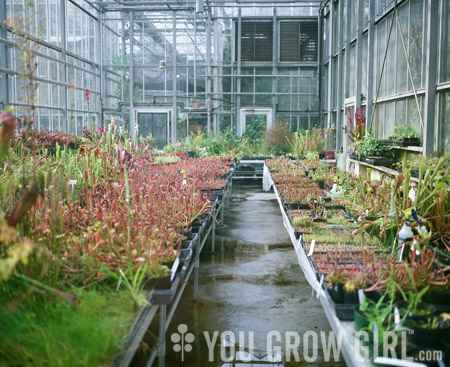
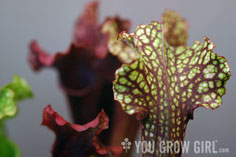
They’re a temperate-warm climate plant that prefers high humidity and can withstand short freezes, but can not survive the killing frost we experience here in the North. Venus fly traps love Toronto’s hot, humid summers, but require a chilly, but not freezing, winter dormancy period that fluctuates around the 50 degrees F mark. For this reason I have grown them as an annual in miniature bogs like the one shown above (photographed at the Atlanta Botanical Gardens) through the summer months, but tend to abandon them once the winter comes. In the right climate you can easily achieve the sort of mass planting shown in this bowl as the plants do reproduce readily and will even set seed.

Soil:

I’ve had a lot of luck using a mix that is 1 part sand, 1 part peat (substituting coir), and 1 part perilite.

Planting:

It wasn’t clear to me if the bowl (shown above) had drainage holes or not. In my experience, I have had best results growing venus fly trap outdoors in a pot with holes with a deep, water-filled saucer placed underneath to keep the soil moisture high, yet also allow for drainage through periods of heavy rainfall.

When drainage is not offered, I line the bottom of the bowl with gravel and keep the pot in a sheltered spot where I can control the amount of water it receives. Venus fly traps like wet conditions, but they can still become water-logged and rot if left permanently submerged in water.

————–

I cover growing a carnivorous bog in my first book, You Grow Girl: The Groundbreaking Guide to Gardening, and if you’d like to learn even more on growing all sorts of carnivorous plants, I highly recommend The Savage Garden: Cultivating Carnivorous Plants by Peter D’Amato.

The Carnivorous Plant FAQ has an detailed section on growing venus fly traps, including a few tricks for dealing with dormancy.

Leave a comment

Taking a New Look at Carnivorous Plants

Photo by Gayla Trail  All Rights Reserved

I just read a fascinating piece via the Telegraph UK that is absolutely blowing my mind.

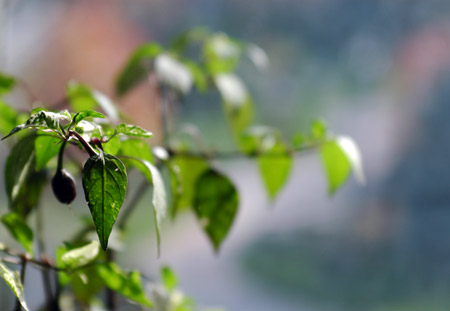
Researchers at the Royal Botanical Gardens Kew have conducted a study looking into plant behavior, specifically carnivorous plants, and are concluding that there are hundreds more carnivorous plants out there in the world than previously realized. Many of which are common to our own vegetables gardens.

The one that makes the most sense to me based on personal experience is nicotiana. I grow Nicotiana alata every year in pots up on my roof and have observed that the leaves are incredibly sticky and attract gazillions of insects throughout the growing season. In fact, I often position the plants in problem areas as a way to attract and kill aphids and other small flying insects. And yet somehow, I never thought to identify this unique ability as carnivorous!

Another plant mentioned is the common, often banal and overrated petunia. I grew petunias this year by chance, something I said I’d never do, ever. But then some were sent to me and I actually sort of liked the variety and the next thing I knew they were potted up and growing alongside the chives and some variegated marjoram. Throughout the season I noticed that this particular petunia had incredibly gummy leaves and attracted legions of tiny, flying bugs all over the leaves, stems, and even the flowers, not at all unlike the nicotiana.

But did I ever think to identify this plant alongside the likes of a sundew or pitcher plant? I should know from studying so much postmodern theory in university, the power that “naming” has to subvert and even define the way we classify or contextualize things. This is a fantastic example of that power at work.

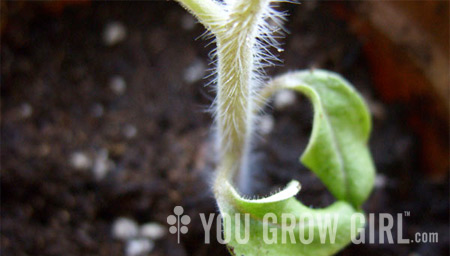
The third example that I find most fascinating are tomatoes and their little sticky hairs. Botanists are now saying that the plants can trap (most of us tomato gardeners know this) and kill insects with these hairs and as the insects die they fall into the soil and are absorbed as nutrients. That’s the real clincher here, because classifying a plant as carnivorous is often about identifying that the plant has adapted to killing insects for nutritional use. I got as far as observing that they could kill, but did not go as far as asking whether or not they were then absorbing the insects as supplemental nutrition. But even if the stickiness and trapping ability is only defensive, isn’t that enough given that the plants are still killing the insects?

This is fascinating stuff and has made me realize how much more conscious I would like to be in the observations I make as I tend my gardens. There is so much amazing stuff to learn and discover in the smallest, day-to-day muddling we do as gardeners, don’t you think?

Leave a comment

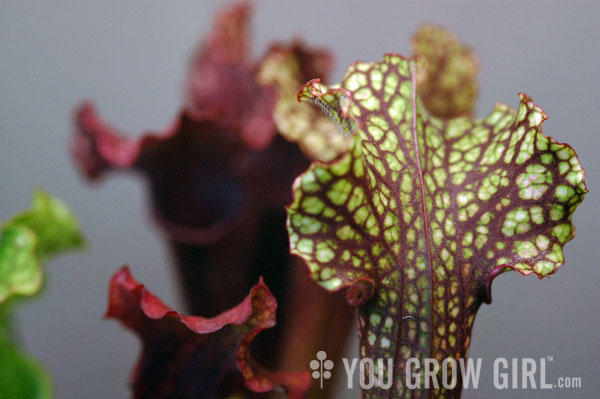
Sarracenia ‘Judith Hindle’

Photo by Gayla Trail  All Rights Reserved

I recently added this compact pitcher plant to my little aquarium of carnivorous plants. It is now complete. I really can’t fit another plant in there.

Okay, I could probably squeeze another sundew in if I tried hard enough. And believe me, if one so happens to come along, I will.

Full picture when I finally find the time to take the plants out of their individual pots and assemble the aquarium as I want it.

Leave a comment

Seven Things (Plus some extra fun things at the end)

I’ve been tagged for a meme. I don’t typically do memes and i know this makes me a terrible meme not doer, but I swear my reasons aren’t bitchy, just awkward.

For example, this current meme requires that I list seven random things about myself. Dear god, the pressure! On the one hand, I do an awful lot of writing that is connected to personal experience, yet there is something about the invitation to, “Write seven random things about yourself” that seems impossible and draws a big blank. I’m growing tense just sitting here writing the prelude to the writing of the seven things I am yet to decide on.

Since I’ve been tagged for this particular meme twice, I’m stepping up to the plate and doing it. Alexa of Invisible Bees has more guts than me and did the meme as intended but with a gardening spin. Genevieve of North Coast Gardening altered the meme and wrote hers as a list of seven articles she has enjoyed in the last year.

Apparently, the seven things can be any seven things, but in keeping with this site I’ve decided to make it seven plants I love. This is of course a difficult topic because it is almost impossible to pick favourites in the garden world and my tastes and interests change constantly. So I’ve decided to try and just keep it with where I am right now. Today. This minute. And I’ve cut food plants out as a possibility to force me to talk about some favourite plants that often go without much fan fair.

Here we go. [Which as of today was started over a week ago. So clearly I have a huge block around memes and picking favourites. For real this time! Doing it...]

Photo by Gayla Trail  All Rights Reserved

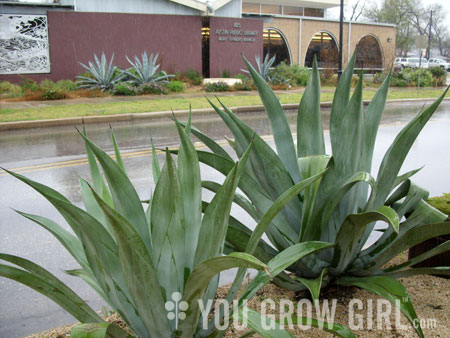
Agave outside Big Red Sun in Austin, Texas.

  1. AGAVE

    Agaves are a long term favourite. Ours is a love that could never die. Thinking back, the interest really took off on our second trip to Oaxaca, Mexico in the spring of 2000. We had been to the coast of Oaxaca the previous year where there were many majestic agaves, but NOTHING like what I saw in the interior. It is there that I learned of the importance of agave to the Mexican people and its many ethnobotanic uses. I eventually wrote an article about this, and while I never did write the part 2, my fascination with them has not disappeared.

    As a gardener and a writer, I have focused more and more on food over the years, but when I think about it I can see that this interest stems from the fact that I am actually more generally interested in ethnobotany as a whole. Food and eating is only one large (and very integral) part of the overall connection between human history and the ways we use plants for survival.

    Despite my love for agaves, I was only able to see them in bloom (up close) for the first time two years ago on our first trip to Cuba.

    My new friend Barry is an agave collector. Meeting him and his collection has rekindled my interest in the plants specifically, beyond their socio/cultural usage. I’ve acquired two new plants this summer, Barry just gave me a third, and I have my eye on a forth spineless type. There are so many incredible agaves out there, one could devote themselves entirely to this genus without getting bored. Unfortunately, this type of devotion requires more space than I can provide as they grow awfully big and the spines are horrible when they stick you.

Photo by Gayla Trail  All Rights Reserved
Drosera spathulata

  1. SUNDEW

    Now here’s a plant whose size I can accommodate in the tiniest sliver of space. They may be small, but sundews (drosera) are infinitely fascinating plants that are both cute and slightly evil at once. I currently have three living in a small aquarium alongside several other equally fascinating (well, nearly) carnivorous plants.

    See more: Drosera adelae, Drosera spathulata, another sundew, cape sundew

Photo by Gayla Trail  All Rights Reserved
Oxalis ‘Burgundy Bliss’

  1. OXALIS

    This is a new interest that had its start in the spring of 2008 when I found myself digging up clovers to put in little containers. Hmmm… or perhaps it has its start in childhood when I went through a brief but rabid four-leaf clover phase, spending hours at recesses and after school searching the lawns for four leaf clovers that I would then laminate between pieces of scotch tape.

    This past spring I bought two oxalis plants and one clover at the annual Parkdale Horticultural Society Plant Sale, making my new plant love official. And then I bought another, very vibrant burgundy one over the summer. To be clear, oxalis and clovers (Trifolium) are not the same thing; they do however look similar, hence the connection. Most oxalis plants are not hardy to the cold in my part of the world, while many clovers, being in the pea family, are. So far I am focused on oxalis with small leaves that look more like vibrantly coloured clovers and am not very interested in the larger-leaved plants. We’ll see where this goes. Hopefully not too far since I am already burdened with three plants to overwinter indoors.

Photo by Gayla Trail  All Rights Reserved
Epiphytic cactus growing down a tree trunk in Guama, Cuba

  1. EPIPHYTIC CACTUS

    Here’s another big category that I am fascinated by. In truth, this interest extends to all epiphytic (air) plants, but I find the idea of cactus that grow in trees particularly strange. What a marvel! I currently have three plants in my home but long for the space to house a really huge pencil cactus. Someday.

    I was very fortunate to finally see one growing on a tree this past year on our last trip to Cuba. We took a horseback trip (also a first which I will NEVER do again) into the mountains to visit a waterfall. The waterfall was nice enough, but it was the plant life that inspired me. I saw many average house plants growing in the wild, up along rock walls and creating thick brush along the edge of the forest. In that environment they seemed anything but average. Tillandsia (another epiphytic plant) filled a tree, but I’ve actually seen so many of those now in the wild that it is starting to become more common place (although never losing its appeal. I still cry like a baby when I see them). The real highlight was a tiny ephiphytic cactus snaking up the trunk of a tree. I’m sure my fellow horseback riding comrades were perplexed by what I was looking at so intently on that tree trunk, but I know y’all will understand [See photo above].

Photo by Gayla Trail  All Rights Reserved
‘Yvonne Decelles’

  1. AFRICAN VIOLETS

    Here’s one you didn’t see coming. It still surprises me some days. I got into them in my first year of university and I know I had had some of them at least a year by that point (that made me 18 years old at the time. Take that “The kids don’t garden naysayers!!”) but I don’t recall actually buying them. Back then I worked at a dollar store in a mall and I often passed through a Woolworth on my way to my job. The Woolworth had an every-changing display of houseplants along that path, which inevitably lead me to take several home to my new apartment. I am fairly certain that the African violets were among the plants purchased there. I also got a few plants from my grade 13 biology teacher, so that’s another possibility.

    Needless to say, true love came to blossom (literally and figuratively) during the year I spent living in a very sunny and warm dorm room. My room was up on the 14th floor and a corner room that was literally wall-to-wall window. The environment was perfect for my African violets and they flourished there. Naturally, success with a plant was a big ego boost that fueled my desire to grow more. I’ve acquired several plants over the years and am most fond of the most ostentatious and outrageous varieties with ruffled leaves, double, ruffled flowers, and crazy variegation. All of my favourites were acquired as leaf cuttings bought from the Toronto Gesneriad Society booth at the CNE that I rooted and propagated myself. I should just break down and join the club, shouldn’t I?

    I also have a special fondness for dwarf varieties that are tiny enough to sit in the palm of your hand. I bought two on a recent trip to Montreal and they were only 2 bucks each! That’s the other stellar thing about African violets: they’re CHEAP.

    To date, my current count is 8. I’d have more but missed the Gesneriad Society table at this year’s CNE. Yes, I actively sought it out and was disappointed to have missed it. And I’m just going to put this out there, but it’s also a personal dream to enter a contest. I know my plants would never win because I’m not cut out for that kind of anal retentive devotion to form (my plants are a rag-tag mess by their standards), but it would be a great excuse to wear a giant soap opera style hat!

    See More: Growing African Violets from Leaves, ‘Yvonne Decelles’

Photo by Gayla Trail  All Rights Reserved
Geranium phaeum ‘Samobor’

  1. GERANIUMS

    Here’s another that took me by surprise. I grew up with your typical red flower geranium. They were everywhere in my neighbourhood where there were gardens, probably because they practically grow themselves, are super cheap, and the kids often sold them as fund-raising items for softball teams and the like. As a result, I grew up with an extreme distaste for geraniums, believing in my mind that they represented the entire scope of the geranium world. That sad thing with a big red pom pom flower on top was a geranium. The end.

    Then, in 1997 I went to San Francisco for the first time and was BLOWN AWAY. That same red flower geranium grew into a wild, tentacled monster in a temperate climate. Not so bad after all.

    Eventually, I came to know that there were lots of other geraniums out there that are true geraniums and not tender pelargoniums like the red-leaved kind I knew. Some are dainty, yet hardy little things, and some grow wild and gnarled if you let them and produce the most amazing pine smell when you brush against their foliage.

    Then later, I got over my bias in a new way and came to appreciate scented pelargoniums aka scented geraniums, the nicer smelling siblings of that original red flower type. I’ve come to grow many over the years and am currently in love with a curly-leaved, variegated variety called ‘Prince Rupert’ that I picked up at a nursery sale for $1.99! It smells like lemons. We’re going to be good friends, I think.

Photo by Gayla Trail  All Rights Reserved
Begonia sutherlandii

  1. BEGONIAS

    This began as a plants I like list and has evolved into a plants even I am surprised are on my list, list. I’ve said it before, but I’ll say it again, I didn’t like begonias. In fact, I had some pretty mean things to say about them that should only be reserved for cacti with straw flowers glued onto them. And even that isn’t the plants’ fault but simple human crassness.

    Somewhere along the way, in what is a running theme, I checked my biases, humbly admitted that I didn’t know jack, was making some cocky, pompous assumptions without a proper education, and changed my mind.

    And now look at me: I’m growing begonias! And I’m really excited about trying to grow my own from bulbils harvested from the orange Begonia Sutherlandii plant above. There are still a lot of begonias that give me the dry heaves, but of those I do like, Wow.

PARTICIPATION

Look at you, making it all the way down here to the end. I feel like I lived an entire lifetime while writing this so I can only imagine what it felt like to read it.

Now comes the second part of the meme, wherein I am asked to share seven blogs I like. I equally hate doing this sort of thing because seven is a very finite number that inevitably leads to leaving someone out. Or worse still, I tag seven people who do not want to be tagged. So now I’ve tagged people who don’t want it, and not tagged those who do. Memes are supposed to be about spreading the love, but participating in them often feels like stepping onto a giant landmine of potential social failure.

So for that reason I’ve decided to open this up to everyone. Go over to your internet website and do the seven questions thing, if you feel so inclined. Come back here and link to it in the comments. If you don’t have a website, just write your seven things in the comments.

In two weeks (I’m giving you time because I know how hard these memes can be) I’ll randomly pick one from the list and send that person a copy of my first book and some buttons and magnets. Hooray!

Leave a comment

Sundew (Drosera adelae)

Photo by Gayla Trail  All Rights Reserved

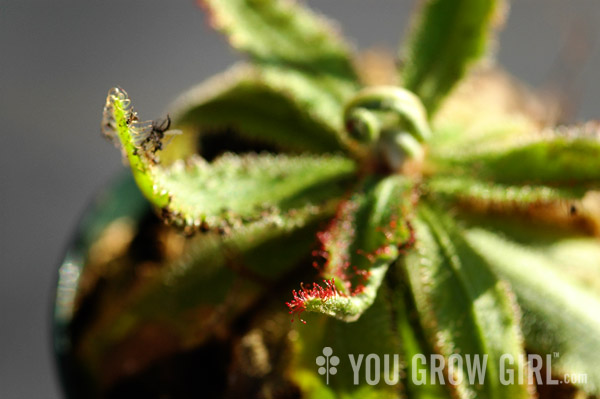
This is the other sundew of the pair I bought in early May. According to my favourite book on carnivorous plants, “The Savage Garden” by Peter D’ Amato, this genus is from Australia and prefers life in a humid terrarium, which is where I have mine right now. Apparently, it puts out red, star-shaped flowers. I can’t wait!

Leave a comment