Storing My Preserves & Cookbooks

In our new(ish) home, I am fortunate to have a cold storage room in the basement where I can keep my canning overflow. This is such a big change from my last place, where canning was stored wherever I could fit it: out of reach in high closets and cupboards, in boxes shoved underneath the couch and the bed. Over the years I became very adept at finding places to stuff jars of food. Of course, these were less than ideal conditions for storing canning long-term as the temperatures were a bit too warm, and it was extremely difficult keeping track of stock.

Now where are the pickles again? Underneath the bed, or at the back of my closet behind the socks?

The new storage room is fabulous, but it is in a difficult to access part of the basement. I have to climb over a hazardous mountain of bikes and bike parts to reach it, and since there is no light, I must also fumble in the dark in a spooky, cobwebbed room with a flashlight or make sure that I only traverse down there before night fall. I’m pretty sure this is where the former occupants kept their pet monster.

Since moving in, I’ve been keeping some of my most popular canning stock in the kitchen so as to avoid THAT ROOM. So when we finally got around to setting up our dining room properly a few months back, I decided that it would be nice to dedicate some space to house a larger quantity of food in jars. The convenience was required, but I have to admit that vanity was also a major factor. Canning is handiwork that I take a lot of pride in and I wanted to be able to see and enjoy those beautiful jars of apocalyptic snack foods regularly, rather than keep it hidden down in a dark and dingy, nightmare-inspiring, cell-sized food prison.

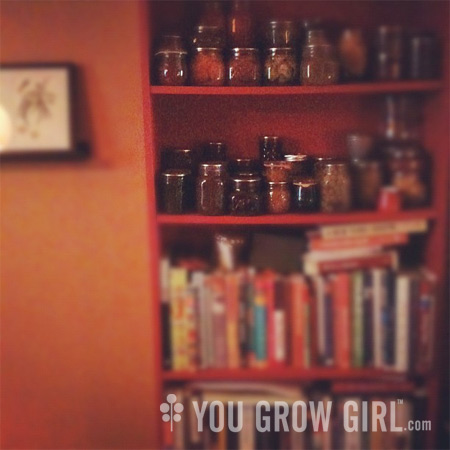
My out-of-control cookbook collection is also kept in the kitchen. It seemed the most likely place to keep cookbooks at first, but to be honest, I tend to use cookbooks for the experience and pleasurable enjoyment of food culture than for the recipes. I think of them more as photobooks and prefer to pursue the pages at my leisure when I need inspiration or am suffering a bought of wanderlust. For that reason, they are better kept close to a comfy sitting spot than a busy kitchen. Furthermore, our new kitchen is awkward and does not have much cupboard space. My cookbook collection was quickly outgrowing its place, and I thought that the shelf space it was using up could be best put for storing pots and pans and the like. So it was in a moment of inspiration that we hauled our old, buckling from the weight of too many books, red (I think this colour is discontinued) mid90s Ikea Billy bookshelf down into the dining room as a place to display and enjoy both my canning and my cookbooks.

I love this new system. The dining room is just the right spot for both collections. Unfortunately, as you can see, the cookbooks are already outgrowing their new home.

————-

The above photo was originally taken with my cellphone and uploaded to my Instagram account (@yougrowgirl).

Leave a comment

Preserving Green Tomatoes

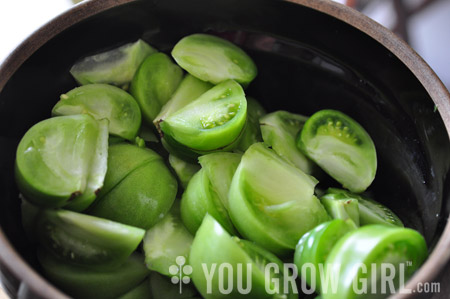
The tomato season is ending quickly. As of today, I don’t foresee many more ripe tomatoes coming off of the vine. I’ve had a good run: 110 lbs of ripe fruit in all! This was my first year weighing the harvest, so while I can’t make an accurate comparison to previous years, I think it is safe to say that it was my best year, ever.

It’s time now to focus on the unripe, green tomatoes. In an attempt to squeeze a few more ripe fruit from the harvest I’ve been nestling those that are nearly there inside paper bags. This sort of treatment isn’t exactly necessary, but with fruit flies still around, I find it easier to keep them off of the goods this way.

In my experience, not all green tomatoes will ripen by this method. The fruit that is really young and underdeveloped tends to go wrinkly and rot rather than ripening, so I reserve this process for the tomatoes that have a blush of colour and save the darker green fruit for eating fresh and preserving.

Eating & Preserving

My favourite way to eat green tomatoes straight off of the plant is batter fried. They are also delicious roasted in the oven. When it comes to preserving, my go-to is green tomato chutney. Everyone loves this condiment, and there is never a lack of friends available to take the surplus off of my hands. If you’re not interested in canning or only have a small batch to work with, you can cut the sugar (and some of the vinegar/acid) from my recipe and store it in the fridge short-term. My no-sugar added, short shelf-life, small-batch version is available in my first book, “You Grow Girl” (see page 154).
Read more…

Leave a comment

Violets Galore

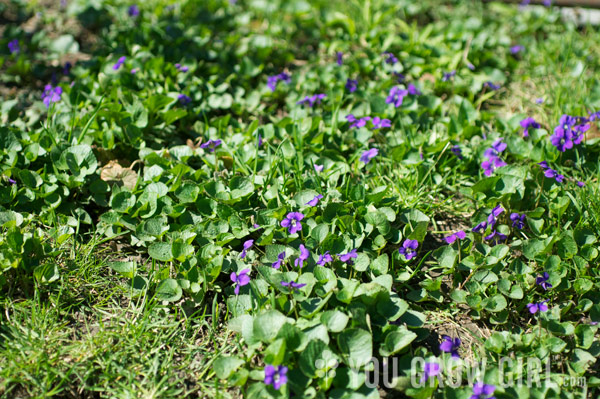
The new yard came with violets… lots and lots of violets. They’re blooming now and even though the yard continues to look like the excavation site of a dead body on a television police procedural…

I’m in heaven.

I have longed to have the space to grow enough violets to make cheerful springtime jellies. A few years ago I set about making this dream real by installing white and purple violet plants into a shady corner of my community garden plot. I began growing them in a large trough on the roof, too. Then we moved here and I inherited a yard of them.

Between all of these locations I should have more than enough to candy, make my jellies, and eat fresh in salads. I like the young leaves, too. Of course, we are currently in the process of digging up the yard, but I’ve been careful to dig around the violets and set each one (barring a few casualties) for replanting. I plan to carefully extract the plants from the grass that is growing around them, and replant them into their own swath along with the three other colour varieties I have collected over the last few years. You think I’m crazy for taking so much care with a plant that spreads like a weed, but I can’t wait for you to see it.

Man, do I ever love having a yard.

Leave a comment

Elderberries

Photo by Gayla Trail  All Rights Reserved

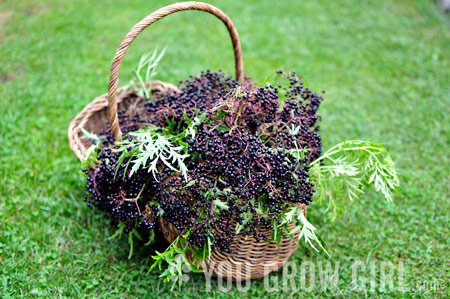
My friend Barry has an elderberry tree in his yard. Last summer he offered up the harvest in exchange for a sampling of the end product. I collected a lot of berries and was a bit unsure about what to do with them. Raw elderberries have a somewhat unpleasant scent and are not edible so it was difficult to commit to a usage without a clear understanding of what I was getting into.

Photo by Gayla Trail  All Rights Reserved

[Please note that while there are elderberries leaves shown in this photo, you should not eat them. They are poisonous!]

In the end, I made cordial. It was pretty good. The berries have an earthy taste. That’s all I can come up with as a descriptor. Earthy. Perhaps a bit pungent. It does taste like berries, I just can’t place a finger on which berries exactly. We dripped it on pancakes, poured a little onto granola and yogurt, and added it to sparkling water on occasion. Elderberries are very high in vitamin C and potassium. Many people use the cordial as a cold and flu elixir, instead of store-bought pharmaceutical cough remedies.

Photo by Gayla Trail  All Rights Reserved

This year I wanted to try using the flowers so I harvested about two thirds of the tree back in June, when the flowers were in season, and left the remainder to develop berries. I had enough to make two batches, so I tried two different methods. Unfortunately, I no longer remember the second (preferred) method nor can I recall what it was that I did or didn’t do that made it better. However, if you’re interested, the first, less preferred method came from the River Cottage Handbook No.2: Preserves, by Pam Corbin.

Photo by Gayla Trail  All Rights Reserved

Photo by Gayla Trail  All Rights Reserved

This year, with only 1/3 the harvest, I made a much smaller batch of cordial, which is fine by me because I think we prefer the elderflower flavor. I have no memory of how I made it last year, but this year I used this recipe from David Lebovitz’s website. Within the notes he makes a remark about straining the cordial a second time through a fine sieve. I’ve found that step to be essential and not overly attentive. Otherwise you end up with a very seedy, crunchy syrup. I didn’t have enough to can so I just sterilized two jars on a low heat in the oven before filling, gave one to Barry, and refrigerated the other.

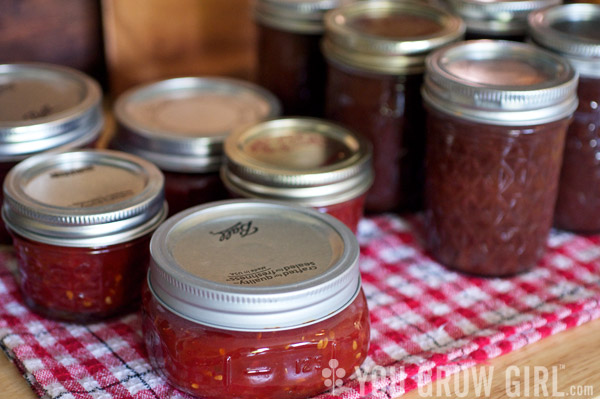
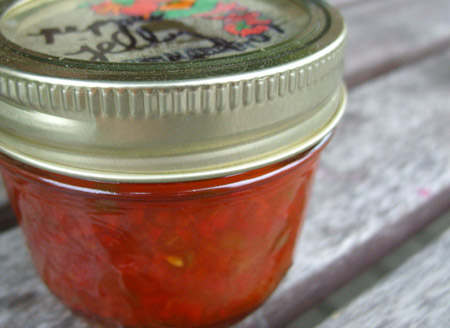
I also made a quick, single jar batch of mixed berry jam last weekend (pictured). But that’s another story.

———

p.s. The site will be down this weekend while we switch over to a new design and work out all of the inevitable kinks. It’s going to be a bit manic, but I’m so excited! A big change has been a long time coming.

Leave a comment

Canning Tomatoes: 3 Recipes

Photo by Gayla Trail  All Rights Reserved

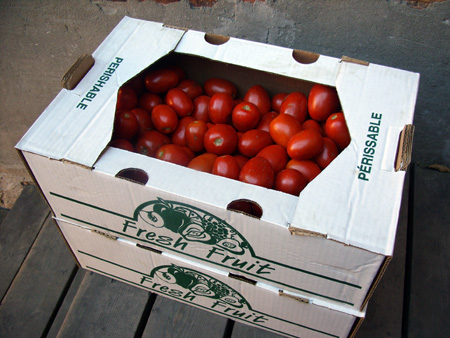
This article and the accompanying recipes originally appeared in print in the Globe & Mail on September 5, 2009. I thought I’d repost it here today since the season is so ahead this year and my large, indeterminate tomato plants are on the verge of a first round of ripening. CAN NOT WAIT! If you’re in a warmer climate, you’re probably enjoying them already and wondering how to use up the extras that are quickly rotting in a bowl and breeding fruit flies on your kitchen counter.

Perhaps that was not the image I should have left you with. Now I am obsessing about my own bowl of small tomatoes and the fruit fly colony I am potentially raising as I write this.

[At which point I did get up to go inspect my bowl of fruit that was in fact housing one rotting tomato and a few fruit flies.]

Photo by Gayla Trail  All Rights Reserved

The article below includes some brief canning instruction and three recipes: Gayla’s definitive green tomato chutney, Superior heirloom tomatoes, and Old-fashioned tomato ketchup.

If you’re itching to dive in further, I’ve included more detailed instructions in my book Grow Great Grub: Organic Food From Small Spaces, along with a few extra recipes.

The Ball and Bernardin (in Canada) books are highly regarded as the most popular tomes, but I have to admit that I find them a bit dull and have never made a single recipe from these books. I personally recommend Well-Preserved by Eugenia Bone. Her writing is conversational and entertaining, and is written from the perspective of a New York apartment dweller with real-world ingredients and realistic, small-batch quantities. I do not have a copy nor have I read it, but someone brought a copy of Canning & Preserving with Ashley English to my spring canning class and on a quick flip-through it looked very thorough, inviting and engaging.

I’m practically writing another article here, but since I’m on the subject, there are three contemporary British canning books that I would also highly recommend: Jellies, Jams & Chutneys, Preserves (This is the copy I have but it is listing at $206!!), and Fruits of the Earth The recipes are a bit more unusual than the stuff I have found in American books, using ingredients and combinations I had never thought to try.

Enjoy!

Read more…

Leave a comment