Five Favourite Italian Edibles

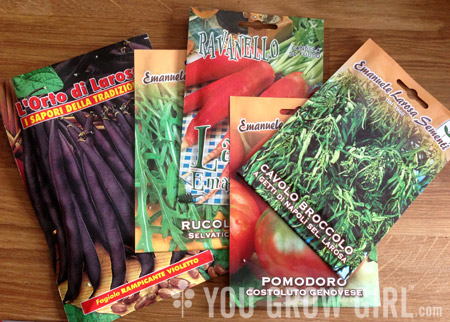
I went to my local Italian grocer this week and chose seed packs for the contest. I tried to stick with varieties that winners can grow in a variety of conditions whether that’s location/climate, season, small spaces, big spaces, and containers. Some of these can be direct sown and some should be started indoors. Something for everyone!

Italian seed packets tend to be very generous and these are no exception. Each packet contains enough seed to sow a farm or share with several friends.

Below you’ll find write-ups on each variety that I chose. Many of these varieties have become available through companies that sell heirloom seed, but I still find that Spigarello is not commonly available. My local grocer didn’t sell it last year and I was so glad when they listened to my pleas and stocked it again for 2013.

There is still time to enter the contest but you must do so over here. Enjoy!

Read more…

Leave a comment

Variegated Arugula

Perhaps it is because I have a penchant for the weird and the unusual, or maybe it’s because I just think it’s pretty, but I seem to have a strong affinity for variegated plants. It doesn’t matter what it is, if there is a variegated version, I must have it.

Well, that’s not entirely true. Some variegated plants have an unhealthy, diseased appearance that is unappealing. Sometimes a sickly look is more than aesthetic. Variegation in plants can occur when cells get confused, causing a mutation that results in a lack of chlorophyll or certain pigments. Sometimes this happens spontaneously but disappears, and at other times it keeps going and spreading as the plant continues to grow.

Some variegated plants can be difficult to keep alive, especially when they produce foliage with no chlorophyll at all. I see this with my variegated citrus trees fairly often. The parts with little to no chlorophyll tend to be weaker than other parts of the plant and more susceptible to problems with pests. Watch your plants and see for yourself. But it’s worth the hassle. I love watching the way the new leaves form. It’s exciting to see what will happen next. With regular plants you always know what will come next, unless of course a spontaneous mutation occurs. A little surprise from nature.

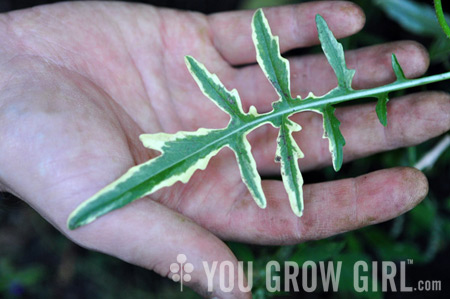
The other day, Davin discovered variegation in some of the arugula aka rucola selvatica (Diplotaxis tenuifolia) growing at our Yardshare Garden (photo above). It’s so pretty! We’re very excited about it, but also feel a bit out of our depth and unsure about how to go about maintaining and even encouraging it to spread. I have never seen or heard of variegated arugula before, and am doubtful that we can get it to stabilize. Most of these sorts of spontaneous mutations revert back to green. It’s obviously in the plant’s best interest to do so.

I checked on the plant last night, and the variegated stem has flowers on it. We’re going to let it go to seed and see what happens when we plant it next year. Probably nothing, but it seems worth a shot. The best way to isolate variegation is by taking cuttings, but I have to admit that I’ve never tried taking cutting from arugula before. It’s so pervasive in the garden and easy to grow from seed, I’ve simply never had reason to.

Fortunately, this particular crop has proven to be very cold hardy. Some of the plants in that section have been growing since last year and seemed to overwinter with no effort on our part. Chances are that we’ll see this again next year.

Either way, this has become a fun diversion and a nice excuse to dip into the more scientific side of gardening for a change. If you’re interested in this side of things like I am, I suggest “Botany for Gardeners” by Brian Capon. It doesn’t say much about the topic of variegation, but there is lots of information about how plants develop and evolve, all presented in a way that is understandable to gardeners with no more than high school level science.

Have you noticed any spontaneous variegation on your plants?

Leave a comment

Mid and Late-Season Planting

My latest Globe and Mail Microfarming article came out on Saturday. I’ve included the text below.

My editor sent a photographer out this time so there are some pictures in the printed version not taken by me, and one of me planting arugula online. I didn’t lay chickenwire over the flat as protection after planting, and that night the raccoons dug it up. They’ve been busy diggers this summer! What are they looking for?

————–

The time is ripe for mid-season planting

A gardener friend recently gave me a few pinches of wild Italian arugula seed, Rucola selvatica, the most fantastic arugula I have ever seen or tasted. The leaves are peppery and pungent yet delicate, unlike the hairy self-seeder I inherited at my community garden plot from its former resident. I can’t wait to grow those seeds into salads; fortunately, I don’t have to wait until next year to get started.

Contrary to popular belief, spring is not the only season for planting. In fact, arugula is one of several crops that actually prefer conditions at the end of the growing season, when the climate shifts to progressively cooler temperatures.

By contrast, trying to grow arugula and other tender, leafy greens as the summer heat rises is an exercise in futility. The leaves grow bitter and tough (if they grow much at all) and the plants rush to produce seeds like their life depends on it.

And that’s because it does. Just like us, plants get rather antsy about procreating before their time comes. Living with the stress of heat and drought signals cool-loving plants to get on with the business of reproduction sooner rather than later. Root veggies suffer a similar fate. They go straight to the flower-making stage, completely skipping the part you want most, the bulbous root.

The good news is that the end of summer isn’t the end of the gardening season but the beginning of another chance to reap further rewards from your garden before the year is out.

When to sow a late-season crop depends on how long that plant takes to reach maturity. To begin, check the number of “Days to Harvest” listed on the back of the seed packet. For example, arugula takes about 40 days. Tack on a week or two to the total time to account for the slower growth rate of plants as the days and nights get progressively cooler. Next, calculate the sow date by subtracting the total number of days from the “First Frost Date” for your region (www.almanac.com provides listings).

Fast-growing lettuce, spinach, chard, radicchio, endive, mâche and mustard greens can be sown into September or later if you’re on the West Coast. Broccoli, kale, cauliflower, cabbage, turnips, kohlrabi, Brussels sprouts, collards, peas, beets, carrots, parsnips and radishes love the last half of the growing season. When to sow varies wildly among veggies, so calculate individually.

Sow annual herbs including basil, cilantro, pansy and viola seeds right now. Better yet, speed the process up and double your bounty by taking cuttings from basil, mint, oregano, rosemary and other herbs that sprout roots easily in a glass of water.

Early fall is also one of the best times to make a permanent home in the edible garden for hardy perennial herbs, fruit bushes and trees. The cooler season is much more forgiving on new transplants and gives the roots a chance to get established before the winter forces the plant into dormancy. It just so happens that most garden stores are eager to get rid of their stock in the fall. Take advantage of end-of-the-season sales to get big discounts on oregano, marjoram, thyme, sage, sorrel, mint, blueberries, strawberries, currant bushes, grapes and apple, plum, peach and pear trees. While the bounty will be meager to nothing this year, you’ll get a bumper crop of fresh herbs in the earliest spring straight through to the following winter and beyond.

- Originally printed in The Globe & Mail (July 25, 2009)

Leave a comment