Greenhouse Seedling Update: The April 2010 Edition

Photo by Gayla Trail  All Rights Reserved

My greenhouse grown plants are coming along and at the rate we’re going weather-wise this spring, a few of these babies could be out the door before the typical May 24 planting weekend in this region. I’ve become more cautious than I used to be as we’ve had some fluke cold snaps and hail storms in the past that have sent me running to cover everything with a blanket or bring a thousand pots into my living room. But things have been so consistently mild this spring, I’m feeling daring.

Now if only the whipping winds would settle down.

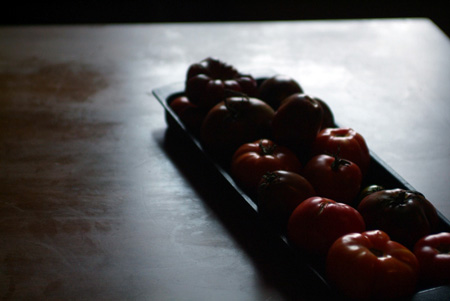
The ‘Variegated’ tomatoes (above) are really starting to show their colours now. I’m particularly pleased with this one and pleased that I decided to grow them again. As I mentioned in a previous post, the tomatoes themselves aren’t much to write home about, but what’s fascinating is that they do start out variegated just like the plant, and ripen to red. It’s quite a visual treat. I’m hopeful that the year I grew them previously was just a bad year for this variety and the tomatoes will surprise me this time around.

Photo by Gayla Trail  All Rights Reserved

This tomato plant looks really big already but is a ‘Black Seaman,’ a determinate (bushing) variety that grows nicely-sized slicing tomatoes if you give it a big pot. I’ve gone as small as a foot-deep but a bigger pot, if you’ve got it, will grow a bigger plant. My first experience with this variety was wishy-washy but it has since gone on to become a favourite. I never go a year without growing one and I always recommend it to container gardeners.

Photo by Gayla Trail  All Rights Reserved

Remember when the naranjilla were teeny, tiny little things? They’ve had a slow start, but the seedlings are starting to come along to a decent size. They are very hairy now and you can see the beginnings of little thorns that will eventually turn into nasty rose-like thorns at maturity. Here’s a reminder of what it looks like at full size. Ouch.

Photo by Gayla Trail  All Rights Reserved
The naranjilla’s cousin, Morelle de Balbis (Solanum sisymbrifolium) is also beginning to put out thorns. I have allergies to some hairy plants in the garden including beans (just the plants), sunflowers, and globe thistle. If I rub against these plants with wet arms, I break out in hives. Even at this tiny size the Morelle de Balbis is proving to be a hazard. I’ve felt some minor itches when accidentally brushing against it’s teeny little thorns. You can bet I’ll be exercising caution when this thing reaches full size and maximum thorniness.

It should make an excellent, although purely ornamental candidate for the street garden.

p.s. I took all of these photos with my cellphone; hence the weirdness.

What about you? How are your seedlings coming along?

Leave a comment

Miniature Daffodils

Photo by Gayla Trail  All Rights Reserved

I wandered lonely as a Cloud
That floats on high o’er Vales and Hills,
When all at once I saw a crowd
A host of dancing Daffodils

- William Wordsworth

I’m getting quite an education in narcissus this year. Although, not just in the botanical sense, come to think of it. Har har.

It seems that as I familiarize myself with the various types, sizes, shapes, and colours that are out there, my attentions have been turning more towards the teeny, tiny, diorama-sized daffodils, like this Narcissus juncifolius I came upon the other day growing in the rock garden section of the Montreal Botanical Gardens. These bright little flowers were one of the highlights of my trip and I spent quite a lot of time documenting them with various cameras.

According to “Gardener’s Latin,” the species name juncifolius refers to the leaves, which are thin and cylindrical like the a grassy rush, aka juncus.

Photo by Gayla Trail  All Rights Reserved

I offer you this photo of one of the flowers next to Davin’s thumb so that you can get a better gauge of their scale.

Tiny but eye-catching.

Leave a comment

Auricula ‘Pinstripe’

Photo by Gayla Trail  All Rights Reserved

I bought this adorable little Primula aricula ‘Pinstripe’ the other day at the Ontario Rock Garden Society sale. It was the one plant purchased there that I didn’t really need, but couldn’t bear to leave behind.

Photo by Gayla Trail  All Rights Reserved

I’m currently keeping it in a little hypertuffa pot I made years back (molded around a plastic drinking cup), until I can find a new spot for it. Ariculas have a very dedicated, if not somewhat obsessive following and I’m probably breaking all sorts rules and generally freaking people out by growing it in this way — and top-dressing with grit no-less. However, it’s my first and I’m thinking of this as a learning experience/experiment.

Overall, I’m very taken with it and will be sad when the blooms have finished.

Leave a comment

Pink Hepatica

Photo by Gayla Trail  All Rights Reserved

I didn’t intend to post another picture of hepatica, although I still have one more with pretty leaves to show. My sole purpose for choosing this photo today was so I could post the following two links to photos of really interesting hepatica varieties: 1 and 2.

I tried to select a favourite and couldn’t do it. So many incredible varieties! To think, I went from knowledge of a white flower with a few different leaf and flower forms, to colours, to discovering a whole new world.

Leave a comment

Tripod and Pea Staking

Photo by Gayla Trail  All Rights Reserved

Staking is one of those topics that I was sadly unable to cover in the Grow Great Grub book due to space considerations. I covered it pretty thoroughly in You Grow Girl and I have to say that years later, and having experimented with other methods, my go-to cheap and cheerful method both in the ground and in containers is still the tripod. I find it exceptionally stable, especially on my roof where the spring and later fall winds can turn epic. It is also the cheapest and most accessible — most of us can find a source of long bamboo poles close to home for less than a dollar per pole. I have even found the occasional multi-pack at the dollar store for even less.

    The tripod method is simply 3 or 4, or sometimes more, bamboo poles (branches work well too) set into the ground at an equal distance around a plant or within a container and then pulled together at the top and held in place with a strong piece of string or wire.

1cg_aug25.jpg

I have fashioned riffs on the tripod for tall plants and climbers including tomatoes, sweet pea, morning glory, pole beans, peas, and cucumbers. I add string or other supports depending on the type of plant I am growing. In 2007 I grew 16 tomato plants and several cucumbers by building 4 sets of 4 tripod stakes supported by 4 poles around the top as cross beams. The added support proved to be unnecessary and drove us nuts all season long as we continuously (and painfully) ran into those stupid cross poles with our necks and heads. A single indeterminate (vining) tomato plant was supported by each pole and I strung mesh along one side that supported the cucumbers and gherkins. You can read more about that over here.

p.s. That’s the ‘Variegated’ tomato in the foreground/left. You can just make out the white splashes in this small photo.

I have even made smaller versions using shorter poles to prop up heavily laden bush beans.

But I didn’t intend to talk about tripod staking today so I’m not sure why I am preambling with that. Today’s topic is pea staking. Of all of the easy, or what I coined “artfully lazy” methods in You Grow Girl, I like pea staking best, most especially when it comes to propping up it’s namesake: peas.

    Pea staking is as simple as locating a bunch of twiggy branches (messy end growth with plenty of small twigs and branches) and then setting them into the soil with the solid end down. Next, plant your seeds in and around where you have set them into the soil and wait for the climbing plants to hitch on and eventually cover the branches in greenery.

This method works both in the ground and in pots. While bare, it appears orderly and decorative in pots, but can just look like a bunch of branches stuck in the ground if used in a large, empty garden bed.

Photo by Gayla Trail  All Rights Reserved

Last year, while walking home from the greenhouse, I came upon a large bundle of bright red, freshly cut dogwood branches. I had about a minute to brainstorm projects I could make with them and whether or not it seemed worth the effort to drag that bundle all the way home. In the end I decided that the dogwood was beautiful and chances were good that I might never come across sidewalk gold like that again. I walked a treacherous gauntlet back to my abode, and despite nearly poking the eyes out of hundreds of hipsters and small children, I was right, they were worth it. I haven’t seen a bundle of any branches, let alone dogwood branches that nice since.

I used all of the branches up; some in big pots as below and smaller branches in smaller pots. They made the pots look like something was happening while they were empty, and the red provided a beautiful contrast with pale green pea plants as they entwined themselves in the branches.

Here’s how it looked when the peas were fully mature. I believe this pea variety is ‘Carouby de Maussane.’

Photo by Gayla Trail  All Rights Reserved

Leave a comment