Timelapse Video: A Day in the Life of a Pot of Herbs

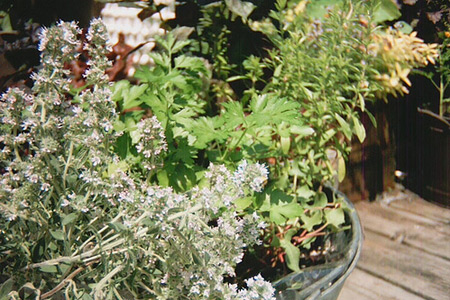
Yesterday, I made a timelapse video of the day in the life of one of the herb pots I am growing on the roof (1 pm – 10:30 pm). I choose to focus on the ‘Rose Petal’ thyme because it’s blooms were attracting a lot of tiny little bees and pollinators.

My favorite portion is around the 8 seconds remaining mark when the light has dimmed and the parsley plant begins stretching one of its leaves upwards.

Night time is red, rather than black because of the annoying security light next door that blazes through the evening and all through the night.

The video was made using a Plant Cam Digital Timelapse Camera (that I bought myself). I love it! Expect more videos in the future.

Leave a comment

Hanging Colander Lettuce Pot

Photo by Gayla Trail  All Rights Reserved

You are looking at one of this year’s serendipitous brainstorms. I feel perhaps a little bit too genius for coming up with it, when really, it’s just an enamel colander filled with ‘Sea of Red’ cutting lettuce and hanging in a wire basket. I quite like it. So much so that I haven’t had the heart to harvest it! Yet.

Here’s how this happy marriage came about. I had this heavy wire hanging basket sitting around, going unused. It’s the sort that is typically lined with coir, which is fine in most gardens but hard to keep hydrated on a hot and sunny roof. While, I’ve found it difficult to use as-is, I’ve kept the basket waiting for a new use to present itself. Despite the issue with hydration, stylishly understated and black hanging baskets made of a sturdy materials are hard to come by so I wasn’t about to get rid of it.

I bought the colander at a local secondhand store with the expressed purpose of growing greens in it. I liked the pairing of butter cream with bright red trim. The holes are small enough to hold soil without adding an extra liner, and the drainage they provide is perfect for growing small greens or herbs.

Photo by Gayla Trail  All Rights Reserved

Once I had planted up the colander, I thought it might be better served sitting up off the ground. Low and behold it fit perfectly inside the otherwise useless wire basket. As an added bonus our digging mammal visitors (squirrels, raccoons, etc) have not been able to get at it, while a second pot of ‘Sea of Red’ cutting lettuce has been dug up several times over the season.

Incidentally, I have experimented with this particular variety by growing the heads spaced at a distance from one another and tightly clustered as you see it here. I prefer it grown together and like the way the spear-like leaves create a literal sea of rich, mahogany that lights up when the sun hits it just so. It’s as satisfying to look at as any flower basket I have grown and I might even eat it for lunch sometime soon before the plants bolt.

Leave a comment

Repurposed for the Garden: Flag Highlighter

Photo by Gayla Trail  All Rights Reserved

When the folks behind this product sat down to envision a highlighter/post-it flag hybrid, I hardly think they knew they were creating a useful tool for gardeners. Students, office managers, and anal retentive note takers? They’re the obvious users.

But I’d bet they didn’t know that around about midwinter gardeners everywhere are kicking back with a cup of tea or a glass of wine, a stack of seed catalogs, a highlighter, and a brick of post-it flags. Preferably while lounging on the john, in the tub, or on long bus rides.

You’ve just made a mental note to avoid touching other gardeners’ seed catalogs in the future.

Or maybe it’s just me. And maybe only I think this is the best gardening tool there ever was! When I saw this in the store last night I didn’t care that I had already marked up most of the 2010 catalogs. I didn’t care that it probably just boils down to a convenience tool and that I could buy a larger quantity of post-it flags and a trio of assorted highlighters for roughly the same price ($4.25). This tool would revolutionize all of my future seed buying plans or just make me really happy while doing it.

And it has. I only wish I had splurged for the 3-pack so I could gift one to a friend.

Leave a comment

Repurposed for the Garden: Forceps

forceps_tool.jpg

The other day, while shopping in the plant section of the Montreal Botanical Garden’s gift store I came upon a long pair of forceps that a staff member must have forgotten, left sitting among the cacti.

In that moment it occurred to me, aha, yes, THIS is just the tool I need to help wrangle those spiny cactus creatures from one pot to another. No more evil, impossible to locate tiny daggers stuck in my fingers. The forceps could also be used to remove fluff and other debris from impossible to reach nooks and crannies in among the spines. I currently use a stiff bristle paintbrush but sometimes that only makes matters worse.

Yesterday afternoon I went to a surgical supply store to pick up boxes of tongue depressors for my forthcoming book launch party. No, we will not be checking your throat for swollen glands or your scalp for lice before allowing entry to the party! Although that does sound like fun.

I use the large tongue depressors as plant tags when I require a vast quantity for an event. They’re cheap at about $.03 each and can go into the compost bin at the end of the season.

While there, I perused the cabinet of surgical steel tools and low and behold, for 10 bucks they had the same type of 10″ forceps I was admiring at the garden shop.

It wasn’t my idea and I’m probably the last known gardener to come around to this, yet scoring the forceps somehow makes me feel like a bit of a genius and slightly more readied for a minor medical emergency.

If you’re looking online, I found this pair for half the price I paid.

Leave a comment

Let’s Learn About the Historical Origins of Herbs, Fruits and Vegetables

originsoffruitandve.jpg

Have you ever heard of sea cabbage, a wild cousin of the domesticated brassicas? Did you know that edible bananas are a primitive plant thought to be related to some of the first trees of the primeval forest?

I didn’t either until this weekend when I was finishing up an article on unusual vegetables and decided to fact check some long-ago gleaned historical knowledge against books in my personal library. What began as a quick check turned into a much longer read.

originsoffruitandve2.jpg

The first book I pulled out is called The Origins of Fruit and Vegetables by Johnathan Roberts (in case you’re wondering mine cost $22US, not $472 YIKES). I think I’ve had this book in my possession since it was first published in 2001, and while I have flipped through the pages of historical prints and food-based artwork more than once, I’m not certain of just how much I have actually read. If you’re interested in plant history and ethnobotany, this book is a great place to start. It’s not exactly a definitive tome on the subject but it’s a beautiful book that provides just enough insight to draw you into searching out more. It also gives you something to talk about in mixed company. Now if only they’d make a gardener’s trivial pursuit for geeks like me.

vanilla_herbal.jpg

Next week I am off on a month long journey to The Caribbean. As you can imagine I am extremely excited about food and plants. One of the plants I am most stoked about seeing up close and personal is the vanilla orchid. I have actually seen the vining plant growing in the greenhouse of a botanical garden, but I have never seen one growing outdoors and in bloom nor smelled the scent of its flowers. Or touched a green pod straight off the plant for that matter. Everything about the vanilla from its history to the process of growing and fermenting the beans fascinates me to no end. I found a book at a used bookstore last week that indulges everything one could want or need to know about vanilla. I plan to read it during the first part of my trip to get in the mood to see vanilla towards the end. Vanilla: The Cultural History of the World’s Favorite Flavor and Fragrance, written by Patricia Rain, the self-proclaimed Queen of Vanilla is indeed what I would call a definitive tome on the subject, covering everything including a sampling of interesting new ways to use vanilla in cooking. If the beans are affordable and customs allows me to bring some back, I plan to get a whole bunch as gifts for friends. I’d also like to try my hand at making homemade vanilla extract to give as gifts. I am after-all going to be visiting places known for both decent rum and vanilla production. I should be able to produce a quantity of excellent extract affordably. I think I’m going to need bigger luggage.

A third book, one that I have gone to many times and have even posted about here is Herbal: The Essential Guide to Herbs for Living by Deni Bown. I bought my copy back in 2002 after much deliberation. At $58.00 the book is not exactly cheap but I promise you it is worth the dough if you are curious about the historical background and usage of the herbs you like to grow or are seeking inspiration to try a few exotics. The book does contain some growing information but is not meant as a gardening primer. I’d suggest Exotic Herbs by Carole Saville, or New Book of Herbs by Jekka McVicar if you’re looking for more definitive growing considerations for a wide variety of common and unusual herbs.

Leave a comment