City Farming — New York Mag Article

In a recent New York Magazine feature entitled “My Empire of Dirt“, writer Manny Howard takes on the arduous task of growing a farm, complete with flora and fauna in his Brooklyn backyard to explore just what is involved in trying to feed himself locally for one month. The results are a humorous and slightly demoralizing mixed bag of mishaps, small rewards, freakish weather, and rabbit and chicken cannibalism which certainly makes for an interesting and sometimes horrifying read.

Eating local is expensive and time-consuming, which is why this consumerist movement will not easily trickle down into mass society. It requires a willful abstinence from convenience and plenty, a core promise of the modern world. Our bountiful era is predicated on the division of labor: We don’t sew our own clothes, we don’t build our own houses—and we certainly don’t farm—because we’re too busy doing whatever it is we do for everyone else.

The ensuing drama and general naiveté of the author would have left me rolling my eyes skeptically (it seems like every paper and magazine has a writer on board trying out these kinds of food-related ‘experiments’ lately) if he had not captured my heart just a little with his stubborn determination. In the end, the intensity of the experience left both he and his family with a hard won lesson in the value of good food and resolve to buy responsibly.

It wasn’t just a matter of buying regionally, or seasonally, or organically—the important thing was to consume responsibly.

I somehow doubt he will keep The Farm up at its current pace but I wonder if he will continue with the garden.

Leave a comment

City Razes Garden

I walked outside the other day, into the street garden with scissors in hand to clip some flowers intended for the host of a party I was attending. As I bent over to snip a few Black-eyed Susan stems I discovered that the flowers were completely gone. All that remained were the ragged ends of about a dozen torn stems. And so Operation Garden Terrorism continues. Sigh.

It turns out that despite the damage and attacks that have occurred this spring and summer, I’ve had it kind of easy. At least I have not found the entire garden gone as Scarborough homeowner Deborah Dale did when she returned home last week to discover that her entire front garden, filled with native plants, had been mowed down by City of Toronto bylaw enforcement officers! To make matters worse, Ms. Dale, a former president of the North American Native Plant Society, will have to pay for the “removal” of her 10 year old garden from out of her own pocket.


Image Source: Treehugger

Several other sites have already written about this event, and while I don’t have much to add to an already thoroughly explored discussion the thought that goes through my mind when thinking about this incident is the question of how we define a garden. The City of Toronto publicly promotes growing native plant gardens for environmental reasons but is seemingly confused about how to support the efforts of gardeners who break the mold of what a garden is supposed to look like — support that is especially needed in suburban areas where the lawn still reigns supreme. Ms. Duncan’s garden was leveled based on the complaints of her neighbors and was told that her native plant garden would have been protected had she applied to have her garden officially designated a “natural garden.” On the one hand it is good that at least The City is trying to address this idea of what a garden can be by providing a provision that has the potential to protect unorthodox gardens. Yet at the same time it seems slightly absurd and a little bit bonkers that a gardener would have to assume that their garden required protection from the biases of their neighbors in the first place and then have both the presence of mind and knowledge of the system to apply for that kind of protection in the first place.

Fundamentally how we define a garden and how we conceptualize a “carefully tended” garden comes down to our own subjective biases. And for better or for worse those biases are about as diverse as gardeners and their gardens.

To add insult to injury it The City is reportedly set to go after Ms. Dale’s backyard woodland garden next.

More Reports on This Incident:

Leave a comment

Food That Hardly Travels at All

rooftop_foodcontainers.jpg

A friend pointed me to this opinion piece in the New York Times that looks at the Eat Local concept as a way to mark environmental impact in food production. The article describes a New Zealand study that challenges the assumption that distance traveled automatically means higher fossil fuel consumption. The study doesn’t undermine the point that local eating advocates make but instead expands the way we are currently looking at energy use to include more factors that arise anywhere in the food production cycle including, “water use, harvesting techniques, fertilizer outlays, renewable energy applications, means of transportation (and the kind of fuel used), the amount of carbon dioxide absorbed during photosynthesis, disposal of packaging, storage procedures and dozens of other cultivation inputs.”

I’ve brought up this article here because although few of us as home gardeners are producing on a massive scale I see urban agriculture and growing food in our own backyards, on rooftops, community gardens, and waste spaces as a way to offset some of our own individual carbon input by eating about as local as it gets — literally stepping out our front or back doors to collect tonight’s dinner. And while that is awesome in itself I have noticed or at least pondered the impact my own small scale food production “systems” may have on the environment. While most of the “factor inputs and externalities” mentioned in the article do not apply to my style of food growing, there are other factors to consider. For example:

  • How much tap water do I use in my gardens?
  • What kind of packaging is used in products such as organic fertilizers, soil amenders, and container soiless mix? How is this packaging disposed?
  • Where do the ingredients in my container soils and amenders come from? For example, are any natural resources being plundered to provide the peat in my mix?
  • How far do these products need to travel in order to get to my garden?
  • What about the materials used to produce the containers I grow in? How far do they have to travel?
  • What about other materials used in the garden? i.e. Stakes, plastic ground covers, tools, etc?
  • What about the plants themselves? Are they high-impact energy suckers or are they suitable for this climate and the conditions that exist here?

Having looked at each of these factors I would say that their impact varies depending on the garden or type of garden. For example my community garden plot is in-ground and does not require things like purchased soil, and containers. I employ water-saving methods such as amending my soil, and applying mulch. It’s a fact that container gardens require more water than in-ground gardens and since I can not hook up a rainbarrel system to my apartment, the amount of water used directly from the tap is a whole lot higher than at my community garden plot regardless of how much I mulch the containers, employ water-wise tricks, use greywater, or run outside with buckets when it rains.

garden_aug07.jpg

I bought packaged soil amenders for the community garden this year and then transported them and myself in a cab from a local garden centre to the alleyway next to my plot. I don’t know where the amenders came from originally although I am hoping that since it was predominantly mushroom compost that it came from somewhere local — yeah it probably didn’t. So in the future I could look into where the amenders are from, buy amenders that are delivered to the curb without packaging, or rely soley on compost from the garden. Thankfully Davin and I have got more composters going at the community garden this year than ever before so that last one is very doable. I walk the bulk of my purchased soil amenders and container soils from the store to my gardens in a granny cart so no fossil fuel inputs there.

As far as containers and container soil goes I feel some relief in that I have been using the same containers and the same soil (with some supplementation of new soil, compost, and other amenders every spring) for several years and will continue to use them for years to come. Many of my containers are recycled items like dresser drawers found on the curb, broken watering cans and busted buckets or items purchased from thrift stores and yard sales.

While I don’t have a special calculating method set up to get a really accurate picture of how my gardens are doing against this sort of equation, through estimation I can guess that the food I grow myself is still generating a much smaller footprint than anything purchased at the grocery store. I’m not absolutely certain about how it holds up against much of the local produce I purchase weekly at the Farmers Market but I would guess that since I am doing a pretty good job of keeping most energy inputs low and adding in the fact that I walk or bike to both gardens and harvest everything by hand my total input has got to be lower still.

What about you? Can you think of any inputs I might be missing in this equation?

Related

Leave a comment

Blogher Conference

Are you going to be attending the Blogher conference in Chicago next week? If you are say hi. I’ll be moderating a panel discussion on visual blogging with a talented group of woman as well as doing a book signing (day and time TBA).

Here’s the scoop:

Blogging is More Than Words

Day One. 4:30pm

Many bloggers actually consider their online space a visual medium. Can the online rendition of your visual output really do it justice? What do visual artists get out of showing their work online? What about virtual collaboration? Gayla Trail moderates a conversation with bloggers Tracey Clark, Renee Garner, Keri Smith and Zoe Strauss, who are making the most of technology to further their non-textual art.

Comments Off

Domino Interview

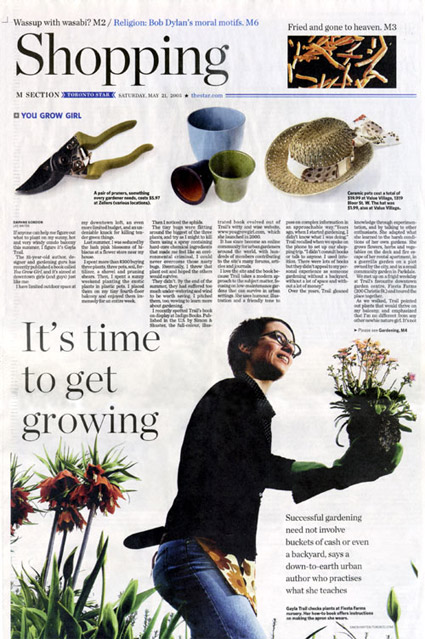
I don’t promote myself as an authority. I’m a person who really, really loves to garden. I know a thing or two but there is a ton I don’t know and will probably never know. I make mistakes. I experiment like crazy. I don’t have all of the answers, I don’t believe in that “right” one way to do things, I don’t have buckets of cash, a sprawling estate or a backyard even. There are a lot of people like me who want to grow something and that group of people have been mostly ignored by the gardening industry.

My interview with The Germinatrix (aka Ivette Soler) is up today on the Domino Magazine blog. This was a really fun and brainy interview — one of my favourites to date. Thanks Ivette!

Leave a comment