We Made a Pumpkin

Thanksgiving weekend has just passed in Canada, and even though I’m not big on the holiday, the one thing I do demand is a homemade pumpkin pie. Fortunately, we made a pumpkin this year. Accidentally.

Here’s how it happened. Back in the late spring, a friend gave us some unmarked transplants for the Yardshare Garden. A few of them were squashes, but at that size we could not yet tell if they were bushes or vines. We didn’t have any full sun spaces left, so we tucked one into a slightly less than sunny spot near the back of the garden. It wasn’t the best spot, and we knew it wasn’t the best spot, but we planted it anyways. I thought it still had a shot and felt it was worth the experiment to see what would happen when the growing conditions aren’t perfect, but not too far off of the mark either. I’ve learned a lot experimenting in this way. Probably more than I’ve learned doing things the right way. Some edible plants surprise you: they turn out nicely but their yield is lower. Others are just too unhealthy and succumb to diseases and pests they might be more resistant to in better conditions.

When we planted the squash, I assumed it was a bushing zucchini. It wasn’t.

And so it grew and grew rather quickly as winter squashes often do. And when it was threatening to take over the yard, I brought over a freestanding trellis I had woven from green branches in the early spring and we wound it up and off of the ground.

It looked pretty good for an unexpected plant stuck in the wrong space. We were all surprised when the plant grew a pumpkin and the critters that visit the garden didn’t get it. I’ve grown pumpkins (intentionally) several times, but keeping them going in community garden spaces that are overrun by mammalian critters is difficult. The trick is to find ways to protect the fruit when you aren’t there, which is most of the time. City critters are smart — they always break through my defences. Yet, here we were with a pumpkin that we didn’t intend to grow, had put in the wrong spot, and had made little effort to protect. Go pumpkin!

Unfortunately, it was a strange summer. It was unbearably hot and dry for weeks, then raining, raining, raining. Not the best conditions for a squash plant that was not in the sunniest spot in the garden. The plant quickly turned the corner from nice to unsaveable in the bat of an eye. Fortunately, by then the lone pumpkin had turned orange and was very near mature. Eventually the plant died back entirely and the pumpkin fell off of its own accord.

Here it is.
Read more…

Leave a comment

Air Potato

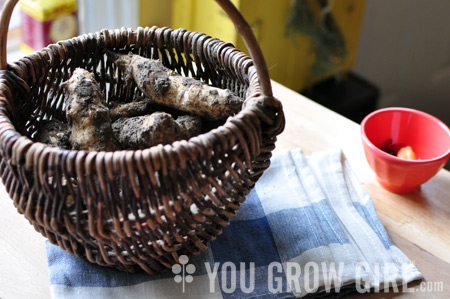
I was introduced to this “potato that grows above the ground” on an organic farm tour in Dominica. It was one of the plants we were most excited about, but because we only got the Patois name (and it turns out I heard that wrong, too), were never able to identify it. Davin and I spent hours searching various spellings, and even guessed at what it could be (a yam) with no luck.

And then just like that Davin found it! Dioscorea bulbifera, aka “air potato” is an African yam (of course) that produces potato-like bulbils along the vining stems. There’s quite a bit of controversy around the plant because not all varieties are considered edible. Many uncultivated forms are very bitter if not poisonous, and there is some debate about how to prepare it to make it safe.

The plant is currently considered an invasive threat in warmer parts of the United States. It’s a very fast-growing vine that can grow up high into large trees and disperse itself easily via the bulbils.

For all of these reasons, the air potato is one weird edible that I would advise against growing.

Leave a comment

Spotlight on ‘Trionfo Violetto’ Pole Beans

Photo by Gayla Trail  All Rights Reserved

Back in June I wrote in my Globe & Mail column about growing beans. Within the piece I mentioned a favorite pole variety ‘Trionfo Violetto.’ It’s been years since I have grown this particular variety and now that the plants are in full swing and producing a little crop of beans daily, I can’t understand why I had set it aside and turned to other, inferior varieties for so long.

Photo by Gayla Trail  All Rights Reserved

First are the dark, pinky-purple flowers depicted in the photo, above. And the way they are set off against the green foliage with a hint of burgundy that almost seems to be applied with a water-color brush.

Photo by Gayla Trail  All Rights Reserved

All of this accented against slender, dark stems, and long, thin, purple beans that are delicious fresh off the vine. I can buy all manner of green beans at my local Farmers’ Market, but the French fillet-style beans are less popular and cost a small fortune.

Stunning, prolific, and delicious. Next year I will double my planting efforts and stop trying with other less interesting varieties.

Photo by Gayla Trail  All Rights Reserved

Leave a comment

Seasoning Peppers

Photo by Gayla Trail  All Rights Reserved

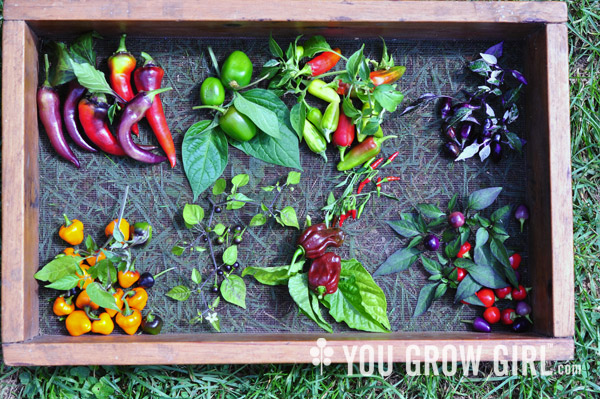
In the Caribbean, that’s what they call peppers that look like hot peppers but aren’t. Although, I have also heard the term used with hot peppers, too. I suspect they really are hot, just not by West Indian standards. All of these were hot, let me tell you, and incredibly aromatic. But hot, ho yeah, at least by my standards.

There was a time when I took pride in my ability to withstand the hottest hot peppers, but those days are long gone. My nearly middle aged digestive system would rather not, thank you ever so much and good night. I like growing hot peppers, and it is always fun to discover a new variety, but these days I enjoy them in small doses.

The green peppers in this photo were a gift from Stevie, Not Wonder. The little peppers were found growing on a bush behind our cottage. The rest were collected here and there. Pepper bushes are fantastically huge in the Caribbean heat. They grow on and on into perpetuity and are not hard to come by.

Leave a comment

Growing Sweet Potatoes in a Bag

Photo by Gayla Trail  All Rights Reserved

My most recent Globe and Mail Kitchen Gardening article is on sweet potatoes and chronicles an experiment I took up by chance, growing sweet potatoes in a shopping bag.

While in Dominica I learned that when there is not enough soil fertility to produce tubers, sweet potato leaves are cooked or steamed like spinach. I haven’t tried it yet, but think this would be a good option when starting the plant too late in the growing season. I have some slips on hand right now that I might plant for this reason.

Read more…

Leave a comment