‘Gezahnte’ Tomato

Photo by Gayla Trail  All Rights Reserved

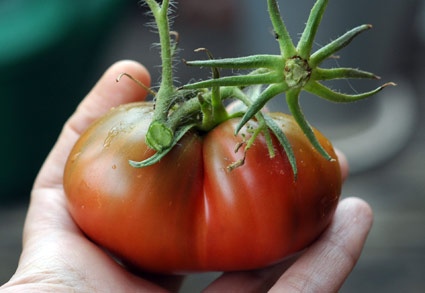
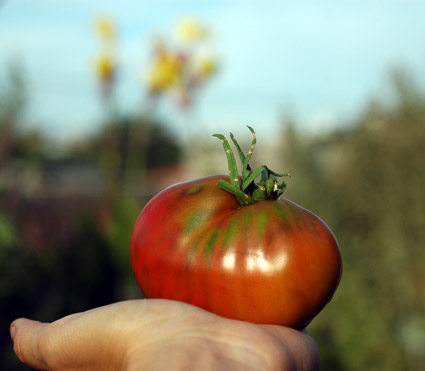
Behold, the first of the non-cherry, indeterminate tomatoes that has reached maturity for 2009. And it’s a beauty. Incidentally, I’ve managed to grow several ruffled tomato varieties this year purely by happenstance. Well, that and the fact that I have a very obvious preference for that shape.

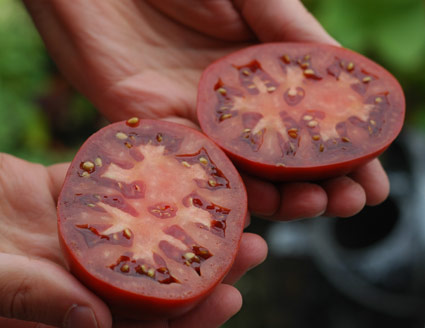
I’m yet to try it out, but I believe this tomato is a stuffer, which means it is fairly hollow on the inside and great for stuffing with veggies and rice and baking in the oven. I’m waiting for another to ripen so it can be put to the test.

Photo by Gayla Trail  All Rights Reserved

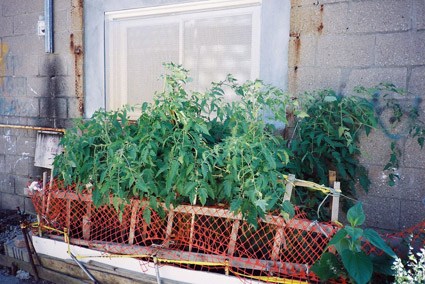
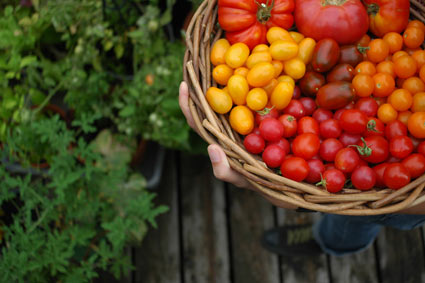
And this is where I admit that my rooftop, container-grown tomatoes are doing pretty well this year despite the troubles that most in-ground gardens are facing with so much rain and cool weather. Don’t hate! These are the sort of conditions under which rooftop and container gardens have the upper hand (finally). I can regulate excess water, I rarely have to pull out the watering can to keep things moist enough, and the garden is warmer than gardens on the ground because it’s up high and exposed. In a typical year I am fighting the excess heat, sun, and drought but this year is almost too easy.

Leave a comment

‘Mini Purplette’ Onions

Photo by Gayla Trail  All Rights Reserved

Every year I go a little nuts growing large crops of onions such as ‘Egyptian Walking’ over at my community garden plot.

Onions grow easily in the ground, but they tend to take up a lot of space in containers. In the past I have grown smaller, bunching onions in pots as a way to have the odd onion on hand without wasting the kind of space that could be dedicated to coveted crops like tomatoes and basil. I like onions well enough, but nothing, not even a batch of slowly caramelized onions is coming between my mouth and a caprese salad.

Photo by Gayla Trail  All Rights Reserved

Speaking of which, I made my first caprese salad of the season last night.

But I’m always on the lookout for something different to try, just in case. In the early spring I nabbed a pack ‘Mini Purplette’ onion seeds with the promise that I would have bulbous, miniature yet mature red onions come late summer. [I got mine from Urban Harvest however, Seeds of Change has them in the U.S.]

Photo by Gayla Trail  All Rights Reserved

And sure enough, this afternoon I reached my hand into the soil of a medium-sized pot and discovered several round, golf ball sized red onions.

Photo by Gayla Trail  All Rights Reserved

I’m very pleased with them and plan to grow more next year. I grew mine in fairly deep containers (about 10″) but am absolutely certain they would size up well in a window box. In fact, I would like to see that — several little onion tops neatly lined up in a row.

Or not. Because really, who am I kidding? My gardens are anything but neat.

Leave a comment

Grow Great Grub

Photo by Gayla Trail  All Rights Reserved

As I mentioned earlier today it’s been a L O N G year. Actually, it’s been a long year and a half. Or two years. Where am I?

I’ve mentioned it briefly here and there but was finally given the go-ahead today to speak freely(ish) about the main project that has been taking up so much time over the last… very long while.

A NEW BOOK!

I’ve been busy making a new book and this time it is all about my biggest gardening love, growing food in small spaces. The book is called “Grow Great Grub: Organic Food from Small Spaces” and is published by Random House/Clarkson Potter.

I’m really excited about this one. Not just because the topic is so specifically near to my heart and where I most find joy in my own small garden spaces, but because I’ve changed and grown in the years since I made “You Grow Girl” and I think this book reflects that.

This new book has lots of pictures, most especially lots of BIG pictures, all taken by me with a few exceptions. It also has a much more gender-neutral design, which I think will take away the small embarrassment some felt in carrying book number one out with them in public. HA! As a funny aside, when the first book came out many people asked if that was me illustrated on the cover. I replied many times that while the woman sort of looks like me back when I had long hair, it wasn’t really meant to be me.

Besides, I would never garden in a crop top. EVER. The end.

This time it really is me on the cover. And my real plants. And my pickles. Delicious pickles. I can’t wait for you to make those pickles. Why is this suddenly reading like a euphemism? I swear, sometimes pickles are just pickles.

Unfortunately, the wait is long. Grow Great Grub will be officially released in February 2, 2010 (I keep joking that the aliens will have arrived by the time this thing sees the light of day), but it is available for pre-order from several online booksellers (and at sale prices too!) in the meantime. Once I’ve had some time to decompress from the long and harried writing/making portion of this endeavor, we’ll begin work on rolling out the details. My sweet, patient, and also very exhausted partner Davin (also my partner in designing and illustrating the book) has put together a quick micro-site and will be helping me build a bigger site soon.

Serendipitously, the book launch will coincide with You Grow Girl’s 10th anniversary so I’ve also got some fun events and whatnot in the works for next spring. Stay tuned and thanks for riding it out with me!

Leave a comment

Mid and Late-Season Planting

My latest Globe and Mail Microfarming article came out on Saturday. I’ve included the text below.

My editor sent a photographer out this time so there are some pictures in the printed version not taken by me, and one of me planting arugula online. I didn’t lay chickenwire over the flat as protection after planting, and that night the raccoons dug it up. They’ve been busy diggers this summer! What are they looking for?

————–

The time is ripe for mid-season planting

A gardener friend recently gave me a few pinches of wild Italian arugula seed, Rucola selvatica, the most fantastic arugula I have ever seen or tasted. The leaves are peppery and pungent yet delicate, unlike the hairy self-seeder I inherited at my community garden plot from its former resident. I can’t wait to grow those seeds into salads; fortunately, I don’t have to wait until next year to get started.

Contrary to popular belief, spring is not the only season for planting. In fact, arugula is one of several crops that actually prefer conditions at the end of the growing season, when the climate shifts to progressively cooler temperatures.

By contrast, trying to grow arugula and other tender, leafy greens as the summer heat rises is an exercise in futility. The leaves grow bitter and tough (if they grow much at all) and the plants rush to produce seeds like their life depends on it.

And that’s because it does. Just like us, plants get rather antsy about procreating before their time comes. Living with the stress of heat and drought signals cool-loving plants to get on with the business of reproduction sooner rather than later. Root veggies suffer a similar fate. They go straight to the flower-making stage, completely skipping the part you want most, the bulbous root.

The good news is that the end of summer isn’t the end of the gardening season but the beginning of another chance to reap further rewards from your garden before the year is out.

When to sow a late-season crop depends on how long that plant takes to reach maturity. To begin, check the number of “Days to Harvest” listed on the back of the seed packet. For example, arugula takes about 40 days. Tack on a week or two to the total time to account for the slower growth rate of plants as the days and nights get progressively cooler. Next, calculate the sow date by subtracting the total number of days from the “First Frost Date” for your region (www.almanac.com provides listings).

Fast-growing lettuce, spinach, chard, radicchio, endive, mâche and mustard greens can be sown into September or later if you’re on the West Coast. Broccoli, kale, cauliflower, cabbage, turnips, kohlrabi, Brussels sprouts, collards, peas, beets, carrots, parsnips and radishes love the last half of the growing season. When to sow varies wildly among veggies, so calculate individually.

Sow annual herbs including basil, cilantro, pansy and viola seeds right now. Better yet, speed the process up and double your bounty by taking cuttings from basil, mint, oregano, rosemary and other herbs that sprout roots easily in a glass of water.

Early fall is also one of the best times to make a permanent home in the edible garden for hardy perennial herbs, fruit bushes and trees. The cooler season is much more forgiving on new transplants and gives the roots a chance to get established before the winter forces the plant into dormancy. It just so happens that most garden stores are eager to get rid of their stock in the fall. Take advantage of end-of-the-season sales to get big discounts on oregano, marjoram, thyme, sage, sorrel, mint, blueberries, strawberries, currant bushes, grapes and apple, plum, peach and pear trees. While the bounty will be meager to nothing this year, you’ll get a bumper crop of fresh herbs in the earliest spring straight through to the following winter and beyond.

- Originally printed in The Globe & Mail (July 25, 2009)

Leave a comment

Your Questions Answered: Watermelon Radish

Photo by Gayla Trail  All Rights Reserved

Question: I am in South Mississippi and my Mother wants to know where you get the pink watermelon radish seed and how she can get some? – Betty

Hi Betty,

Watermelon radish are a fairly unknown winter radish that are beginning to gain popularity. The seeds themselves aren’t particularly easy to find; however, the radishes have begun to show up in farmers’ markets. Look for them in the fall.

While chances are slim that you’ll be able to buy seeds at your local garden shop, they are readily available online. Search for them by one of their many names, including: Red Meat radish, Beauty Heart, Chinese Red Meat, Asian Red Meat, Watermelon radish, Rose Heart, Misato radish, Xin Li Mei (心里美), Shinrimei, or Roseheart.

I found my pack of seeds back in the spring at a local seed sale. The company I purchased them from, Greta’s Organic Gardens is Canadian and located in the Ottawa area. I’m pretty sure they ship to the U.S.

A few other online sellers include:

Back in the spring, I mentioned in an interview that I would be growing these radishes for the first time this year. What the interview doesn’t include is that ‘Watermelon’ is a large, winter radish that does not fair well in the spring. The best time to start them is in the late summer/early fall as the days grow cooler. There’s still lots of time to order seeds and get on growing a crop this year!

Oh, and if you’re wondering how to eat them, the flesh inside is deceptively sweet and tender. We eat them raw, just like a regular radish, but chop the harder skin off first. We also grate or slice it thinly on top of salads, and they also taste yummy pickled.

Leave a comment