Italian Edibles

I have begun to purchase seeds for the 2011 growing season, and because I now live in an Italian neighbourhood, I have easy access to Italian edibles. The above photo represents my first, in-store (as opposed to online), impulse seed purchase of the year.

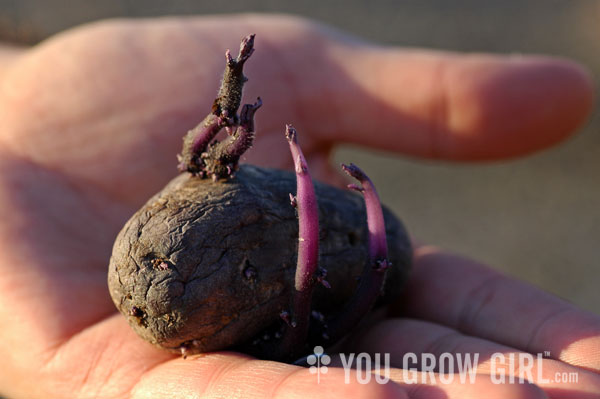
Most of the seeds I bought were varieties of radicchio (Cichorium intybus) aka cicoria, or cultivated chicory. I have grown a few varieties over the years, but was inspired to purchase seed and try out a few more by a recent trip to my local Italian grocer, where I purchased two varieties I had never tried before. The one on top is ‘Rosso di Treviso’ and ‘Catalogna Puntarelle di Galatina’ the bottom is (more info on both to follow).

Radicchio is a bitter green and an acquired taste so it is not as popular in the home garden as it could or should be. Not only are the colourful heads a beautiful addition to the garden, but the plants are perennial, although I have found the second season harvest are sometimes more bitter.

Here’s what I bought the other day:

Radicchio ‘Triestina da Taglio’ – This is described as a cut and come again variety. I have sown other radicchio varieties thickly and grown them in a cut and come again fashion, but it was interesting to find a variety that is especially suited to it. The leaves are green and not particularly exciting, but perhaps it will make up for what it lacks aesthetically in flavour.

Chicory ‘Catalogna Puntarelle di Galatina’ – Large, dense, segmented heads that remind me of conjoined spears of asparagus, with dark, indented, dandelion-like leaves. Very bitter. Over the weekend I prepared it by thinly chopping the whole thing fresh, with a splash of olive oil and lemon juice on top, a dash of Balsamic vinegar, and a pinch of salt. I also tried roasting it whole in the oven, and ate it plain. It was equally good this way, but in the future I think I will reserve young, newly harvested plants for eating fresh.

Radicchio ‘Rosso di Treviso’ – Apparently, there are two types. The one I bought to eat from my local Italian grocer is ‘Precoce’, but the one I bought as seed is ‘Tardivo.’ The latter is said to be the tastier of the two, but I would prefer to grow the first as it is prettier, and I am sometimes too vain about the edibles I give preference to in the garden. Here’s a great article that says much more than I can about the history of the plant, including links to recipes worth trying.

Radish ‘White Tip’ – I have a hunch that this is just another name for a variety called ‘Sparkler’ that looks like a round ‘French Breakfast.’ This is a great short variety, suitable for container growing.

Cucumber ‘Carosello Barese’ – They are described on the package as a hairy cucumber that is crunchy and fresh on the inside, but I found this site, where the author suggests that it may be a melon, not unlike the Armenian cucumber that is eaten as a cucumber (Cucumis sativa), although botanically a melon (Cucumis melo). This should prove to be an interesting addition to the garden, and I look forward to growing, and eventually tasting it.

Leave a comment

Growing and Eating Cardoon

My final Globe and Mail article for the 2010 growing season was on growing and eating cardoon. Cardoon is lesser-known relative of the artichoke that is considered a delicacy in Mediterranean cuisine. Like artichokes it grows into a stately and somewhat dangerous thistle-like plant, but unlike artichokes you eat the stems, not the flower buds. It tastes a lot like artichoke, too.

Back in the spring, I started a few cardoon plants from seed, eventually growing one in my community garden plot and the other at my friend Barry’s.

His spot was ideal, whereas mine fell a bit short. My cardoon grew well enough, but stayed small. The plant at Barry’s got just want it needed and then some. It was really sunny, warm, protected, and in soil that was well watered but very free-draining. Mine was in rich soil with lots of organic matter, but watering was inconsistent (we ran out of water at the garden for a time), and the only spot I could afford was a bit cramped with a taller, more robust plant that shaded out the young cardoon a bit too much.

Last weekend we finally went to Barry’s to harvest the cardoon. It turned out to be the biggest I have ever seen. The yield from one plant was a lot more than I’ve seen in stores or purchased myself. We actually got enough out of it to make 2 batches of cardoon gratin (see recipe below), whereas a typical stalk yields only one.

Many cardoon growers say that going to the trouble of blanching the stems is unnecessary, but now that I have done it, I disagree. For such a large and fibrous plant the stalks we blanched were tender and delicious. I didn’t have to overcook them the way I’ve had to with some of the bunches I have purchased in the past.

I stick by my original assessment. Cardoon is a bit of a pain, and an absolute nightmare to prepare and cook, but it is a stunning plant and a delectable, but acquired taste. What can I say? Some of the best things in life don’t come easy.
Read more…

Leave a comment

A Glut of Green Tomatoes

When it comes to dealing with an end of season garden glut I have one rule: everything roasted. I am yet to find a vegetable or fruit that doesn’t benefit from this treatment. I thought I’d tried it all and there were no more surprises left. I was wrong.

Last weekend I pulled out almost all of our tomato plants in all three gardens. I left in a few that had fruit that had some hope of developing a bit further before it gets too cold. There’s green tomatoes and there’s green tomatoes that are too green. I prefer to try and get them as developed as they can be before packing it in for the year. And before anyone mentions the hanging the plant upside down indoors trick; I simply don’t have the space. My neighbor tolerates a lot of my little gardening eccentricities in our shared hallway space: overwintering plants, bags of soil, stacks of terracotta pots, jars of tomato seeds…. For the record, he keeps a life-sized cutout of John Wayne in that same shared space. It was there a good month before I stopped suffering a miniature heart attack every time I walked into the hallway. For that reason alone I think we’re fairly even, but full-sized tomato plants hanging from the ceiling might be pushing things too far. I know where the boundaries of social decorum lie and I try to respect them. Most of the time.

But I digress. As I always do. Back to the tomatoes. In short, I have a lot of them and am in the process of making my famous green tomato chutney as I type this [ed. I wrote that a few days ago. The chutney is done and I have already given half of the jars away as gifts!). I did not intend to can them this year; I just don’t have the time. It’s funny how you can forget what 2 pounds of chopped tomatoes plus miscellaneous ingredients looks like until it is there in front of you. I had it in my head that I could just make it and stick it in jars in the fridge rather than canning. I do not have a fridge that big or the appetite to eat it all quickly enough. So canning it is.

Unfortunately, (or fortunately depending on how you look at it), one batch does not take care of all of the green tomatoes I’ve harvested. What to do with the rest? I love fried green tomatoes, but that’s a lot of fried stuff. I’m spending an inordinate amount of time sitting on my ass these days. The only part of my body getting exercised are my typing fingers. I do not need to introduce several pounds of fried tomatoes to my digestive tract right now.

And then I remembered my glut rule: everything roasted. I adore roasted tomatoes but had never tried roasting green tomatoes. If green beans are delicious roasted with a drizzle of olive oil and a pinch of salt then surely green tomatoes would benefit from the same treatment?

In conclusion: they do and then some. It’s a revelation!

Instructions are simple:
Read more…

Leave a comment

Variegated Arugula

Perhaps it is because I have a penchant for the weird and the unusual, or maybe it’s because I just think it’s pretty, but I seem to have a strong affinity for variegated plants. It doesn’t matter what it is, if there is a variegated version, I must have it.

Well, that’s not entirely true. Some variegated plants have an unhealthy, diseased appearance that is unappealing. Sometimes a sickly look is more than aesthetic. Variegation in plants can occur when cells get confused, causing a mutation that results in a lack of chlorophyll or certain pigments. Sometimes this happens spontaneously but disappears, and at other times it keeps going and spreading as the plant continues to grow.

Some variegated plants can be difficult to keep alive, especially when they produce foliage with no chlorophyll at all. I see this with my variegated citrus trees fairly often. The parts with little to no chlorophyll tend to be weaker than other parts of the plant and more susceptible to problems with pests. Watch your plants and see for yourself. But it’s worth the hassle. I love watching the way the new leaves form. It’s exciting to see what will happen next. With regular plants you always know what will come next, unless of course a spontaneous mutation occurs. A little surprise from nature.

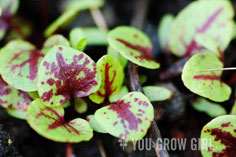
The other day, Davin discovered variegation in some of the arugula aka rucola selvatica (Diplotaxis tenuifolia) growing at our Yardshare Garden (photo above). It’s so pretty! We’re very excited about it, but also feel a bit out of our depth and unsure about how to go about maintaining and even encouraging it to spread. I have never seen or heard of variegated arugula before, and am doubtful that we can get it to stabilize. Most of these sorts of spontaneous mutations revert back to green. It’s obviously in the plant’s best interest to do so.

I checked on the plant last night, and the variegated stem has flowers on it. We’re going to let it go to seed and see what happens when we plant it next year. Probably nothing, but it seems worth a shot. The best way to isolate variegation is by taking cuttings, but I have to admit that I’ve never tried taking cutting from arugula before. It’s so pervasive in the garden and easy to grow from seed, I’ve simply never had reason to.

Fortunately, this particular crop has proven to be very cold hardy. Some of the plants in that section have been growing since last year and seemed to overwinter with no effort on our part. Chances are that we’ll see this again next year.

Either way, this has become a fun diversion and a nice excuse to dip into the more scientific side of gardening for a change. If you’re interested in this side of things like I am, I suggest “Botany for Gardeners” by Brian Capon. It doesn’t say much about the topic of variegation, but there is lots of information about how plants develop and evolve, all presented in a way that is understandable to gardeners with no more than high school level science.

Have you noticed any spontaneous variegation on your plants?

Leave a comment

We Made a Pumpkin

Thanksgiving weekend has just passed in Canada, and even though I’m not big on the holiday, the one thing I do demand is a homemade pumpkin pie. Fortunately, we made a pumpkin this year. Accidentally.

Here’s how it happened. Back in the late spring, a friend gave us some unmarked transplants for the Yardshare Garden. A few of them were squashes, but at that size we could not yet tell if they were bushes or vines. We didn’t have any full sun spaces left, so we tucked one into a slightly less than sunny spot near the back of the garden. It wasn’t the best spot, and we knew it wasn’t the best spot, but we planted it anyways. I thought it still had a shot and felt it was worth the experiment to see what would happen when the growing conditions aren’t perfect, but not too far off of the mark either. I’ve learned a lot experimenting in this way. Probably more than I’ve learned doing things the right way. Some edible plants surprise you: they turn out nicely but their yield is lower. Others are just too unhealthy and succumb to diseases and pests they might be more resistant to in better conditions.

When we planted the squash, I assumed it was a bushing zucchini. It wasn’t.

And so it grew and grew rather quickly as winter squashes often do. And when it was threatening to take over the yard, I brought over a freestanding trellis I had woven from green branches in the early spring and we wound it up and off of the ground.

It looked pretty good for an unexpected plant stuck in the wrong space. We were all surprised when the plant grew a pumpkin and the critters that visit the garden didn’t get it. I’ve grown pumpkins (intentionally) several times, but keeping them going in community garden spaces that are overrun by mammalian critters is difficult. The trick is to find ways to protect the fruit when you aren’t there, which is most of the time. City critters are smart — they always break through my defences. Yet, here we were with a pumpkin that we didn’t intend to grow, had put in the wrong spot, and had made little effort to protect. Go pumpkin!

Unfortunately, it was a strange summer. It was unbearably hot and dry for weeks, then raining, raining, raining. Not the best conditions for a squash plant that was not in the sunniest spot in the garden. The plant quickly turned the corner from nice to unsaveable in the bat of an eye. Fortunately, by then the lone pumpkin had turned orange and was very near mature. Eventually the plant died back entirely and the pumpkin fell off of its own accord.

Here it is.
Read more…

Leave a comment