Extending the Harvest

Photo by Gayla Trail  All Rights Reserved

This piece was originally published in The Globe & Mail over the weekend as a part of my series on kitchen gardening.

Regarding using burlap and burlap sacks: Just to be clear, do keep them away from the crowns of your plants since they can get awfully heavy when wet. In fact, they are best used over the winter to prevent the erosion of large, open patches of soil from which annuals have been removed. Even better still, place the dead plant matter (browns) and some kitchen scraps (greens) underneath the burlap and you’ll have fresh compost on the spot come spring.

———————–

I love a fresh, crisp fall day. Many of us would agree that it would be the best season of the year if not for the fact that it is a stepping-stone to the inevitable: winter.

Who knows what this fall will bring given the wacky weather hijinx we’ve experienced this year. But let’s pretend for a moment that everything will go as planned and there won’t be snow sprinkled on the peppers tomorrow morning (please gods). We can’t control the weather or stave off the inevitable, but as gardeners there are a few methods we can employ to hold back the effects of seasonal change and keep the party going just a wee while longer.

You’re already one step ahead if your garden is a raised bed. They warm up slightly early in the spring and tend to stay warmer as the fall cools down. A thick layer of mulch such as straw, buckwheat hulls, or shredded newspaper keeps the soil and surface roots warm through nippy nights and breezy fall days. An actual blanket made of burlap gets the job done too, but can get awfully heavy when wet so be sure to cut big holes to keep it off the crowns of plants. An even better blanket still is black plastic. The dark colour attracts the sun’s rays and the plastic holds moisture through fluke fall droughts.

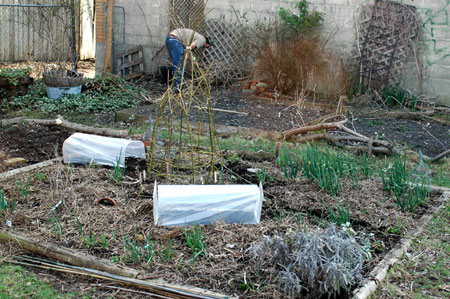
In lieu of cumbersome blankets, which can be difficult to maneuver in small spaces, or used alongside them, are an assortment of store-bought and homespun contraptions that can be fitted over individual plants or entire beds to trap warm air and create the effect of a miniature greenhouse. Hoop houses are toasty-warm tunnels made of metal or plastic hoops draped with a clear plastic tarp that let’s light in and keeps warm air from escaping. You can buy them ready made from garden suppliers such as Lee Valley or make your own inexpensively using bendable metal shaped into arcs or dollar-store hula-hoops cut in half. Push the arcs into the soil intermittently to support the length of the tunnel and cover with a big sheet of plastic. Secure the plastic in place by stapling to the sides of raised beds or with clips purchased at the hardware store.

Greenhouses made to cover individual plants are called cloches. Fancy glass cloches are nice to look at but expensive at about $30-40 a pop! Never mind, you can make as many as you like in a variety of sizes for free from plastic water bottles rescued from the recycling bin. Simply cut off the bottom and set the cloche over tender greens or frost-sensitive plants you’d like to keep in the garden just a little bit longer. Keeping the cap in place locks warmth inside, or you can remove it to water your plants and let heat escape on particularly sunny days.

Cold frames are the way to go if you’d like to get a shot at keeping particularly cold hardy greens such as mâche, kale, spinach, and arugula producing food straight through into the winter (and beyond). It’s really nothing more than a low-tech box with a hinged glass or plastic lid. The trick is to dig the box at least a few inches into well-draining soil and give it a south-facing position. Open the lid when it gets too hot, and insulate both the sides and top with newspapers, straw, and old burlap sacks when night temperatures drop below freezing. They’re not exactly practical when growing up on a roof or in pots but compact versions set on top of a planter box will ensure at least a few extra homegrown salads this fall.

Leave a comment

Special Order for Comfrey

Photo by Gayla Trail  All Rights Reserved

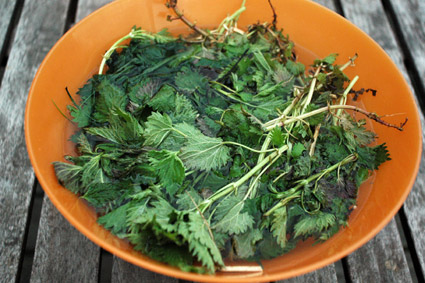
I recently wrote about the nutritional benefits of mulching and fertilizing with sea kelp. A commenter mentioned using comfrey, to which I replied that I am a big fan of comfrey as a fertilizer and would recommend it as a mulch, although I would suggest chopping it up or drying first since the leaves are very large and would form a dense mat when wet.

Comfrey is definitely worth growing as a ready made source of potassium, magnesium, and phosphorous if you’ve got the space. The trouble is it is awfully aggressive and will take over where ever you plant it, and then some. This is why I don’t grow it. I do however, have a secret location where I go every year to harvest a bit to make into liquid feed. That was until this year when I went to harvest from my secret stash and discovered it was no longer accessible. Noooooooo……

The tally so far: Summer is too wet and too cold, the tomato harvest is mostly crappy, and I can’t get any comfrey. The horrors.

But then, a happy turnaround. The other day I ran into a fellow forager/gardener. The subject of nettles came up which lead to comfrey and my recent loss. She mentioned that the farm she works for has a huge patch of comfrey that they use for making their own fertilizer. All I had to do was pay for the time it takes her to pick the leaves. Two days later I rode over to a local market and picked up a big box of comfrey. And while it did rain briefly, Monday was oppressively hot and humid so I stopped at the hardware store on the way home and bought a fan for my office window. Then I balanced a box of comfrey and a fan on top of my bike basket and walked it home because I am not adept enough to ride while balancing both, unlike those dudes you see balancing a twenty-four case of beer (we call it a two-four around these parts) on top of the turned around handlebars of their 10-speed with one hand and a six pack dangling from the other. While I’m on the subject of death-defying balancing feats on a bicycle, I once saw a guy balancing a massive rug on the handlebars while riding. On another occasion, I witnessed a guy with a TV, although that didn’t work out and the TV smashed onto the road.

And that, friends, is the story of the week summer finally arrived (we’ve had sun AND heat for days!), hope returned for our tomatoes, and I got my comfrey. Things are looking up.

Photo by Gayla Trail  All Rights Reserved
1. Chop up the comfrey with a pair of sheers or scissors and soak in a tub of water. I put a brick on top to hold it all underneath the liquid. 2. Let it sit for a day or two until it gets stinky and the leaves are broken down. 3. Strain off the leaves and put them in the compost bin or bury them in the garden. 4. Use the remaining liquid as a fertilizer by spraying on the leaves of your plants or pouring into the soil around the roots.

Leave a comment

How to Compost and Reduce Waste

Photo by Gayla Trail  All Rights Reserved

Since The City of Toronto is week three into a city workers strike that includes garbage collection, it appears (see above) to be a very good time to reintroduce some resources on small space composting.

One sure-fire, easy way to compost that I haven’t included here is to dig a hole. Yes, like the infomercials say, It is that easy! Dig a deep hole, put the scraps into the hole and cover it over. Done. Dig a really deep hole if you plan to bury crab and shrimp shells, fish parts, or anything that might attract vermin. Your plants will love it!

In lieu of digging a hole, I present to you these other very viable options:

Leave a comment

Handy Garden Tip: Hair Bobble Tomato Tie

Photo by Gayla Trail  All Rights Reserved

A friend gave me a pack of these “I Double Heart Jesus” hair bobbles years back and I’ve been trying to find an excuse to keep them ever since.

I lived the bulk of my life with long hair until I cut it all off around age 30. Chances are good that I’m well over the long hair phase. Say in the future I did fancy long hair again, would I really tie it back with “I Double Heart Jesus” flower-shaped hair bobbles? While pushing 40? And not attending raves or under the influence of any drugs whatsoever?

Never say never, I suppose.

I’m on a Get Rid of it All bender lately, which is oddly corresponding with a Must Preserve Everything bender. So basically I’m casting things aside and hoarding simultaneously. There’s a paradox. When I’m not spending my free time canning, I’m digging through drawers and closets searching for items to purge.

And then I came upon the “I Double Heart Jesus” hair bobbles. Stay or go? They can stay, but only with the provision that they serve a purpose.

And that is when it occurred to me that a hair bobble would make a simple to add and remove tie (just pop it on and off) for my growing tomatoes.

Some would be horrified. Some would say I am cluttering my garden with junk (too many pieces of flare!) and should stick to tasteful ties such as carefully knotted lengths of jute or quietly camouflaged pieces of green wire. I like those too, but right now, I’m enjoying the giggle I get whenever I spot an “I Double Heart Jesus” flower-shaped hair bobble while watering or tending to my plants.

One can’t always practice good taste. It can get a bit dull.

Leave a comment

Happy Summer Solstice, 2009

Photo by Gayla Trail  All Rights Reserved

In celebration of the advent of summer, my partner Davin replaced the chalkboard portion of this frame with a new one (the old had become warped from a year spent outdoors) and made the first drawing of the season. Our goal this year is to document all the drawings on the board with a photo. We didn’t do that last year and subsequently lost any record of some brilliant drawings.

Photo by Gayla Trail  All Rights Reserved
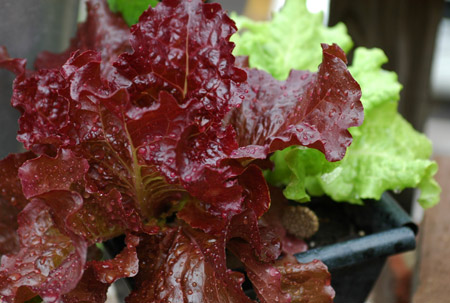
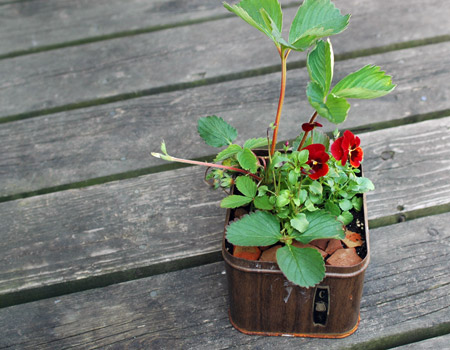
This first drawing was inspired by the collection of pots set on the table underneath the chalkboard (the shadiest part of the roof). Here’s what it looks like hung above them. Most of the plants sitting on that table are greens, lettuce, and violas that have been shifted to less intense heat and sun regions of the roof as a way to extend their life a little bit longer. We still have a ton of lettuce going and can’t possibly eat it all at once! Most of the remaining plants are occupying space underneath taller plants that provide a little bit of respite from the heat and are in larger pots that stay moist longer.

I wrote more about making a chalkboard for the garden when we came up with it on a whim last year. This year we picked up two chalk pastel pencils at our local art supply store Woolfit’s that allow you to draw much thinner lines than a typical piece of chalk. They’re so great and easy to use that we plan to get more in a wide variety of colours.

More chalkboard drawings (2008): Swiss chard, We Want Sun, Rain, No Squirrels, Flowers, in progress, torture and waterboarding.

Leave a comment