Making More Herbs

Photo by Gayla Trail  All Rights Reserved

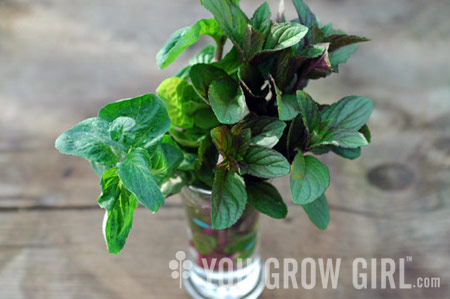
About a month ago, I wrote a guest post for Apartment Therapy/Re-Nest on propagating herbs by cuttings. This is how I quickly double my basil harvest every summer at no extra cost. Basil grows easily from seed too, but stem cuttings are fast and easy — they’ll produce roots in water in about a week or two! By mid-summer my collection of scented geraniums (Pelargoniums) are huge! Why not take a few cuttings and share the wealth with friends?

On the Re-Nest site someone asked a question about taking cuttings from bolting plants. I have not been able to post a comment so I am adding a reply here.

SoRad: We grow basil like an annual in colder climates, but in tropical conditions the plant is a perennial. There are also varieties of basil that are reproduced by cuttings only… they don’t produce seed. Some basil varieties bolt quickly and constantly, while others only do-so when the weather gets really hot.

Bolting when it comes to basil is more about the conditions a particular variety prefers rather than “age.” It is better to take cuttings from plants that aren’t under heat-stress, but I have found that it can be done successfully — your best bet is to move the rooting cuttings to a cooler spot.

Read more…

Leave a comment

Hanging Colander Lettuce Pot

Photo by Gayla Trail  All Rights Reserved

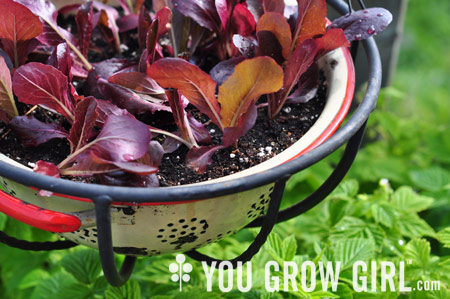
You are looking at one of this year’s serendipitous brainstorms. I feel perhaps a little bit too genius for coming up with it, when really, it’s just an enamel colander filled with ‘Sea of Red’ cutting lettuce and hanging in a wire basket. I quite like it. So much so that I haven’t had the heart to harvest it! Yet.

Here’s how this happy marriage came about. I had this heavy wire hanging basket sitting around, going unused. It’s the sort that is typically lined with coir, which is fine in most gardens but hard to keep hydrated on a hot and sunny roof. While, I’ve found it difficult to use as-is, I’ve kept the basket waiting for a new use to present itself. Despite the issue with hydration, stylishly understated and black hanging baskets made of a sturdy materials are hard to come by so I wasn’t about to get rid of it.

I bought the colander at a local secondhand store with the expressed purpose of growing greens in it. I liked the pairing of butter cream with bright red trim. The holes are small enough to hold soil without adding an extra liner, and the drainage they provide is perfect for growing small greens or herbs.

Photo by Gayla Trail  All Rights Reserved

Once I had planted up the colander, I thought it might be better served sitting up off the ground. Low and behold it fit perfectly inside the otherwise useless wire basket. As an added bonus our digging mammal visitors (squirrels, raccoons, etc) have not been able to get at it, while a second pot of ‘Sea of Red’ cutting lettuce has been dug up several times over the season.

Incidentally, I have experimented with this particular variety by growing the heads spaced at a distance from one another and tightly clustered as you see it here. I prefer it grown together and like the way the spear-like leaves create a literal sea of rich, mahogany that lights up when the sun hits it just so. It’s as satisfying to look at as any flower basket I have grown and I might even eat it for lunch sometime soon before the plants bolt.

Leave a comment

Grow a Mixed Strawberry and Herb Container

Photo by Gayla Trail  All Rights Reserved

When I was in the West Indies, I was surprised to see how much people coveted strawberries. While I was salivating over golden apple and fresh bananas, West Indians were paying through the nose for a basket of pathetic, well-traveled berry-like objects. I don’t think strawberries grow very well in extreme tropical heat. That didn’t stop one gardener I visited in Dominica from trying. As my own strawberries begin to set fruit and ripen I wonder if her little plant has made it and if she was able to savor a few homegrown berries this year.

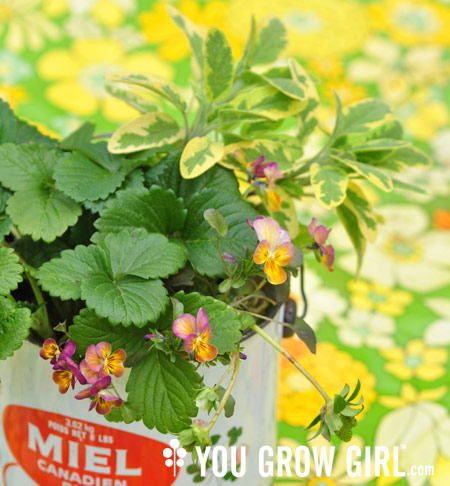
Here in Toronto, it’s not too late to start strawberries. My first article of the season for the Globe & Mail explains how, but did not include this photo of a mixed planting I put together using an old honey tin I bought at a yard sale. If you are going to use something like this, don’t forget to add drainage holes. I made several in the bottom using a large nail I keep on hand for this purpose. Everything in this pot is edible, including the flowers.

One Each of: An unknown hybrid strawberry (the berries are ripening now!), ‘Golden’ sage (it is not hardy here and does not grow very big), ‘Gem Apricot Antique’ viola (may soon have to be replace for something more heat tolerant as the summer kicks in, or you can just pull it out when it kicks it and let the strawberry and sage spread.)

Leave a comment

Keeping Track of Plantings

Photo by Gayla Trail  All Rights Reserved

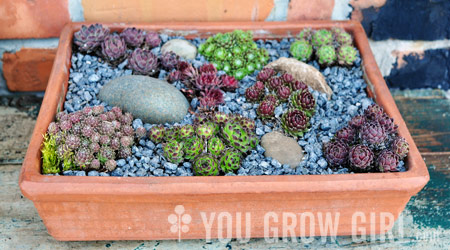
This is one of those ideas I wish I’d thought of but didn’t. Who can remember all of the different plants and varieties one is growing at any one time? Especially when the plants are all so similar like those in this sempervivum trough.

My über gardening pal Barry is behind this very smart method of keeping track of plant varieties that can work for pots or whole gardens. The other day I asked about a plant in one of his pots but he could not remember the name. He disappeared inside for a second and returned with a binder full of plastic-covered photos, each one marked with the names of plants and varieties, just like this one. Okay, possibly a bit tidier than my slapdash version, but you get the idea.

I have since adopted it for my own mixed plantings rather than burying the tags next to the plants as I often have in the past. It’s a smart and fairly simple way to keep track of plants and avoid ugly white tags that only mar your efforts to make a beautiful planting.

Leave a comment

Planting a Sempervivum Trough

Photo by Gayla Trail  All Rights Reserved

Sempervivums or Hens and Chicks as they are commonly called, are an incredibly hardy, and drought tolerant succulent that can take a fair amount of abuse, yet when I was starting out on my roof, they were the last plant I wanted to grow. I’d come to associate them with the few that had been slapped into the tiny front garden of my childhood home. And while I had fond memories of playing with my dolls on the pretend Martian landscape they created, my overall impression as an adult was that they lacked a certain luster.

Photo by Gayla Trail  All Rights Reserved

I don’t recall how it happened, perhaps nostalgia won out, but I eventually came around to growing a few. That summer they bloomed, creating exotic, alien-like flower stalks. I was hooked and decided I would never be without them again.

Read more…

Leave a comment