Send a Seed-filled Card That Celebrates the Arrival of Spring

January of 2011. I was not feeling the New Year vibe. I realized then that for the gardener, the New Year comes when we can once again dip our hands into the soft earth, and I made a resolution to make a big deal about spring when it arrived.

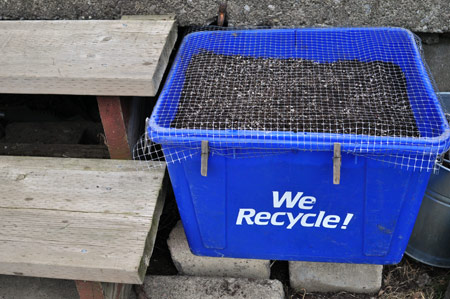
And I did. That spring, Davin and I made our own holiday cards and sent them out to friends. Each card included a packet of seeds and a piece of paper with simple instructions for growing them. I chose mesclun mix, an assortment of easy, quick-growing, cut-and-come-again leafy salad greens that are harvested early while the plants are young and tender. I felt confident that friends with a wide range of living spaces and varied gardening experience would be able to handle it.

Read more…

Leave a comment

Botanical Display Cabinet

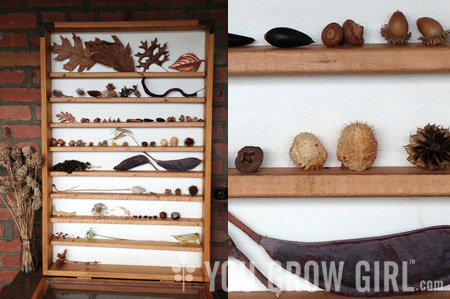
I can’t seem to help myself from bringing home plant bits from here and there whether its on a trip, out on a walk, or from my own gardens. I am in awe of the architectural shapes and designs found in nature and I want to have their beauty around me at all times of the year. It is the same with rocks, shells, and sticks. The world is full of beautiful and incredible things and I am constantly amazed by it all.

I bought this homemade display cabinet rather impulsively for $15 at the flea market a few months back. It’s meant to sit flat on a table rather than propped up as I have it now. Davin could not see its potential and wasn’t particularly excited about carrying it all the way to the car, but I persuaded him to give it a chance. I could see his point as the plexiglass front is scratched and worn from its original use as a flea market stall display (it sat flat on a table rather than upright), and the thing is awfully large and heavy. Still, I think he was eating his words once I got it set up and filled with random seedpods, leaves, and dried flowers we have collected over the years.

Read more…

Leave a comment

Make Your Own Fruit Fly Carrousel

Perhaps it is the cold weather that brings them indoors in droves or a last push to procreate before the end times come, but the fruit flies are taking over my kitchen right now as they do every single fall. They are everywhere. They settle on anything that doesn’t move (edible or not) and alight like a cloud of horrible little monsters when the cupboards are opened or a light wind disturbs them.

I invoke the spirit of my grandmother and shake my fist at no one. “I cast yee out foul things! Satan, I rebuke you!

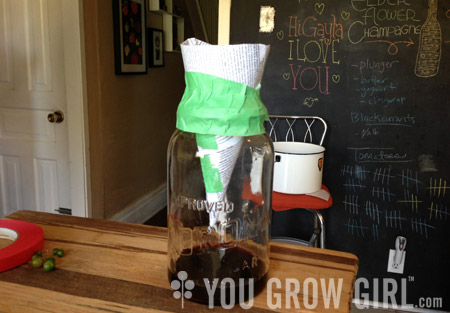
Not surprisingly, it doesn’t work. What does work is a homemade system invented by Davin that we call “The Carrousel”. Its name is inspired by the classic Sci-Fi film from 1976, Logan’s Run. In the film, citizens of a Utopian/dystopian future who are over a certain age are entered into a death machine called the Carrousel under the guise of reincarnation/rebirth or “renewal.”

In our version of The Carrousel, fruit flies are lured into a jar of no return via a funnel system that leads to an intoxicating lake of old red wine. To make your own simply:

Read more…

Leave a comment

Make Your Own Herbal Bath Tea

This is an old project that I originally posted to this site back in the early 2000′s. It was lost when we switched over to a new design, but I’ve brought it back in time for holiday gift-making. (p.s. the photos are small due to the original page design)

You can expect a few more oldies, but goodies to appear here over the next week.

———————

This is a simple, but satisfying gift to make using herbs grown in your own garden. I’ve been making them for years and can fire off a large batch in one night. It’s the perfect gift for those who bathe — which is just about everyone.

    What You Need:

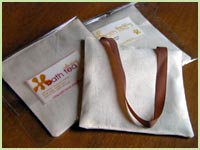
  • Cotton muslin or pre-made resealable tea bags (large size).
  • Ribbon or string
  • An assortment of herbs (see recipes below)
  • Essential oils (optional)
  • Rolled oats, epsom salts, sea salt (see below).
  • Cellophane bags, cellophane roll, other packaging.

To make the bags you will first require some unbleached cotton muslin. Other cotton fabrics can be used, but I prefer this kind the most because it is dirt cheap ($2.00 and change for a yard or cheaper if you buy scraps from the ends bin) and has an open weave that holds in herbs yet allows their goodness to leach out easily into bathwater. In the past I have purchased ribbon (I’ll explain its use later), but this year I found some nice seam binding tape in earth tones for a very good price (29 cents a yard).

If you don’t want to sew you can purchase special large-sized, sealable tea bags made especially for this purpose. They are relatively cheap to buy and can be sealed with an iron. However, I guarantee you that even the most inexperienced sewer can make this. Keep in mind that it is going to be used a few times and eventually tossed into the compost heap. Precision is not necessary.
Read more…

Leave a comment

Venus Fly Trap Bowl

Every botanical garden has their forte, their special something that sets them apart from the others. Prior to any trip that includes a stop at a botanical garden, I tend to scour websites in anticipation of the sort of plantings I will see. However, before my trip to speak at the Atlanta Botanical Gardens last month, I decided not to do any research before hand. I thought it might be more fun to be surprised and wowed without the anticipation that comes with knowing what to expect.

Sure enough, I was absolutely giddy to discover that one of the garden’s claim to fame is their carnivorous collection! I have lots more to share with you, but first is a project that can be achieved at home.

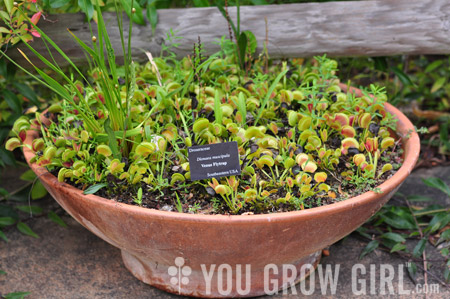
Venus fly traps (Dioneae muscipula) are probably the most well-known carnivorous plant, and are widely available as impulse buys in big box stores and supermarkets. Yet, few of us get to really experience them beyond one small plastic shell packet in a cardboard counter display. The plants are marketed as an enigma, tend not to last long in our dry winter-heated homes and are a little bit intimidating as a result.

They’re a temperate-warm climate plant that prefers high humidity and can withstand short freezes, but can not survive the killing frost we experience here in the North. Venus fly traps love Toronto’s hot, humid summers, but require a chilly, but not freezing, winter dormancy period that fluctuates around the 50 degrees F mark. For this reason I have grown them as an annual in miniature bogs like the one shown above (photographed at the Atlanta Botanical Gardens) through the summer months, but tend to abandon them once the winter comes. In the right climate you can easily achieve the sort of mass planting shown in this bowl as the plants do reproduce readily and will even set seed.

Soil:

I’ve had a lot of luck using a mix that is 1 part sand, 1 part peat (substituting coir), and 1 part perilite.

Planting:

It wasn’t clear to me if the bowl (shown above) had drainage holes or not. In my experience, I have had best results growing venus fly trap outdoors in a pot with holes with a deep, water-filled saucer placed underneath to keep the soil moisture high, yet also allow for drainage through periods of heavy rainfall.

When drainage is not offered, I line the bottom of the bowl with gravel and keep the pot in a sheltered spot where I can control the amount of water it receives. Venus fly traps like wet conditions, but they can still become water-logged and rot if left permanently submerged in water.

————–

I cover growing a carnivorous bog in my first book, You Grow Girl: The Groundbreaking Guide to Gardening, and if you’d like to learn even more on growing all sorts of carnivorous plants, I highly recommend The Savage Garden: Cultivating Carnivorous Plants by Peter D’Amato.

The Carnivorous Plant FAQ has an detailed section on growing venus fly traps, including a few tricks for dealing with dormancy.

Leave a comment