First Harvest at the Community Garden

Photo by Gayla Trail  All Rights Reserved

We popped over for a quick mini-visit to the community garden yesterday afternoon. I wanted to bring some kitchen scraps to add to the compost bin on our way to have lunch and run errands. We left the container at the garden with a mind to return to pick it up on our way back home and do more garden inspection.

It’s only been a few weeks since my first trip of the season to the garden and already so much has grown. Before going on I should state for the record that the reason growth is so quick in my garden is because I never, ever leave it empty. I grow a lot of edible perennials like herbs, flowers, garlic, fruit, and onions that take up residence in the plot year-round, holding down the soil and preventing erosion. It also means that even in a cold climate like Toronto we manage to get very early and very late season crops.

But I digress. Just look at the growth in just nine days! Some of the peas I planted around the trellis have emerged at least a few inches above the soil line. The gooseberry bush I planted early last fall has full leaves and lots of teeny tiny flower buds. We’re going to have a pretty reasonable first gooseberry harvest this summer!

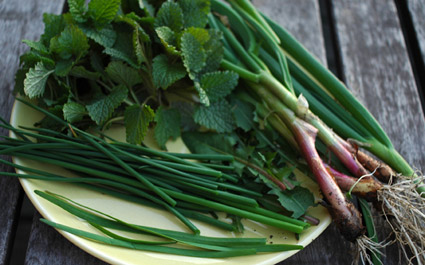
And speaking of harvests, I made my first real harvest of the season yesterday. I took home clippings from a variety of perennial herbs (garlic chives, marjoram, oregano, sage, and thyme) in addition to handfuls of onions. Looking at a photo of the full community plot (actually the sage section is cut off) you can see that there are an awful lot of onions (some are garlic too). They are always one of the first edibles to come up in the spring and one of the last harvested in the late fall. Most of the onions are ‘Egyptian Walking’ onions (aka “Egyptian Clumping’ onions) a type that come up very early and reproduce by developing a topset of bulbs later in the season. Their name is derived from their unique growth habit; the heavy topsets literally fall over and take root in the soil, giving the impression that the onions are creeping about and reproducing themselves throughout the garden. I like to control their placement slightly by collecting the topsets in the summer, tossing them into bare spots as I harvest mature plants throughout the season. They are a particularly rich-flavored onion, reminiscent of garlic. You can eat the topsets as well as replant them, their taste even more like garlic than the mature bulbs.

Photo by Gayla Trail  All Rights Reserved
‘Egyptian Walking’ onions with topsets.

We get a continuous harvest of onions throughout the growing season through this perpetual reproduction but, I’ve been itching to grow some varieties that produce larger bulbs. I bought seeds for a variety called ‘Red Torpedo’ for this purpose but was seduced by the possibility of an even earlier harvest when I came upon a bin of red onion sets for sale later yesterday afternoon. This is why I can’t make solid garden plans — I am too easily swayed to make impulsive decisions! You should see the purple fingerling potatoes I impulse-bought for planting from the local organic produce store only a few minutes prior to my run-in with the onion sets.

Photo by Gayla Trail  All Rights Reserved
Red onion sets waiting to be planted.

And so I bought a handful of red onion sets of unknown origin, which I took back and planted at the community garden. I had no plan for their placement so I basically pulled out a few bunches of mature ‘Egyptian Walking’ onions and replaced them with the new sets. They say the rough and tough cultivation of onion sets make them more prone to disease and a little risky to grow, but I figure the ‘Egyptian Walking’ onions can handle it and I kept them a bit of a distance away from the others to be safe.

Photo by Davin Risk All Rights Reserved

I left the garden with my bundle of onions in hand and an overwhelming sense of pride knowing I will be supplementing our meals with them over the coming week. It was quite a shock to realize that this sense of pride doesn’t diminish with time. I’ve been growing food for quite some time now, you’d think it would become a commonplace part of my life but instead every new harvest, especially the first one of the year, is filled with that original sense of amazement and awe. I’m so glad the growing season is back in full swing!

Leave a comment

Early Days at the Community Garden Plot

Photo by Gayla Trail  All Rights Reserved

Last fall I decided to participate in a national growing experiment called, The Great Canadian Garlic Collection, wherein hundreds, possibly thousands of gardening nerds are growing garlic, recording their results, and then pooling the data so we can all find out which varieties grow best under varying conditions. Believe me when I say that it is all VERY important work and I have taken my role as a participant very seriously. In fact I am taking it all so seriously that it has forced me to change my evil, too-open-to-suggestion-and-last-minute-changes ways by making a garden plan.

Last fall, when the garlic arrived in the mail, I knew I would not be able to do what I usually do which is just stick it wherever it will grow and forget about it until spring. I had to keep track of the garlic, the varieties I am growing, and then record my observations over the span of two years. For the first time ever I needed a serious plan. A plan that can’t be changed on a whim. A plan committed to paper.

And so I decided to make an experiment out of this experiment. I decided to try growing a slightly more formal garden at my community plot than is my way. My way is generally one based on informal companion planting. I grow plants in groupings that work, share, look gorgeous, and love together but I don’t get hung up on formally arranging things. I enjoy a bit of organization and try to keep chaos at bay in other areas of my life, but since the gardens aren’t so much my spaces anymore as they are work spaces, I try to leave a little space for serendipity to take hold. I do not use rulers or string. I do not mark space. I do not make a design on paper that can then be implemented in the earth.

But like I said all of that had to change with the introduction of the very important garlic. And so I set about making a plan last fall. I came up with a design and I set to blocking off the garden using sticks and string as markers. I planted the garlic, recorded its locations, drew in the herbs and perennials, finishing off with carefully marked blobs for spring plantings.

Photo by Gayla Trail  All Rights Reserved

And then in a telling Freudian slip, at the very moment I needed to place my early spring seed orders, I lost the plan. My subconscious did not want to be told it can only grow 4 tomato varieties. My subconscious was gonna grow those ‘Chocolate Cherry’ sunflowers formal plan be damned! I searched high and low but it was gone for good. I went ahead and ordered the seeds without the plan.

In the end it wasn’t a big deal, although as always I have far more seeds than I can grow. The overall layout was still marked off with string at the garden. Garlic sprouts have emerged from the soil with accompanying tags indicating the varieties. The perennials are marking their space, leaving me with empty pockets to fill with the seedlings I started under lights a month or so ago.

Photo by Gayla Trail  All Rights Reserved

And despite the formality there is still plenty of space for serendipity and last minute inspiration. When I went to do clean up on the garden last week I had the impulse to build a sculptural trellis to grow peas and beans on. I am overstocked on attractive pea varieties and thought it would be nice to grow them in the community plot this year. The community garden is surrounded by weed trees that require aggressive pruning every year less we lose sunlight to the garden entirely. I used some of those prunings to build a gnarly tripod trellis, reinforcing it with woven branches at the base. I’m rather fond of it. It is going to look gorgeous covered in peas, if the groundhog doesn’t get to them first!

Photo by Gayla Trail  All Rights Reserved

Leave a comment

Thrifty Ugly Bucket Camo

Photo by Gayla Trail  All Rights Reserved

The discussion around inexpensive containers for indeterminate tomato plants in a recent post has brought up a good point regarding how to conceal the clinical blandness of food industry buckets. The conversation in that post reminded me of a brilliant camouflage technique I discovered on a Saturday walk through my own neighbourhood a few years ago. I have shown this image during several presentations yet it did not occur to me to share it here. I’m not sure who the gardener/designer is although I’m fairly certain it is connected to the small restaurant that is located at this intersection. Whomever they are, what they have done to transform this corner with very little money is brilliant. The tomato plants seen in the foreground are growing in your average industrial food industry bucket but has been concealed using cheap bamboo blinds.

Photo by Gayla Trail  All Rights Reserved

Putting something like this together is incredibly easy and very nearly free. The blinds are cut to size, wrapped around the container, and secured in place by wrapping string around everything and tying a knot. Try securing with wire first and then covering it up with string if you’re concerned the twine won’t hold on its own. Jute is a very affordable but weak string. It can be replaced with a stronger twine made of cotton or sisal. All kinds of decorative options are available in abundance in the curbside economy. Replace bamboo curtains with wood curtains, grass beach mats or any combination of discarded natural fibre rugs, mats, or blinds.

These materials will probably only last a year outdoors but at least you have given them another year of life out of the landfill. By the end of the year they may even be weathered enough to break into bits and put into the compost bin.

Photo by Gayla Trail  All Rights Reserved

Another trick I employ when I can’t find anything to disguise ugly containers is to surround them with prettier pots. Organize larger, utilitarian buckets and garbage bins at the back of the arrangement, placing smaller, decorative pots with attractive plantings of pretty flowers and brightly coloured heirloom veggies in front. If the smaller pots are too short raise them up using larger decorative pots turned upside down as props. Make shelves out of bricks and discarded pieces of wood and then disguise that layer behind a lower tier comprised of smaller pots that sit on the ground. This tactic can be a little bit labour-intensive over the course of a growing season since it requires rearranging as the plants expand and grow. But containers generally require rearrangement for this reason regardless.

The fluidity and possibility for change that comes with container gardening is a positive that big money designers use to their advantage. While most of us can’t afford to swap out expensive containers for new expensive containers on a whim, with a little ingenuity and creativity any of us can fancify ugly buckets or simply rearrange pots to improve the overall look of our container gardeners.

Leave a comment

Winter is Cold, News at Eleven

Photo by Davin Risk

Photo by Davin Risk

Sigh. This view of my roof garden from the door feels a million miles away today.

Remember summer? Yeah, me neither. If not for photographic evidence I would have to assume these so-called memories are in fact only beautiful delusions. I know many of you in the Southern Hemisphere are in the midst of it so you will have to excuse my mid-winter pity party. Over the last few days the temperature has plummeted to an unbearable, and therefore unacceptable bone-chilling cold. Unbearable I tell you!! I held out for two full days hunkering down indoors without stepping foot outside until today when I had no choice but to suck it up, put on as many layers as possible and face it. Even worse, our Taste of Summer life-sustaining preserves are rapidly depleting: the red pepper katsup is no more (good-bye delicious sauce!) and I just opened the final jar of Blackened Salsa Ranchera.

Not to be dramatic, but people are dying over here!

See you in 5 months July, wherein you can expect to find me complaining about the heat.

Leave a comment

Grow Where You Are Planted

Organic Gardening Magazine

So I was gonna hold off on this one until it hit new stands but it looks like Organic Gardening Magazine let the cat out of the bag early and has published an article I wrote for the Feb 2008 issue (“Grow Where You Are Planted”) on their website.

I really enjoyed writing this article. When they approached me about writing a piece the timing was good — I had been itching to write about the topics covered and needed the impetus to get off my butt and do it. It’s a short piece briefly outlining my overall experiences as an urban gardener. The article also addresses outsider feelings I have struggled with since entering the world of garden writing and publishing as a career: Where and how do I fit in to this world of gorgeous, expansive gardens, expensive hardscaping, and quaint early-life garden experiences? Since writing the first book, several interviewers have asked about my childhood and early experiences with gardening. I have stammered and fallen over myself every single time. There is no easy answer to this question. There certainly are informative early experiences but my feeling has often been that the answer they are looking for is not one I can provide. And as far as how do I fit into this world, well it seems that in every category possible I stick out like a sore thumb. I did not have quaint early childhood gardening experiences, there were no early-life mentors, I live in a small apartment, I have only lived in a house with an actual backyard for 3 brief moments through the course of my entire life, I still consider myself to be lower to barely lower-middle class, I have never owned land, I don’t drive a car, I do not have a degree in horticulture (I studied Fine Arts), I have a terrible potty mouth… shall I continue? When attending garden shows and giving presentations I have rarely felt comfortable with the other “Gardening World Celebrities” and have always felt a bit like an impostor accidentally admitted to the Country Club. It’s not a feeling of inferiority or insecurity so much as a feeling of strangeness and difference. And a feeling that sooner or later that membership is going to be revoked.

It has taken some time but I’ve finally hit on an answer to this issue that I bring up in the course of the article. The answer is in the tagline I’ve been using for this site over the last few years, “Gardening for the People.” I’ve been living out the answer all along. I just needed to get there in my own head, for myself, in a new way. Gardening is not just a homogeneous experience in which rich white people with big floppy hats and sparkling teeth increase their social standing and property value through proper plant and rock placement. Gardening is for all of us. Gardening is for anyone who loves plants, or wants to grow food, or thinks flowers are pretty. Gardening is for anyone who is scared to try but who wants to give it a go. We all come to this from different places, different backgrounds, different experiences (and experience levels), and different interests. My life is complicated. Your life is complicated. I’d wager a solid bet that the seemingly quaint life of every single “Gardening World Celebrity” is also complicated.

In the end I don’t care how different we are. The only thing we need to have in common is the love. And even that isn’t a prerequisite.

Check out the article here or see it in the February 2008 issue of Organic Gardening magazine.

Leave a comment