Daddy Long Legs (Phalangium opilio)

Photo by Gayla Trail  All Rights Reserved

I found this daddy long legs (Phalangium opilio), a close spider relative but not an actual spider, sitting quietly on my cucumber plant the other day. I looked it up in my “Garden Bugs of Ontario” book (thanks again Chair!), and it turns out they go by another name, harvestmen. No idea of the origin but I am assuming that has something to do with the fact that they can shed a leg when under attack.

Leave a comment

Slugs and Snails: A Paradox

Photo by Gayla Trail  All Rights Reserved

Why is it that I can crush a slug underfoot, albeit with some trepidation? But when it comes to snails, forget it. They are carefully transferred to another area away from my lettuce and kale.

I’ll let a snail slime all over my hand without wincing or cringing. Slugs? No way! Slugs creep me out just a little bit.

And yet when you think about it, what are snails but a slug-like creature living inside a pretty little shell.

I accidentally brought one home from the community garden on a head of lettuce yesterday. It is now living in a small terrarium with a stem from my currant bush until I get a chance to release it “back into the wild.” I would never show that kind of compassion or care for a slug.

For me, it comes down to the fact that these snails are some of the first wild creatures of my childhood. There was a time when I would spend recess tromping around in a ditch at the side of the school yard searching for these elusive, exotic critters. It was a victory to find one and I would spend the few minutes before the bell letting it crawl over my hand, considering its movements with great interest and wonder. The landscape of my childhood was primarily a tiny postage stamp yard in a townhouse complex and my grandmother’s hi-rise apartment balcony. We had sparrows, yellow jacket hornets, neighborhood cats, and the occasional pigeon, but no snails.

It turns out that in this part of the world this particular type of snail is neither elusive nor exotic — the state of my cabbage are a testament to their numbers. Yet they still hold that fascination for me: the way they extend and contract their antennae; the speed at which they can get around in what appears to be an almost sliding motion with their house firmly affixed to their backs. Snails are a marvel really, and so cool to watch.

Yes, my feelings towards them is primarily nostalgic and a bit self-centered, but for me my paradoxical relationship to snails and slugs in the garden are one of many lessons in seeing the value in all the living creatures, even the pests.

Does that sound too Pollyanna-ish?

There is a lot of focus in gardening literature on getting rid of the offending creatures. An abundance of battle analogies. Believe me, I’m guilty of using this kind of language myself. And at times I have truly felt at war and at odds with all sorts of critters. That’s probably not going to go away entirely, nor do I think it is meant to. There is nothing unhealthy in being self-interested when it comes to keeping your garden alive and productive. I want my currant bushes to make fruit. I want to eat at least some of the tomatoes I grow.

Yet, it is also healthy to stand back from the war making, fighting battles, and rallying of the troops now and again to discover and cultivate a sense of awe and respect for the critters that we share space with, including those that are at odds with our agendas as gardeners.

Maybe next week I’ll take a few minutes to cultivate a sense of wonder and respect for the slugs…. before I proceed to crush them underneath my shoe.

Leave a comment

City Chickens!

Photo by Gayla Trail  All Rights Reserved

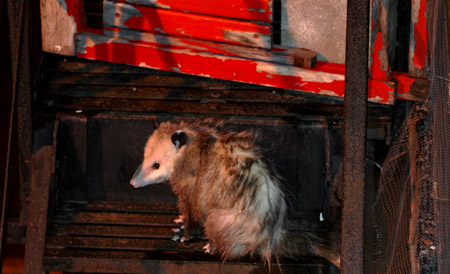
I went to visit some city chickens yesterday afternoon. Chickens! I have a fascination with chickens, but alas, it is not legal to keep them in Toronto. And even if it were legal, I do not have a backyard. Some people do keep chickens on a roof, but between the raccoons, possoms, my cat, and the neighbour’s cats, I don’t think it would be a happy life.

Photo by Gayla Trail  All Rights Reserved

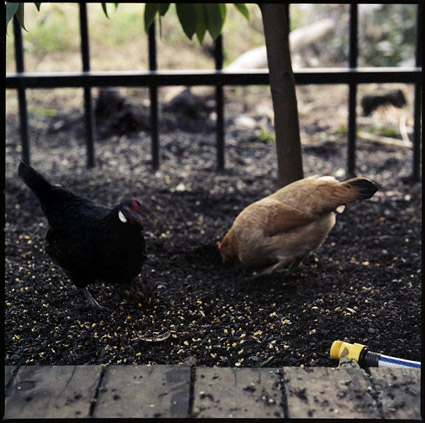
And watching these chickens I can see that they have a scratching behaviour that roof chickens would not be able to indulge in easily.

I learned something new about chickens yesterday that gave me pause for thought. Chickens eat plants! Yes, they eat insects. And yes, they eat weeds. But they are not discerning about either, which means that if you’ve got a chicken and a garden living together you can expect the chickens to take a bite or two (or several) from your prized plants. The chickens I visited were penned off into a very large roaming area (the largest I have seen for 3 chickens) and they had still managed to strip the leaves off of most of the foliage in that area within just a few short months! And that’s on top of their regular diet which includes lots of greens.

Photo by Gayla Trail  All Rights Reserved
Good to know. Maybe I’ll shift my urban livestock dream to ducks.

Leave a comment

Your Questions Answered: Tomato Thieves

Question: We always love your articles and website. Keep it up!!

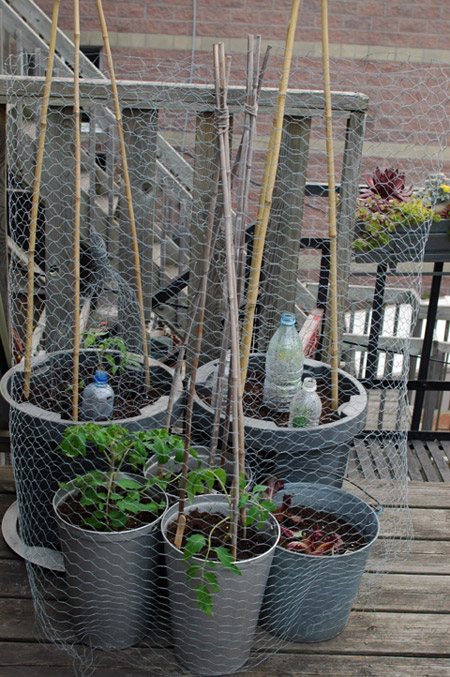
In this past weekend article on tomatoes, you didn’t answer the burning question: what did your brother do about the squirrels??????? They have already chomped the small tomatoes that were forming on our one plant and I know they are just waiting for more. The plant is doing very well, is covered in blossoms, but the furry thieves are lurking and watching. I have thought of making a chicken wire cocoon to go over the plant, but I wondered if you had any other suggestions. Lots of wildlife in the centre of the city!

- Virginia

Answer: Hi Virginia,

The quick answer is nothing. He did nothing, and consequently only managed to get a taste of a single homegrown tomato. On the flip side, he did say it was the best tomato he’d ever tasted in his life and it has made him eager to try again this year, but with some kind of security measure in place.

When it comes to dealing with mammalian critters I find that there are no hard and fast solutions. Cities are not the lifeless concrete jungles we’ve made them out to be, which is a very good thing. I appreciate the surprise and awe that comes from discovering a bit of wildlife up on my third floor roof in the sky, even if it means we have to share space and an inevitable loss of food. However, I will admit that it is easier to take this generous attitude in June when my tomatoes haven’t yet begun to produce. I’ll be shaking my fists and raging come July when half-eaten tomatoes start appearing on the vine. Why must they taunt me by only eating half? If you’re going to take my hard-won food, eat it all!

Mammalian critters have complex brains and personalities. Like us, there is a lot of variation in temperament and taste between them, even those of the same species. What works for the raccoons around here, might not work for raccoons across town, let alone across the country, or the continent. In fact, what works this year might not work next year when the local posse have had time to figure out their own solutions to your trickery.

Feeling optimistic yet?

Of course, you could always luck out. The squirrels are particularly ravenous in my brother’s part of the city, whereas I can get away with less protection and still come out at the end with a decent crop and only a few tomatoes lost. I pout and whine, but in comparison to some I don’t lose much. If your garden is in an area like my brother’s, I suggest doing exactly what you mentioned above — wrap the whole thing in a chicken wire cocoon and call it a day. It’s not the prettiest solution, but it does seem to keep the critters off the goods. My brother only has one plant so there’s no point in messing around. Chickenwire may be ugly but it does lend itself to interesting shapes. I like to use lots of extra and sculpt those bits so it’s not just a big blanket of wire around the plant and pot but something almost interesting that looks intentional.

If your critters aren’t great climbers, you can try wrapping just the bottom of the pot so they can’t get in. I’ve never seen a squirrel climb an actual plant, but that’s not to say it can’t happen. They do tend to prefer a perch, whether that’s inside the pot, a chair next to it, or a railing where they can easily sit and get at the fruit near the top.

If you’ve got multiple plants, then you’ve got an opportunity to do some testing to see what works and what doesn’t. There are lots of other solutions that others have employed. Most of these don’t worked for me, but that doesn’t mean they won’t work for you.

  • Pepper flakes and pepper sprays: There’s a lot of contention about this one. Some say the critters touch the pepper and eventually get it in their eyes — not a nice feeling to experience. Some say that’s a load of garbage and the animals aren’t that dumb. I have no answer one way or the other so I don’t use this method. Do know that to be effective, you’ll have to be diligent about reapplying regularly.
  • Obnoxious music: Set a small radio next to your plants and set it to an AM station that plays something grating, like ABBA. Let it be known that I enjoy a little ABBA now and again, but even I will agree that it grates after a while.
  • Things that smell like your pet: Used pet bedding and hair are popular deterrents. Simply spread bits around the soil, hang around plants, or clip it to stakes. This has never worked for me and our immune city critters — they’ve attempted to raid the garden when all of us, including the cat, were sitting right there!
  • Vinegar soaked rags: This is another homemade trick, but you’ve got to contain the rag from dripping vinegar (a natural herbicide) onto your plants and soil. A small margarine container should do the trick.
  • Pinwheels and whirligigs: Set them in the pot with your plants. I find that the constant motion scares away the birds but doesn’t seem to phase our city squirrels and raccoons — they’ll think you’re cute for trying!
  • Sprinkle bloodmeal around the plants: This can work, although I can’t say I love the smell. Coffee is also used but tends to do more to deter digging animals than those looking to score a free meal.


What do you do to keep the squirrels, raccoons, possums, and other mammalian creatures from dining on your tomatoes?

——————–

p.s This week’s Globe & Mail article is on basil.

Leave a comment

Mantis Watch 2009: HATCHED!

Photo by Gayla Trail  All Rights Reserved

I woke up this morning to the news that the mantids had begun hatching from the egg case (aka ootheca) and were filling up that little bag.

I honestly didn’t think it was going to happen and had been wondering if the case was a dud. Turns out I was just too impatient. I bought my egg case about 3 weeks ago and have since learned that the case requires that much time with fairly steady warm temperatures and reasonable humidity. If you’ve got a case that isn’t hatching, don’t give up on it.

Photo by Gayla Trail  All Rights Reserved

Here’s another photo of the tiny critters moving about. I opened the bag and placed it in a small tank so the babies could hatch and harden their exoskeletons in a sheltered spot. It’s a bit cold out there right now and I’m slightly worried about throwing them to the weather wolves, so-to-speak. Only a few hours old and I’m clucking around like a mother hen. About praying mantids, insects designed to fend for themselves moments after emergence.

Please note I am NOT keeping these mantids as pets. There are simply too many of them, and a tank is not an appropriate environment for so many mantids. Plus, they’ll be ready to eat their first meal in a day or two. I did put two scouts outside (we’re calling them Bill & Ted) to see how they do before unleashing the masses. The remaining, oh, 100 odd mantis nymphs will be going outside very soon, although I’m keeping one for a short time to watch its progress. He/she is already in a separate container away from his/her’s cannibalizing siblings. If you’d like to learn more about keeping mantids, there’s a ton of information online.

Photo by Davin Risk All Rights Reserved
This is the tiny mantid I plan to keep. He/she remains unnamed. Any suggestions?

Isn’t he/she a beauty? Such fascinating little critters.

Leave a comment