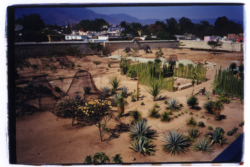
A Visit to Suphattra Land Fruit Farm, Thailand

At this time last year I was just home from Thailand and dying (at least it felt like I was dying) from jetlag so severe, it still pains me to think about it. Back in Feb I posted a slideshow of dragon fruit images taken at a fruit farm in Rayong, with the promise of more photos from that particular trip. It took me a while to circle back, but here they are.

The first few images in this slideshow are of the tram waiting area where several types of fruit were on display. Once the tram arrived our tour of the farm began with the requisite giant novelty fruit, and a series of appropriately bad, lost in translation jokes made by our tour guide, Mafia Bangkok. That’s him in the bright blue golf shirt (9th photo below), cradling a durian freshly picked off of the tree.

Read more…

Leave a comment

Floral Thailand: A Slideshow

I can’t believe that it’s been almost a year since I went to Thailand. One of the things that struck me while there was the inspired use of floral motifs in all design, whether architectural or fabric. I even saw fruits and vegetables intricately carved to look like flowers. The following pictures were all taken on the first official day of our tour, which began at the Grand Palace in Bangkok. Grand doesn’t begin to describe it.
Read more…

Leave a comment

This is Dragon Fruit (Thailand)

Pitaya, or dragon fruit, is a strange edible that is commonly sold (at a premium) in Asian food markets. The fruit is hot pink on the outside with an edible, white interior flesh that is dotted throughout with tiny, black seeds. The taste is mildly sweet, ever-so-slightly sour, and if I’m being honest, rather bland. Its saving grace are the crunchy seeds as they create a textured sensation that is fun to eat, not unlike a kiwi, but more exotic. I like it fresh and chilled, spooned straight out of that intense fuchsia skin.

The thing that intrigues me most about this fruit is the fact that it is grown on a cactus, and an epiphytic (air plant) one no-less. Hylocereus undatus is a night-blooming, jungle cactus that originated somewhere in the tropics of South America and the Caribbean, but is now most closely associated with South East Asia, where the fruit is grown commercially. Hylocereus is remarkably easy to grow as as houseplant and takes off equally well from seeds or cuttings. I know several gardeners that have successfully grown the seeds harvested from store bought fruit with no special effort or preparation. The plant requires more moisture and nutrition than a typical cactus, but can withstand periods of drought. It takes a tropical climate or a heated greenhouse to grow a plant large enough to produce fruit, but in the right conditions it can be made to produce in cramped quarters or a large pot.

Dragon Fruit, Thailand
Dragon Fruit Flower
Dragon Fruit, Thailand
Dragon Fruit, Thailand thumbnail
Dragon Fruit Flower thumbnail
Dragon Fruit, Thailand thumbnail

There is a special place in my heart for epiphytic plants, so I was naturally excited about our trip to Thailand last year and the possibility of not just tasting a dragon fruit fresh off of the plant in its local environs, but actually seeing how they are grown for commercial production. As luck would have it, our trip did take us on a fruit farm tour to Suphattra Land in Rayong. Photos of that trip are attached and I will post more this week of some of the other fruit we saw there. I took several film shots as well, but as usual, I am buried in film and haven’t made it that far into the pile.

Read more…

Leave a comment

The Human Side of Plants

“All truths point to a universal truth; all the divisions of nature are closely akin to one another.”

Rancho la Puerta is a mostly media-free retreat that provides guests the opportunity to unplug from television and Internet for a week, as much or as little as they choose to do so. In its place, the ranch offer movie nights and an extensive book and music library that guests can patronize during their stay.

I brought plenty of books to last me through the week, as I do on all trips, but recognizing that they were primarily connected to work in some way, I ended up setting them aside in favor of some light fare that I found in the library. However, as a plant and nature nut, the line between work and play is nearly impossible to maintain. I could not help but find my way over to the library’s Baja ecology resources and guidebooks as I required help in identifying the foreign flora and fauna that lives on and around the ranch. I simply could not wait until we got home to begin researching the life nearby.

While in the library, Davin took some photos of the older books, and it was through him that I was introduced to “The Human Side of Plants” by Royal Dixon (1914), an early predecessor to books like The Secret Life of Plants that tried to uncover and prove sentience in plants scientifically.

Read more…

Leave a comment

Leaving California with an Aching in My Heart

The trip to Rancho la Puerta begins and ends at the San Diego airport. This was my first time to Southern California, and since it turned out to be cheaper (due to the New Year travel rush) to stay a few days in San Diego than fly home straight away, we took advantage to enjoy a bonus day and a half in the city.

Having now had a chance to see first hand what gardening is like in Southern California, I can say with authority that I would move there in a heartbeat to enjoy that luscious, long-season growing. I spent the last few minutes before we had to head to the airport running from one neglected front yard citrus tree to the next screaming (mostly on the inside), “Dear god, look at all of these oranges!”

If it were not for the state of traffic and poor public transportation options, I would be cranking up the Zeppelin and packing my bags right now. I can’t live in a car dependent city, never mind the fact that my stomach was in my throat every time we got on the road. Since I’m being honest, the earthquakes freak me out a bit, too.

This garden was the first I saw when we arrived at our hotel. You’ll recognize the large clumps of blooming bird of paradise (Strelitzia). It seems to grow like a weed here and I noticed that it was a public garden planting favourite. But the real show-stopper, the plant that I could almost leave my bike-riding, public transportation utopia for is the giant Dr. Suess-like Fox Tail Agave (Agave attenuata).

My god, that is the most phenomenal agave I have ever seen in my life! Alas, I try my best to keep my little collection of potted agaves healthy, but what I wouldn’t give to grow a massive cluster like this.

There are several benefits to living and gardening in a southern climate, but it’s the promise of a killer agave garden that gets to me most.

Leave a comment