Amomum

Photo by Gayla Trail  All Rights Reserved

This is a tricky one as I haven’t yet properly identified it. Perhaps you can help? I took this picture at Papillote Gardens in Dominica. The tag read, “amomum cardamomum”, but both are actually words for cardamom and together do not make a botanical name. It was definitely a type of cardamom or at the very least, something in the ginger family. It turns out that there are a lot more ginger family plants than I ever imagined so my claim to knowledge in this area is forever humbled.

My best guess is that this is some kind of black cardamom (Amomum subulatum) or Amomum subulatum fresh off the plant. I have searched high and low but have been unable to find a photo of the plant with fresh pods to confirm its identification. My other thought is that it could be some kind of related, inferior (or false) cardamom that I’ve never heard of.

And so I put it out to you. What do you think it is?

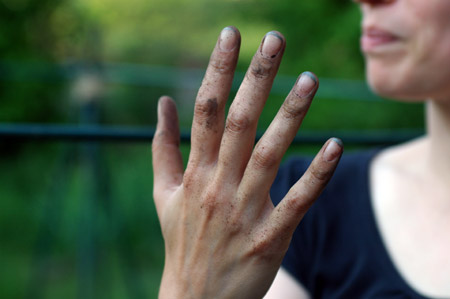
As Davin was holding the open pod, the purple colour staining his skin (which I might add he picked and opened without encouragement from me) he kept saying, “I hope this isn’t poisonous.” I suggested that if there was any doubt, he should wash his hand immediately and refrain from sticking it in his mouth anytime soon. And then, you know, hope that skin contact doesn’t act as a good delivery system for this particular poison. Two months later he is still alive so apparently it wasn’t.

The life of a botanical hand model is wrought with peril.

Leave a comment

The Requirement to Garden

Photo by Gayla Trail  All Rights Reserved

This is a long one. I suggest you make a cup of tea and a snack before starting.

    And now listen carefully. You in others-this is your soul. This is what you are. This is what your consciousness has breathed and lived on and enjoyed throughout your life-your soul, your immortality, your life in others. And what now? You have always been in others and you will remain in others. And what does it matter to you if later on that is called your memory? This will be you-the you that enters the future and becomes a part of it.
    - Boris Pasternak (Doctor Zhivago)

Back in December 2009 my partner Davin and I took a month long trip to the Caribbean. We spent 4 days in Barbados, 3 weeks in Dominica, and one week in St. Lucia. Since that time I have posted on and off here with photos and short stories depicting my botanical experiences through that month. There are still so many gardening and plant related stories left to tell. Every single day was loaded with new plants, flowers, food, sights, and sounds. We went on hikes into the rain forest, up mountains, and to a Boiling Lake. We got to see a place that felt like witnessing the birth of the world. We stayed on an organic food farm and picked ginger flowers that would be made into centerpieces for rich people. We visited an organic farm that specializes in traditional herbal medicine. We went inside an ocean-side cave. We touched walls covered in more ferns than I have ever seen in my life. We walked among grasses and cacti. We saw plants I will probably never be able to identify. We spoke with humble gardeners, visited massive backyard farms, and met an incredible 99 year old woman. We found new friends to whom I feel a great deal of gratitude. It was pretty much awesome.

As you can see I have barely scratched the surface here and hope to get a chance to tell you some of these stories over time.

Photo by Gayla Trail  All Rights Reserved

Read more…

Leave a comment

Beehive Ginger

Photo by Gayla Trail  All Rights Reserved

I first came upon this incredibly strange ginger (Zingiber spectabile) while touring a wonderful garden and wilderness retreat in Dominica called Papillote.

Read more…

Leave a comment

Frangipani Tree (Barbados)

Photo by Gayla Trail  All Rights Reserved

I thought I’d post a sunny photo today since we’ve been living under grey skies all week and I’m about to collapse into a no-sun, low-energy coma. Although, scrolling through folders of photos of us frolicking in the Caribbean a few months ago is kind of miserable in its own way.

I took this photo on the first of a short four-day stay in Barbados, where I saw lots of wonderfully fragrant fragipani (Plumeria) trees in bloom. If you have never smelled a real frangipani bloom I hope you get the chance someday. They are extremely sweet, soft and rich. For many they epitomize tropical floral fragrance.

We walked for miles through the countryside on that first day trying to see as much as we could. It’s a good thing I soaked it all in while I had the chance because I don’t believe I saw a single frangipani through the following three weeks. Frangipani plants do not like their roots to be waterlogged. Barbados has a MUCH drier climate than Dominica so I figure that has got to be the reason.

Here’s a link to the photo and story of the very first frangipani plant I had a chance to see and smell, ten years ago.

Leave a comment

February at the Community Garden

Photo by Gayla Trail  All Rights Reserved

We popped over to the community garden yesterday afternoon with a frozen pail of compost. I thought I would take some pictures so you can see what it looks like in the middle of winter.

As you can see, not much is happening. Drab and dull. We stop using our plots between October/November and March/April depending on the season.

Photo by Gayla Trail  All Rights Reserved

If I wanted to really maximize the space, I could construct some cold frames within my plot and grow cold hardy greens like kale, mache, and spinach. And I would, but unfortunately the lane-way that leads to the garden is typically treacherous terrain through the winter months. We haven’t had much in the way of snow and ice this winter — it’s the first year since joining the garden around seven years ago that I’ve been able to get to the garden gate with relative ease.

Instead, I grow edible perennials as a strategy for extending the season. Cold hardy, perennial herbs such as garden sage, oregano, marjoram, chives, garlic chives, mint, and ‘Egyptian Walking’ onion function as the bones of the garden, holding in the soil and offering up a harvest that starts in the early spring and lasts straight through to the late fall.

Here’s what it looks like in April.

There are also a few self-seeders including calendula, chervil, bloody dock, lovage, shiso, lemon balm, and chamomile that pretty much grow themselves. They can be a curse or a blessing of plenty depending on how you look at it.

Over the years I’ve also added a few small fruit bushes including gooseberries and American black currant, and several strawberries (wild and alpine types) as a way to get garner yearly crops that don’t require seasonal planting.

Photo by Gayla Trail  All Rights Reserved

This is a wild geranium that showed up one day. I always let a few survive since they’re not too invasive and I like their pretty little pink flowers. As you can see, it is also proof that plants don’t necessarily “die” during the winter, but stay alive in a dormant stage underneath the snow.

And it looks like we’ve had a visitor in our absence. I noticed new graffiti in a couple of spots along The Beer Store wall.

Leave a comment