Let’s Try This Again

The other day I posted about a datura that wasn’t a datura that I thought had been given the patois name “Agouti Umbrella,” but is not in fact the “Agouti Umbrella” even though it certainly looks like it could be one.

The fern-like moss shown in the above photo is the real “Agouti Umbrella” aka “Parasol Agouti.” In my defence, it doesn’t seem to make much sense does it? After all, the Brugmansia, which incidentally is labelled Datura in one of the books I have been using as a reference (confused yet?) is shaped like a large parasol covered in drooping umbrellas.

But, no.

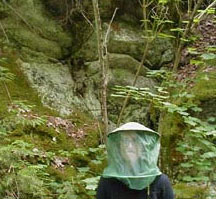
This teeny weeny little plant called Sellaginella that I saw growing in the forest, at a friend’s place up in the Valley (here is another source of contention. The idea that one would travel uphill to arrive at a valley continues to confound me), and as seen in the photo above, taken on our hike to the Boiling Lake, is the real “Agouti Umbrella”.

Huh?

This has proven to be another lesson in the importance of scientific names. Case in point, I was introduced to several plants on the trip that I haven’t been able to show you because I can not identify them. Davin and I spent about three hours collectively attempting to identify a plant that we can’t find a single reference to both online or in books. All I have is the Patois or Creole name, and even that can get very confusing. A single plant can have a different Patois name depending on which island you are on, or even which community on any given island you happen to be visiting at the time. For example, there are nine varieties of yam on Dominica, and different Patois names for any given variety from village to village. As a result, I’ve pretty much given up trying to identify yams. It’s enough that I know the genus.

Added to that is the fact that I didn’t always hear the Patois correctly. I grew up with a grandmother who spoke Patois or “Kweyol” as it is sometimes called, (although she would never teach me) and who spoke with a pretty typical Dominican accent, and I still couldn’t understand what people were saying at times. It is a beautiful accent by-the-way. Very lyrical and sing-songy. So while I have my notes to refer back to, there have been many times when my spelling was way off the mark.

One of the books I have been using to make identifications, “Caribbean Wild Plants and Their Uses” by Penelope N. Honychurch, is helpful in that the index is organized by the scientific, English common, and Creole names. But it’s a small book and just about any plant that grows in the Caribbean is growing somewhere on Dominica. That’s a lot of plants to cover. They really need their own, comprehensive book.

Leave a comment

In Search of My Grandmother’s Garden (A Visual Presentation)

A front steps container garden in Newtown, a neighbourhood in Roseau, Dominica.

This coming Monday I will be giving a presentation to the Parkdale Horticultural Society on my epic December/January 2009/2010 trip to the Caribbean. I’ve assembled a range of images from plants, to food, to some personal insights from all three of the islands we visited. There is a special emphasis on Dominica, in part because we were there the longest, because the island is especially important to me personally, and because it offers so much from a botanical point of view.

The montane/cloud forest (mid-high elevation). Dominica.

While most of Dominica is very rugged mountainous rainforest, it is an island of many microclimates. As a result, everything that grows elsewhere in the West Indies is grown somewhere on the island. You can never run out of plants to discover. I can’t wait to go back, but for now, putting this presentation together has offered me the chance to go back and re-experience it all through the thousands of photos I took. I even learned a few new things that I didn’t notice when I was there taking the photos!
Read more…

Leave a comment

Agouti Umbrella

In Dominica, you might just see a giant Datura Brugmansia (I was told they are sometimes called “Agouti umbrella“*), flush to the breaking point full of drooping, soft peach flowers. Chances are good that you’ll see this on several occasions, in varying locations, and always the same colour.

I saw this one on a steep mountain road in the village of Trafalgar on a climb up to visit the most amazing twin waterfalls that run hot and cold (also called Trafalgar). It was raining at the time, as it is almost always raining in the rainforest.

Long story short: we were not let in due to incredibly ridiculous local politics and posturing. I’m still very bitter about what went down and the fact that I did not get to see the falls. But the brugmansia was incredible and so was the view from the top of the hill.

* An agouti is a rodent that lives in Dominica. It kind of looks like a large guinea pig. I saw one from the back on our second last day on the island.

Turns out I messed up. My notes had datura as agouti umbrella but it’s actually a small fern called selanginella that goes by this colloquial term. Oops. Seems like it should be the datura though, doesn’t it? The little fern does not remind me of an umbrella. Brugmansia does. Go figure.

Leave a comment

Pillow Cotton

I couldn’t resist sharing another image from the presentation I am working on and will be giving later this month.

This is Giant Milkweed (Gossypium). The only time I saw it on the trip was when we travelled to the north end of Barbados to visit the Animal Flower Cave. The cave was a must-do item for me. When I was growing up, my mother, who is from Barbados, spoke of it fondly. What she described was an ocean-side cave filled with blooming flower animals: sea anemones. Unfortunately, the anemone population has dwindled significantly over the years. While the cave and the surrounding landscape was fantastic, and one of the highlights of the Barbados leg of our trip, what I saw was nothing like the cave as it would have been in my mother’s day.

But I digress. When I hopped off of the last of a three bus journey, the very first plant I noticed was the Giant Milkweed. How could I miss it? It looked like an overgrown version of the milkweed that grows in dry landscapes here in Toronto. The landscape at the north end of the island, and on Barbados in general, is quite dry and flat. There are a lot of dry fields. For that reason, I didn’t see this plant in Dominica, an island that is almost entirely mountainous rainforest!

I did some research and discovered that Giant Milkweed is sometimes called “pillow cotton” because the giant pods are filled with a soft and silky fibre that was once used to fill pillows. How appropriate. You see, for a good month prior to our trip I worried endlessly about the availability of a decent pillow in Dominica and wondered aloud to anyone who would listen as to how I might pack my pillow in addition to all the books and camera gear I felt necessary. This is all because I read somewhere that there was a pillow shortage in Dominica due to a fire, and that it is hard to get stuff there period, regardless. Which is true.

I know this sounds very Princess and the Pea, but I assure you that I can sleep on rocks as long as I have a good pillow. I NEED my pillow. Of course, after all of that fuss, I forgot the pillow at home and then worried about it endlessly during our 4 days in Barbados. Where could I get a pillow? When would I get a pillow and would it take me over Liat’s minuscule carry on limit?

I should have harvested some “pillow cotton” from the Giant Milkweed and made my own while I had the chance.

Amazingly, later that night — our last night in Barbados, and well after I had resigned myself to “suck it up already”– I purchased the perfect pillow from a group of ladies (the Pillow Ladies), and at the fish market of all places!

Comments Off

Whimsy Must Live

Over at Garden Rant, in a post entitled “Whimsy Must Die” and the follow-up “Couldn’t Resist“, people are going off, once again, about ugly, tacky gardens.

Despite the last fiasco (which I will not link to here), I find myself surprised by how many people take very real offence to a front yard covered in garden gnomes and other so-called kitsch ornamentation — most especially gardeners whose outdoor aesthetic choices are often unfairly subject to the neighbourhood judge and jury. If I came across any of the yards shown in the Garden Rant posts while walking around my own town or any other, I’d snap a few photos and walk away with a big smile on my face.

Look, I’m not above talking crap about an ugly garden (Hello, red-dyed mulch). We all have our own opinions and it’s okay to be decisive and critical about the things we see on display in the public sphere.

But at the end of the day, I’d defend the crassest, tackiest displays of pure cheese (within reason. eg. serious environmental concerns) on principle. I may believe that my own taste is IMPECCABLE and above snide remarks, but I don’t want to live in a kitsch-less world devoid of tacky ornamentation. Walking past the same tastefully designed front garden is BORING. In fact, this kind of homogenous tastefulness is slowly taking over the neighbourhoods surrounding my apartment as older Portuguese and immigrant families are being displaced by rich people who hire the same garden designers. The gardens look nice enough, but holy god is it ever getting dull.

Gone are the interesting religious shrines and tires painted white and cut into the shape of tulips. I miss them.

Case in point: There’s a garden around the way from where I live that looks like a dollar store threw up all over it. Imagine every single cheaply made plastic whirlygig and abomination on a stick you’ve ever seen — this garden has one. I’ve made many side remarks to friends in passing. “Dear god, look at all of the rubber ducks.” “Oh look, it’s got a dancing salmon, too.” Once the snickering is done, we always agree that if that garden was replaced by a cluster of ornamental grasses and some carefully arranged rocks, we’d be disappointed.

For me, it comes down to the fact that the artists behind these masterpieces are having fun. And they are fearlessly bringing their individuality out into the open to share with the world, good taste be damned.

Last week, while walking with a friend to the CNE — a yearly pilgrimage for purveyors of bad taste and even worse food — we chatted about gardening in the city and how one of the best things multiculturalism and immigration has done for Toronto (among many good things) is show the old guard keeping-up-with-the-Jones’-types how to let go a little.

A front yard slathered in melting stuffed animals fills me with as much joy and wonder as a well-tended bed overflowing with horticultural gems. What matters is the enthusiasm of the gardener and their willingness to put it out there. Call it tacky, tasteless, crass, kitsch, embarrassing, ugly, cheap, crude, or whatever you want, but the day whimsy is killed off for good will be a sad day indeed.

Leave a comment