What Makes a Good Gardener?

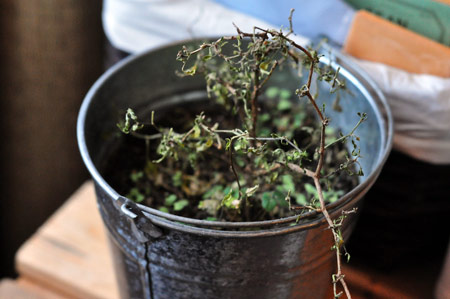
Photo by Gayla Trail  All Rights Reserved

This year, more than any other year in the last decade, I have heard from more burgeoning or wanna be gardeners admonishing themselves or simply stating, “I can’t garden; I kill plants.

Statistically, a huge number of people have taken up gardening for the first time over the last few growing seasons (hooray!) so it stands to reason that this rise in self-proclaimed Black Thumbs is a result of a large population of beginners trying to find their footing and getting a bit lost along the way.

Gardening is intimidating. It is an active pursuit and there are choices to be made everyday in the garden that can have an effect on that little piece of earth we’ve inherited for a time. At the same time, our actions in the garden feel like they carry a heavier weight than they actually do. Just so you know, being responsible for the death of a plant by neglect, a lack of knowledge, or improper placement is not a big deal. A basil plant is not a hamster.

And then we look around at magazines and books and all we see are beautiful, organized, tidy, well-appointed gardens. The fantasy is nice inspiration but it also serves to give beginners a false perspective on what is achievable as a beginner and what is expected of them.

When I started taking gardening on my roof seriously, I was excited about treading into new terrain but I also felt a lot of shame and anxiety around my mistakes. Over subsequent seasons I enjoyed the garden when I was alone, but still found myself feeling guilty or ashamed when people came to visit. I often pointed out the plants that weren’t thriving or the sections that looked terrible the second my visitor walked into the space. By calling out my garden’s faults, I was saying, “Hey, I know you’re judging me and I’m on board.” I was getting the judging out in the open before they could as a strategy to avoid added embarrassment and shame. And you know what? A lot of that judgment was in my own head. I very much doubt most of those people even noticed half of the so-called transgressions I pointed out to them, or cared for that matter. They were seeing what looked good. I was the one fixating on what didn’t.

A while back, I started adding a section on what makes a good gardener to some of the presentations I give. I think it’s about time that I write about some of these ideas and start a wider discussion about it here. A dialogue around this kind of gardener’s anxiety would have gone a long way to alleviate my own anxieties sooner and allowed me to enjoy my garden more back then, as I do now. It might also help me kick lingering feelings of shame in the ass that sometimes rear their head. After all, often times the topics we write about are those we need to hear most ourselves.

Since it is clear that most people are defining a Black Thumb as a “killer of plants,” and a Green Thumb as someone who keeps plants alive, I think it will help to begin this conversation by stating matter of fact that even so-called Green Thumbs do not keep every single plant they tend to alive. I kill plants. Every single gardener I have ever met, regardless of their experience level has admitted that they kill plants. I am yet to meet this mythical creature, the E.T of gardeners, who has the power to nurture fried marigolds back to the land of the living or perhaps less dramatically (but still unrealistically) manages to make every plant that comes under their care flourish.

Photo by Gayla Trail  All Rights Reserved

This is my roof garden in July 2007. Last year, while showing this photo during a presentation, I suddenly became embarrassed about that top-sided orange watering can and quickly launched into a ramble about how embarrassed I was about the stupid can until someone in the audience snapped me out of it by telling me to shut up and get on with the presentation. Sometimes we need other people to tell us when our perspective has gone askew and bring us back into reality.

What Makes a Good Gardener?

1. Experience: Gardening makes you a better gardener. Nobody magically wakes up one day knowing exactly what to do in the garden. You learn by doing it and a great deal of that doing is in screwing it up [see Failure, below]. The good news is that you’ve got your entire life to become a better gardener and every new season is another opportunity to get some of the stuff that went wrong right, and reapply some of went right.

2. Consistency and Persistence: Plants need regular care. Unfortunately, growing a garden isn’t like learning to crochet. You can’t put it down and take it back up three months later and expect everything to be right where you left off. Developing a habit of going out there on a regular basis is important. Some of us can’t make it out there everyday, especially when we are growing at community gardens that aren’t right in our own backyards so it is important to give yourself a break when you can’t make it. That said, being in your garden on a regular basis means your plants are more likely to get the care they require. Consistency and persistence also offers you the chance to catch problems and observe changes.

3. Observation & Adaptation: Good gardeners are great observers. They watch for signs of distress so they can catch problems before they get out of hand. Fortunately, the act of gardening teaches us to be better observers so as you spend more time gardening, chances are good that you will naturally pick up all sorts of observations along the way. Give yourself time and space to meander in your garden and just look around and enjoy the little things as they unfold.

As an observer, you will naturally find yourself noticing changes in your plants and the climate. Given more time and experience, you will be able to predict some of the issues that occur with your plants before they happen. This will eventually lead you to a better ability to adapt to whatever the weather or nature throws at you.

The fact is that a lot happens in the garden that is out of our control. You can’t predict a cool, wet season like the one we had last year on the East Coast. There is no way of knowing that all that basil you put in is going to suffer through a wet summer. But you will come to understand the kind of weather that makes basil plants unhappy and be able to adapt to changes in weather that will allow you to do what you can to make the plants more comfortable before they reach the point of rotting in the soil.

No two years are alike so having A WAY TO DO THINGS year in and year out is nearly useless. As conditions change, you will likely need to change and adapt some of your strategies with them. The best gardeners can be flexible and aren’t rigidly locked into a specific way of doing things that is unchanging.

4. Failure: Perfectionism is dead. I should put that in all caps, bold, and then underline it for emphasis. Here you go: PERFECTIONISM IS DEAD. In the real world gardeners kill plants and gardens get pests and diseases. Sometimes life gets in the way and we don’t have the money to buy something we want or the time to commit to making our garden the showpiece we would like it to be. This is not evidence that you have a Black Thumb. More importantly, you learn more when you are willing to take chances & give yourself space to screw up. It’s often in those failures that we have the biggest AHA! moments.

And yes, unfortunately, there’s always going to be that one know-it-all neighbour who’s got a wagging finger and something to say about what they think you are doing wrong in your garden. The only thing I can say to that is that it’s their problem, not yours. There’s a difference between sharing knowledge and shaming others into doing things the way we see fit. It’s a mistake to assume that our way is the only right way.

The act of gardening serves as an excellent life lesson in accepting one’s failures that extends beyond the garden. Over the years, gardening, and later writing about gardening, has helped me to recognize and confront my own feelings of inadequacy, shame and guilt: shame about class, not having enough, not being good enough, not being enough period, and sometimes being too much. It has invited me to indulge and delight in my desires freely, while asking (and sometimes forcing) me to have patience, take things slowly and look for frugal alternatives. Every minute in the garden is about relearning patience and reveling in the moment. Spending hours upon hours nurturing and observing plants has brought joy into parts of my life that I thought were irreparably scarred. It has provided a safe place for that long buried, hurt little kid inside me to play freely and to live the moments of wonder, discovery and self love she had to hide from angry adults.

My gardens have given me permission to experiment, break rules, and foster a rebellious streak that is an important but often pushed aside part of who I am.

Our gardens should be a free space where each of us can find joy, make discoveries, and feel whole. Guilt, shame, and feelings of insecurity have no place there.

Leave a comment

Orchids at the Montreal Botanical Gardens

Photo by Gayla Trail  All Rights Reserved

Last month, I spoke and signed books at the Annual Montreal Seed Fair held at the Montreal Botanical Gardens. When things got a bit harried at the event, I took the opportunity to relax with walks through the greenhouses.

Inhale deeply. Exhale deeply.

I’ve said it at least a dozen times, but of the greenhouses I’ve visited, those at the Montreal Botanical Gardens remain my favourite to date and always a highlight of any trip to Montreal. Oh how I wish we had greenhouses this inspiring here in Toronto! [Speaking of which... the super amazing Drawn & Quarterly bookstore is hosting an event for the book next month so I'll be headed back there soon. Stay tuned.]

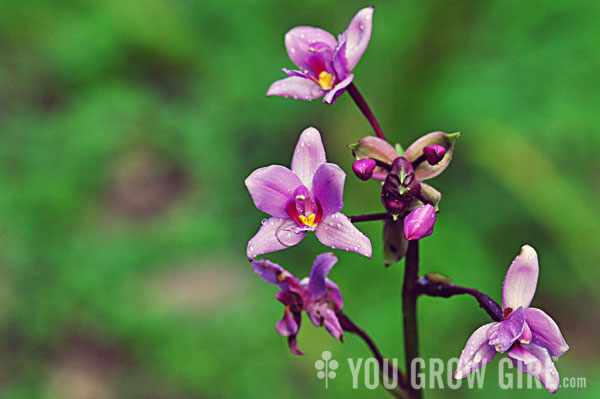
The orchid conservatory was in full form during my trip, and possibly the best I have ever seen it. I took a ton of photos. Here are just a few of the orchids that caught my interest that day.

Photo by Gayla Trail  All Rights Reserved

Sarcoglottis grandiflora

Photo by Gayla Trail  All Rights Reserved

Jade Slipper Orchid (Paphiopedilum malipoense)

Photo by Gayla Trail  All Rights Reserved

Ludisia discolor ‘Alba’

Photo by Gayla Trail  All Rights Reserved

Phragmipedium ‘Court Jester’

Photo by Gayla Trail  All Rights Reserved

Paphiopedilum ‘Green Mantle’

Read more…

Leave a comment

Peperomia rotundifolia

Photo by Gayla Trail  All Rights Reserved

Several plants in the peperomia genus are grown as common houseplants here in North America, but have you ever seen one like this?

I was first introduced to this particular plant in Dominica, where it goes by the local names Jiwonflè*, Jonflè, or Giron Fleur**. It is most often found in very damp and dark places, and as a result most of my photos were lousy. Last month I found it again (as seen here), on display in the Tropical Rainforest Conservatory at the Montreal Botanical Gardens and was able to get a better photo.

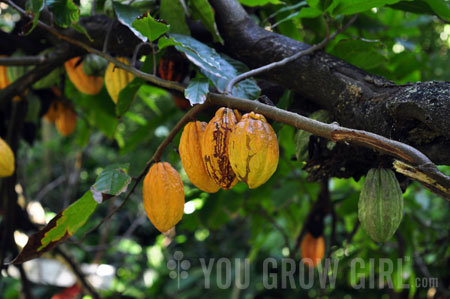
Jiwonflè is a tiny trailing succulent that grows as an epiphyte, hanging from the branches of trees, most commonly cocao and grapefruit. In Dominica, the plant is brewed into an herbal cold remedy but what’s most fascinating is the smell. When you crush the leaves, it emits a soft green peppercorn aroma. I suppose this shouldn’t be too surprising since peperomia is in the same family as black peppercorns (Piperaceae).

Read more…

Leave a comment

Oxalis Corymbosa

Photo by Gayla Trail  All Rights Reserved

This morning, I set out to post a different photo until I was reminded that it is St. Patrick’s Day, a day I most often associate with clovers. Technically oxalis and clovers aren’t the same thing, but they are often mashed together around this particular holiday. In truth, I’m going through a rather rabid oxalophile phase (am I the first to coin this term?) and don’t really need an excuse to post a photo of anything oxalis, or clover for that matter.

I found this particular oxalis growing in an area of Dominica called Giraudel, right beneath the nipple fruit, in fact. The plant is used locally as an herbal tea for sore throats and has the local name ‘Malgoj.’* I saw it several times throughout the island, and later in St. Lucia as well.

Photo by Gayla Trail  All Rights Reserved
This is what the leaves look like.

* Source: “Caribbean Wild Plants and Their Uses” by Penelope N. Honychurch.

Leave a comment

What’s on Your Windowsill? (Plus Giveaway)

Photo by Gayla Trail  All Rights Reserved

A visit to Erika’s apartment a month back has inspired a new sense of excitement about my own windowsills. The morning after the tour, we experienced a rare winter treat here in Toronto: sunshine! While my windowsill has been transformed several times since, here’s what it looked like on that first morning of sun.

In the photo above you can see [left to right]: ‘French Lace’ scented geranium, Chilean oxalis bulbs that I recently planted, another oxalis that has gone dormant, variegated Cuban oregano (that thing does not stop growing. I have cut it back hard, several times), and the edge of a ‘Centennial’ kumquat tree.

Photo by Gayla Trail  All Rights Reserved

This is the other windowsill in my office [left to right]: Microgreens freshly sown in a recycled salad container (behind), spineless blue agave (front), lithops, another dormant oxalis, donkey’s tail sedum (Sedum morganianum) (hanging).

Photo by Gayla Trail  All Rights Reserved

And here’s what it looked like yesterday afternoon when the sun was shining once again [left to right]: Pelargonium ‘Fair Ellen’, yet unidentified echeveria I bought a few days ago, pelargonium ‘Mabel Grey’, another unidentified echeveria from the same purchase, sea onion (Ornithogalum caudatum).

What are you growing on your windowsill?

Please post a link to a photo or post on your blog about what’s on your windowsill. We can inspire one another and beat the winter is almost over blahs.

Next Friday, March 19 at 5pm EST I’ll randomly select two people from the comments below to win one of the following price packs:

prizes_mar2010.jpg

  1. One of our “I Heart Dirt” tees, six packs of organic vegetable and herb seeds from Cubit’s Organics, a package of assorted garden buttons and magnets (also designed and produced by us), and one of the few remaining Grow Great Grub book launch party door prizes that includes a specially made “Grow Great Grub” button and a pack of organic vegetable seeds by Urban Harvest.
  2. Six packs of organic vegetable and herb seeds from Cubit’s Organics, a package of assorted garden buttons and magnets (also designed and produced by us), and one of the few remaining Grow Great Grub book launch party door prizes that includes a specially made “Grow Great Grub” button and a pack of organic vegetable seeds by Urban Harvest.
Leave a comment