Give Me Your Rusty Metal and Your Beautiful Decay

Last night, I gleefully laid out the collection of items I had purchased from the flea market onto the floor and imagined how I will use them in the future. Most of the items were purchased for the garden and some will make an appearance in the photos I take for future book and assignments.

Most of the items that show up in my work projects are also used by me in my home. Few are purchased for one-time usage and then shuffled out the door. Perhaps it would be better that way, but I am a collector, always have been. Still, I can’t recycle the same plates, bowls, and fabrics book after book, photo after photo, so to keep things fresh, I collect an affordable hodgepodge of items that I like, primarily from thrift shops. I’ve never really been into sets anyway. It’s one part of my job that gives me an excuse to indulge in a whim that I would be otherwise forced to curb. It is why I go to the effort of dragging home dirty curbside “treasures” on my bike and why I fill up my luggage with special canning jars when I go away on business trips. In truth, I was doing these things before it became a part of my job — this just gives me the justification I need to continue.


Part of a burgeoning collection of rusty witches’ cauldrons. Some are used as pots. Some just sit there. What can I say? I like them.

Read more…

Leave a comment

Want / Don’t Want

The first pieces of flair I added to the garden early last year was a collection of bird and bee houses that I affixed to the left front side of our ramshackle shed. Recently, high winds have been knocking them off and when putting them back up I happened to notice a few stray baby yellow garden spiders (Argiope aurantia) and a big egg case affixed to the back of one of the houses.

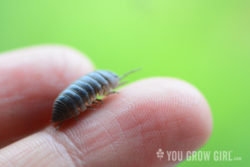
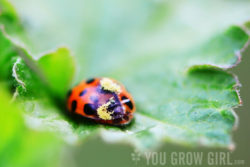
Since then I’ve been watching eagerly to see if there was any movement. And look what I discovered today…

Read more…

Leave a comment

A Year of Progress in the Garden

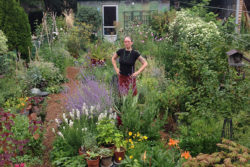
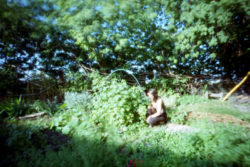
The other day I posted the above image, a photo of the garden as it was at that very moment. I’ve been swinging back and forth lately between satisfaction with the garden’s progress, and frustration with the weather and the feeling of being behind. Or if it’s not that it’s a nagging dissatisfaction that it hasn’t come far enough and is not enough… yet. And then I find joy in a new flowering bulb that emerges, that fresh look that the soil has after it rains, and the relief in finally having laid down a new layer of mulch and I come back full circle to satisfied again.

It was that seesaw of ambivalence that held me back from pressing the post button for a minute before I got over it and let the image go live. Despite my own uncertainty and/or insecurities I am not Better Homes & Gardens and I have never aspired to be. We’ll leave that to those who are better suited to it. I have intentionally rejected that path as a gardener, and thwarted that role as a garden writer for all sorts of reasons, the most basic being that it’s not me. As a result, I feel a commitment to showing my gardens as they are, as never-ending projects that are always in progress. I don’t stage them for photos or wait for that final moment of “doneness” because in truth that moment will never come.

Read more…

Leave a comment

The Gleaners and I


Foraging dandelion blossoms.

This was originally written as a guest post on Free Range Chicken.

“My mother’d say, “Pick everything up so nothing gets wasted.” – from The Gleaners an I

I recently stumbled upon “The Gleaners and I,” a documentary that I first saw several years ago about the ancient tradition of gleaning, or rummaging for unwanted stuff. In the film, Agnes Varda follows many different types of people as they glean a variety of different things: primarily food that has been tossed away by farmers, city dwellers, and so forth, as well as objects, furniture, and whatnot that is used by people for their subsistence or turned into art. Through the film, the filmmaker herself is revealed as a gleaner of sorts: a gleaner of gleaners. And in gleaning these stories and experiences, she asks a lot of interesting questions about how we assign value to food and objects within a culture of commodification and over-commodification. Is commercial value meaningful, or arbitrary and shallow? What is beautiful? What is waste?

The story that is most poignant to me as an eater and a gardener is the first one that takes us to a potato field where tons of perfectly good, edible potatoes have been cast aside to rot as waste because they are too big, too small, or misshapen. The value placed on the potatoes that make it to market is purely aesthetic–they are unblemished and therefore deemed beautiful and commercially viable. It has nothing to do with nutritional value or taste.


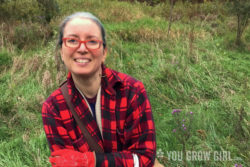
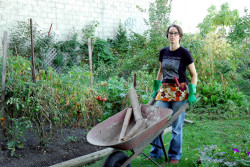
Foraging early spring wild edibles in the pathways at my community garden. That’s my plot behind me.

As a gardener, I have hands on experience with food. I have a hand in its development and I see its progress from seed to harvest. I know what food looks like, feels like, and tastes like. Through this process, I am given an insight into what good food is and how to define it. Through the experience of being a producer, I become an educated consumer, and at times, the lessons of the garden have helped me to redefine “value” outside of the parameters of commodity in general. Beauty is messy, mangled, and imperfect. Some of the best things in life are free. My yearly income has absolutely no bearing on my value as a person. The fact that I can grow my own food is a skill that I can use for the rest of my life. Its value is limitless.

Watching this film again was a good reminder of these lessons that gardening has taught me. It was a reassertion of where I’ve been, who I am, and the life I have created for myself. It was a gift.

What life lessons has being a gardener taught you?

Leave a comment

The Human Side of Plants

“All truths point to a universal truth; all the divisions of nature are closely akin to one another.”

Rancho la Puerta is a mostly media-free retreat that provides guests the opportunity to unplug from television and Internet for a week, as much or as little as they choose to do so. In its place, the ranch offer movie nights and an extensive book and music library that guests can patronize during their stay.

I brought plenty of books to last me through the week, as I do on all trips, but recognizing that they were primarily connected to work in some way, I ended up setting them aside in favor of some light fare that I found in the library. However, as a plant and nature nut, the line between work and play is nearly impossible to maintain. I could not help but find my way over to the library’s Baja ecology resources and guidebooks as I required help in identifying the foreign flora and fauna that lives on and around the ranch. I simply could not wait until we got home to begin researching the life nearby.

While in the library, Davin took some photos of the older books, and it was through him that I was introduced to “The Human Side of Plants” by Royal Dixon (1914), an early predecessor to books like The Secret Life of Plants that tried to uncover and prove sentience in plants scientifically.

Read more…

Leave a comment