File Under: Weird Food

Earlier this year I discovered that the fruit from the Kousa Dogwood tree (Cornus kousa) are edible and I’ve been waiting until the end of summer to get a taste.

The first fruit on my friend Barry’s tree are starting to ripen and I managed, over the weekend, to collect a few from out of the clutches of the neighborhood squirrels. The fruit are ripe and optimal eating when they turn from green to bright red, and from hard to squishy. You should be able to squish the orange fruit from the centre easily. That happens to be just how I ate my bounty. The skin is unpleasant tasting. It looks like a lychee, with the texture of some of my favourite tropicals, sugar apple and sour sop. The insides are bright orange and soft, with a couple of hard pits. It tastes like papaya.

I’ve read that there is a lot of variation between trees and varieties, so if you have the chance, I’d suggest trying fruit from a sampling of trees. The fruit I ate are small but tasty. They are from a landscape tree that is bred for the flowers, not the fruit. But there are varieties with much larger fruit that are worth searching out if you’re looking for more than a light snack.

Related:

  • Paw Paw (Asimina triloba): A local and unusual tree fruit that is also coming into season.
  • Search this site by the tag, Weird Edibles to find out about other unusual vegetables, herbs, and fruit to grow or forage.
Leave a comment

So, I Got This Email from Bryan Adams

Or, I should say, someone claiming to be Bryan Adams.

hey there
cool site!
i came across your page while researching pineapple cultivation.
keep smiling
bryan

I wrote him back, because, COME ON, how could I not reply? I mean, I’m laughing at myself now, because you’d think I’d be cool about it, but instead my inner ten year old quickly and aggressively hijacked my emotions and was all, “Holy crap, Bryan Adams thinks my Internet Website is cool and wants me to keep smiling!

And he did write back from what appears to be a legitimate account. But who can say? I’m not going to waste time trying to prove the email’s legitimacy. It’s much more fun to just believe that Bryan Adams, a Canadian superstar and photographer that I associate with a certain period of my childhood, likes my Internet Website. I mean, why not? It’s plausible. If there is one thing I have learned from a brief, ridiculous addiction (in the 90s) to the “Inside Star Closets” feature of a now defunct tabloid, it’s that celebrities are people too.

You see, 10 years ago when I started the site, I quoted a phrase on the about page that I believe originated from an interview with Bryan Adams. It’s been a long time and about a million people have said it since, but what (I believe) he said was, “Gardening is the new rock n’ roll.”

And now, ten years later and a completely unexpected life and career switcheroo later, and I am conversing via email with the originator (or I believe to be) of that quote. How oddly full circle is that? Even if it’s not the real Bryan Adams, although he claims to be and the content of subsequent emails come off as sincere, it’s still oddly surreal.

This morning, the newest email in my inbox was from The Person Claiming to be Bryan Adams, stating that he might have said that at a time when he was “…obsessing over Gunnera.”

Bryan Adams is a gardener.

It never ceases to amaze me, the people who turn out to be gardeners. Ten years ago we really wanted that quote to be true, although at the time I preferred to think of it as the new punk rock… subversive, D.I.Y, and artistic. Because when I say “punk rock” I don’t mean messy, pissing all over the place Sex Pistols type punk. I mean the punk rock of my teenage years: Sonic Youth, Dinosaur Jr., Husker Du, Big Black…. By the shear volume of people who are saying it, people still want it to be true. Perhaps it already is. These days, my generation is gardening more than anyone ever expected. And I like to think that the way we are doing it is all of those things I mentioned above. But of course, every generation thinks of themselves in that way, don’t they? We’re all the most authentic and the most subversive in our own minds.

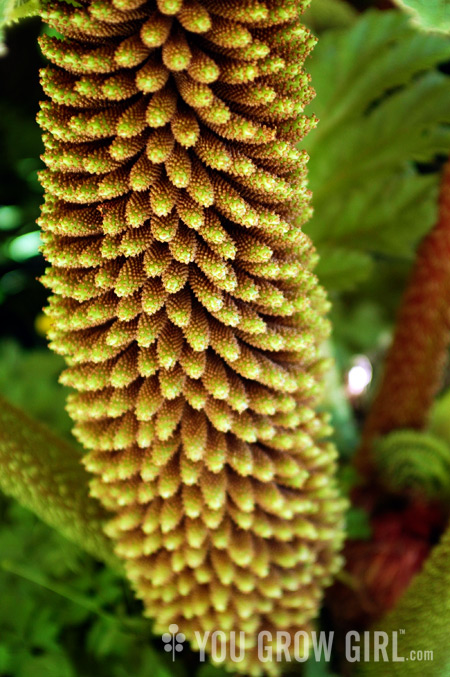
Back to the Gunnera. Last night I had a dream that I was visiting San Francisco. I’ve been itching to visit my favourite spots there recently. And we still flirt now and again with the idea of trying to move there permanently. But I digress…. Then I woke up to an email about Gunnera. Not an obvious connection there for you, but the only times I have seen that plant in person was on trips to the Botanical Garden in Golden Gate Park. I’ve made trips specifically to see that plant.

Have you ever seen it?

This is me in the summer of 2006, standing in front of a Gunnera at the Golden Gate Park Botanical Garden in San Francisco. As an aside, rolled up pants make me look stunted in the leg region. Dully noted. Also, what am I doing with my arm there? Pledging allegiance to the Gunnera with the wrong arm?

Gunnera is a massive, prehistoric botanical mammoth. I can’t help but associate it with heavy metal. And this is what I said to The Person Claiming to be Bryan Adams in a subsequent email. And amazingly, there was a brief email exchange. I will say this for The Person Claiming to be Bryan Adams: he’s very diligent about responding to email.

“Gunnera is an amazing plant. The name alone always seems to conjure up the idea of a Metal-themed garden. Sort of like the Bach-inspired garden here in Toronto, but the inspiration would be Slayer’s “Seasons in the Abyss” or Metallica’s “Fade to Black”. Oh dear, now I am off on a mental tangent planning this ridiculous garden.”

Now, whenever “Run to You” comes on the radio or “Heaven” turns up in a random dramatic television series, I will think about Gunnera, a brief, like minded exchange with someone who may very well have been the real Bryan Adams, and the imaginary Metal Head Garden.

And I will smile.

————

UPDATE: It’s the real Bryan Adams. For a garden writer, I’ve received some pretty odd, and at times downright creepy email so I was pretty skeptical that these emails could be from the real Bryan Adams. Why anyone would go to the trouble of pretending to be Bryan Adams (and creating a pretty convincing email account) is completely beyond me, but I just don’t know anymore. As Tess said in the comments, one of the beautiful things about the Internet is that it is in some respects a great connector, a democratizing force of sorts. You never know who you’ll run into and what you’ll learn about them. But there’s a lot of crazy, too. Still, I was too skeptical. And Mr. Bryan Adams is clearly a friendly fellow and a genuine person who also happens to be curious about growing a pineapple. At the very least I should send him a “Plant Geek” button as a peace offering because he is clearly one of us.

Well that was fun. So what should we do today?

Leave a comment

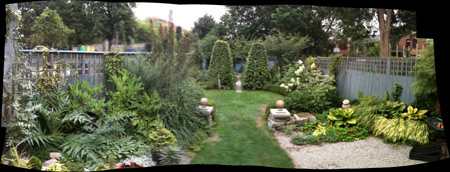
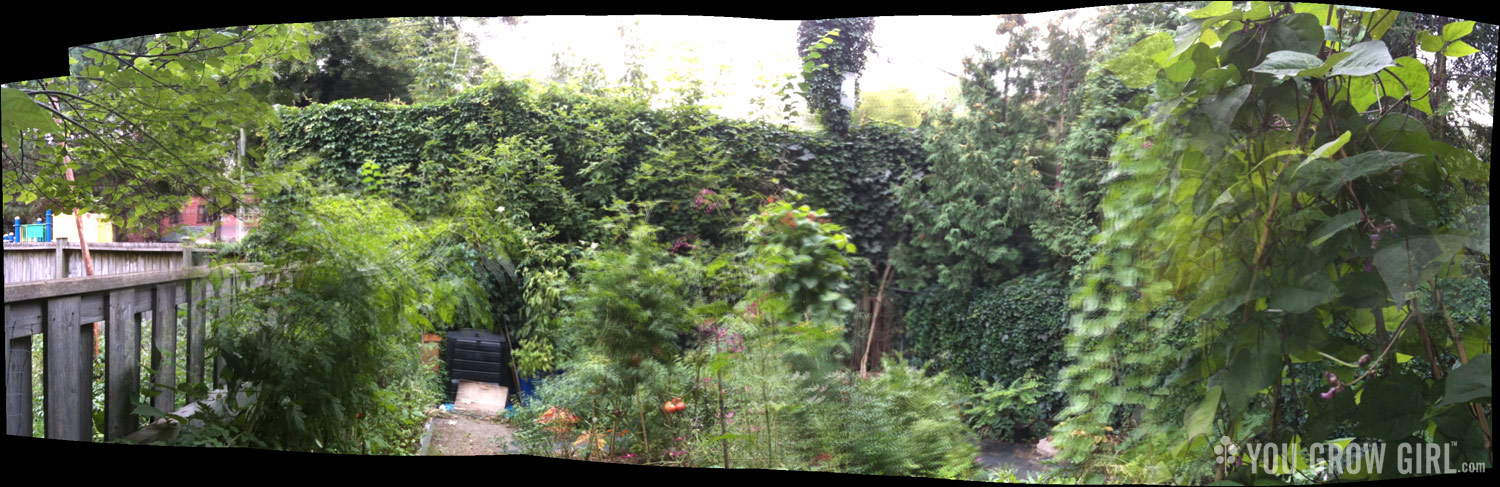
Barry’s Garden: Panorama


Click on the image to see full-size.

The other day I showed a few stitched panoramas taken of the Yardshare Garden using an iphone and an app called AutoStitch.

Today’s photo was taken in mt friend Barry’s backyard.

One of my favourite features in his garden this summer are the ‘Mahogany’ nasturtiums that have been going gangbusters since June (right side). Their deep red blooms look so good against all of the chartreuse foliage in that corner.

Leave a comment

It Came from the Compost Bin

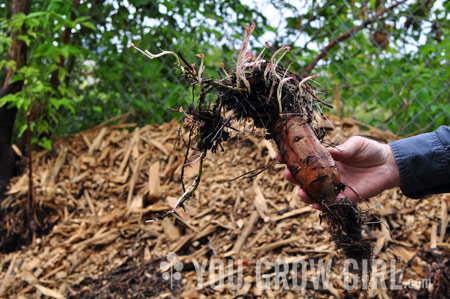
I’m not even sure how a whole sweet potato got in there in the first place, but this one really wanted to grow.

That giant pile of wood chips in the background is the result of a large weed tree that fell down and flattened a portion of our community garden, including our ramshackle compost bin. But Davin, our resident Compost Technician keeps plugging away at it, undeterred. Proof positive that one does not require a proper bin with four sides and a top to turn garden and kitchen waste into compost.

Leave a comment

It’s About Thyme

I’m way behind on posting past articles from my Globe & Mail column. This profile of thyme was published on July 19, 2010. I thought I’d go with it first since the article set to be published this coming Saturday is a profile of another favourite garden herb: sage.

—————–

Most of the country, including Toronto, has just now survived a heat wave. It was hot, especially out on the roof garden, my little piece of heaven turned to hell by the scorching sun. It was only inhabitable after dark – we spent the week offering emergency critical plant care by flashlight.

In that heat, some containers required watering three times per day! The lettuces, violas (miraculously still alive), and even typically resilient basil and tomatoes growing in larger pots put up a fuss of dramatic fainting, fretting, and impromptu wilting when the heat was at its worst. My once lush and healthy lemon tree mysteriously dropped all of its leaves on one side. But trusty, tough-as-nails thyme never once complained. I simply shifted a few pots into slightly less intense sun and it was business as usual.

For a tiny plant, thyme has got it all – looks, an easy going nature, a deliciously warm aroma, a pungent, complicated flavour, and it makes an impact in a cramped space. It is one of only a few edibles that can survive a full growing season in the 4” transplant pot it came home in. In fact, thyme will grow just about anywhere and in anything. In the wild, thyme grows among rocks in very free-draining and poor, often sandy soil.

It’s a very hardy plant that can survive a cold zone 4 winter, as long as the soil is not dense or soggy. I inexplicably lost several plants in my community garden’s premium soil, until I finally hit on the key – thyme simply will not tolerant life in wet soil through a wet winter. This plant doesn’t do nutrient rich, gorgeous soil well. To keep it alive, add lots of rock, sand or grit to increase your soil drainage in-ground. I recently visited a garden filled with happy thyme, all grown directly on top of driveway gravel!

Soil drainage is generally easier to achieve in pots. Most thyme varieties will adapt to pots too small or difficult for anything but cacti and succulents as long as there are lots of holes for water to flow straight out. Potted plants won’t survive outside year-round throughout most parts of Canada but a little pot in a sunny window can provide some fresh greenery here and there until it is warm enough to go back out in the early spring. Otherwise it is new transplants each year. Don’t bother growing from seed unless you intend to grow a lot of any one variety.

Speaking of variety, thyme is an incredibly versatile herb and far beyond the woody and pungent common type (Thymus vulgaris) available at most grocery stores. I’ve got about 12 varieties in a surprising breadth of flavours, smells, colours, and growth forms growing on my roof right now, yet my collection if far from complete.

Next to the common English thyme, deliciously fragrant lemon and lime citrus types (Thymus x citrodorus) are probably most popular and widely available in garden shops and corner markets. There are several varieties that qualify in this category – they come in shades of green, gold, variegated gold ‘Aureus’, and variegated silver ‘Silver Lemon Queen’. ‘Doone Valley’ is very low growing, with round, green leaves spattered with pale gold and cream. ‘Orange Balsam’ and ‘Orange Spice’ have a sweet and spicy orange peel smell and pointy leaves that strike me as a bit conifer-like.

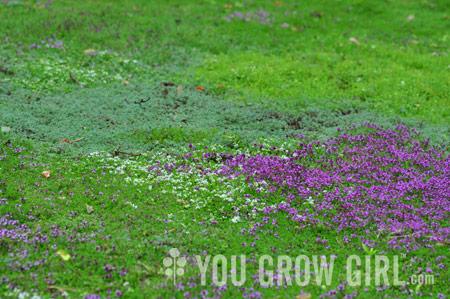
Next up are the creepers: Mother-of-thyme (Thymus serphyllum), Thymus ‘Coccineus’, and woolly thyme (Thymus psuedolanuginosus). They aren’t particularly edible, but they make an aromatic, drought tolerant lawn alternative that you can actually walk on. There are also very diminutive types that form a soft, plush carpet over and between cracks in cement and stone walls. If you’re going to go this route, be sure to grow several varieties together so that you have different textures, smells, and flower colours in bloom together and at varying intervals.

The most compelling are the mimics; thyme plants that smell convincingly like other herbs. I’m currently growing ‘Lavender’, ‘Nutmeg’, ‘Oregano’, ‘Caraway’ (Thymus herba-barona), and ‘Rose Petal’. While I am still finding culinary uses for some of the more unusual flavours, I’ve found that all types seem to pair well with onions. Roast a couple of summer onions in the oven along with thyme leaves and stems, and a splash of olive oil. Don’t forget to dry a few sprigs at the season’s end so you can enjoy this warming dish through the winter.

Leave a comment