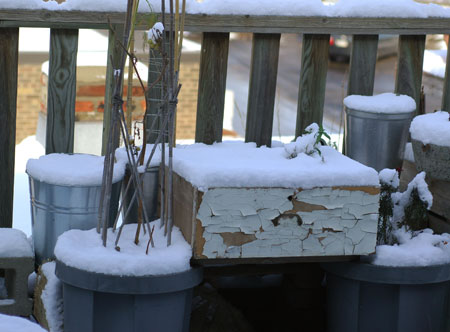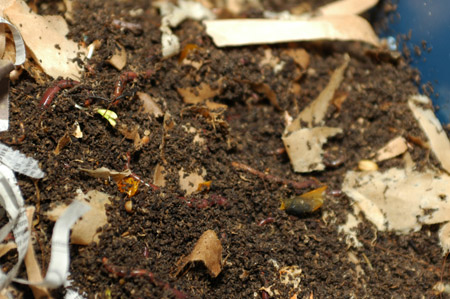
My composting worms are housed in an average-sized bin that we keep in the hallway just outside our apartment door. This spot next to the recycling bin is great three out of four seasons of the year since it saves precious space inside our apartment and is the perfect distance between the roof garden and the kitchen. Unfortunately, the winter season poses a problem. The hallways are heated but just barely, not nearly enough to keep redwigglers (Eisenia foetida) alive.

This year, rather than lugging the big bin into the apartment and living with it underfoot until spring, I decided to downsize. The population in my bin is pretty tame right now. It’s good for the worms to have lots of room in the bin but mine were the equivalent of a two person family living in a monster home. Resizing and moving the contents was easy enough. The bin wasn’t ready to be harvested so I simply prepared a new bin using a smaller container I already had on hand. The worms went into the new bin, bedding and all.
They needed a small top-up of bedding so I shredded some used paper bags I had been saving and moistened it slightly before adding it to the bin. I’ve tried a variety of methods and materials for making bedding over the years and brown paper or paper bags shredded in a paper shredder is my favourite way to go. I don’t mind newspaper but prefer not to use it for reasons that really only come down to pure vanity.

Improvements
I made a few changes to this new bin based on its size. I was most concerned about creating good air flow in such a small bin so I added a few extra holes to the bottom and top with a few more added to the sides. I also added a large hole on top using a drill bit meant for making doorknob holes. I added a piece of coir planter lining, which can be pulled out to increase air flow. I did this because sometimes the bin can get too wet, requiring me to prop open the lid to increase circulation. This works well but I tend to forget about it and leave it propped for too long, sometimes drying out the bedding more than I had intended. The idea behind the larger hole is to regulate air flow more subtly. We don’t have vermin so there is no fear of mice getting into the bin through the large hole and taking up residence. If you do have mice that come in for the winter I would suggest adding more small holes and skipping the larger hole.
Another little trick I’ve come up with over the years is propping the bin on top of small flower pots. Bricks and cans work too. Propping the bottom up allows for better air flow underneath the bin. And the extra plastic lid underneath catches any run-off which can be saved and poured onto your plants as fertilizer.
In Conclusion: I Rule
We’ve been living with the new bin for about 2 weeks now and so far it has been great. I love it and have offered myself numerous mental high fives since making the shift. As you can see, the new bin fits perfectly underneath a table in the kitchen so composting takes about 5 seconds. The new larger hole on top has been genius — I haven’t had any problems regulating air flow and have avoided having to prop open the lid.
For more on vermicomposting:
Leave a comment