Edible Toronto Magazine

Edible Toronto Magazine

There’s a new magazine in town, and I mean that quite literally. Edible Toronto is the Toronto edition of a group of locally-relevant edible cities world-wide. There’s an edible Brooklyn, an edible Seattle, and there’s even an edible Hawaiian Islands. Supported by Edible Communities, a member-driven organization, the locally-centred magazines aim to create relationships around good, local food between consumers, local growers, and chefs. Many of the articles are about farmers, farms, growers, markets, community events and restaurants but there are also recipes and gardening articles.

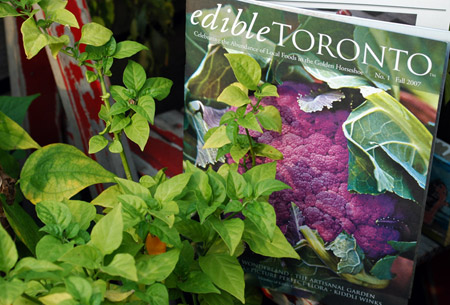
The title of the Toronto edition is a little misleading since it is actually meant to serve the surrounding Golden Horseshoe area. I love the purple broccoli cover photo by FoodShare’s Laura Berman. Their “Where to Get It” page has not been updated as of yet but I can tell you that I picked my copy up in the lobby of The Gladstone Hotel but I have also been told that they’re available at the Dufferin Grove Farmer’s Market (I think they were gone by the time I checked last week).

And did I mention it’s free!

Leave a comment

Over-wintering Hot Peppers

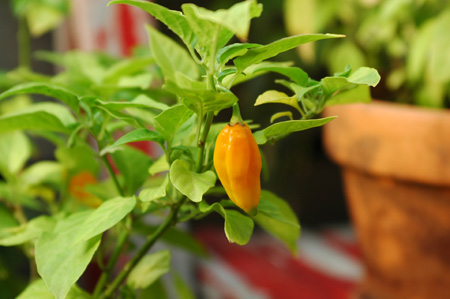
fatalipepper.jpg

What a pleasant surprise discovering that the ‘Fatali’ Hot Pepper I started from seed in the Spring of 2006 (1 1/2 years ago) finally produced those adorable little wrinkly peppers I couldn’t wait to see. ‘Fatali’ is supposed to be one of the hottest known hot peppers with a heat that rivals ‘Habenero.’ I’m too afraid to actually try it and will have to enlist a friend to do the taste-test.

I don’t know why but this is the only variety I have ever grown that did not produce in its first year. In fact all it did last summer was put out leaves and stems without a single flower bud. The growing conditions were right and every other plant went berserk with fruit… the answer to this quandary continues to elude me.

Not one to give up, I brought the plant indoors last Fall once the temperature had dipped, nurturing it in a window with Southern exposure, then moving it to a space under grow lights when the window ledge grew too cold. Come late spring, once the last frost date was in the clear and warmer temperatures were on the way, I moved it to a protected spot outdoors, gradually shifting it closer to a full sun position once it was used to the hot sun and wind (this is called “Hardening Off”). The plant looked a little sad at first having been deprived indoors but quickly bounced back with fresh leaves a trim from my shears.

tricolorpepper.jpg
‘Variegata’ Hot Pepper

You can try overwintering just about any hot pepper indoors, including plants that have already produced a crop that year. I’m thinking about bringing in some of the attractive ornamental varieties I grew this summer. Space underneath the lights is always tricky around here but I just can’t bear to see those beautiful plants wither up and die outside.

Related:

Leave a comment

Aphids Suck

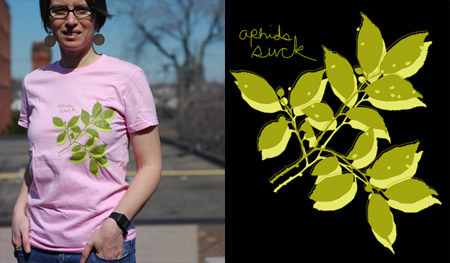
tee_aphidssuck.jpg

Declare war on the aphid nation in this battle-ready tee, now available in pink or black. We’re taking pre-orders for a limited time which allows us to make the design available in a new colour (for those of you, like me, who like their shirts black) and a much wider variety of sizes from Women’s Fitted medium all the way up to Unisex XL. We’ve also reduced the price for a limited time.

Leave a comment

Okay, NOW It’s Fall

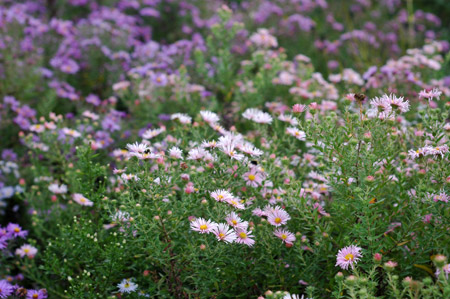
asters.jpg

Break out the apple cider and make some treats, Fall is officially here.

And while the weather is happily still very late-summer-like the signs of autumn are everywhere, especially in the harvest. One of the farmers had pie pumpkins at the market this week. I’m realizing now that I should have bought one. An unidentified mammal ate every single developing ‘Long Island Cheese Squash’ off the vine growing in my community garden plot this year. Boo. Hiss. I had one fertilized pumpkin developing that I thought might have a slim chance but it was gone when I went to check up on it yesterday. Next year I will have to construct some kind of mammal-proof barrier around the little pumpkins. I am saddened that there will be no delightfully flat and scalloped homegrown pumpkin to set on the counter before turning it into a pie.

Next on the agenda is a batch or two of apple and mint jelly and I’ve been toying with the idea of trying my hand at pickled watermelon rind. I already have the apples, mint, and watermelon, now I just have to work up the energy to make it all happen.

Leave a comment

Growing a Nepenthes Terrarium

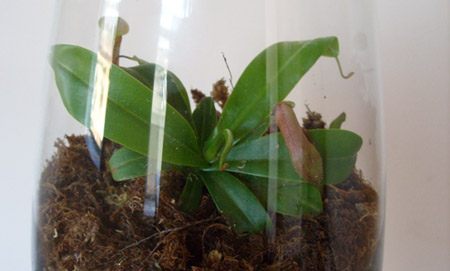
nepenthes_terrarium1.jpg

Look what my spouse brought home for me yesterday as a gift for being sick. If this is what I get for being sick what do I get for being a fully-functioning, productive member of society? Actually being sick was a nice excuse to lay in bed watching Wonder Woman reruns and re-reading back issues of Bitch Magazine until today, the forth day, which just happens to be one day too long. I am both exhausted and bored out of my skull. Those last days of summer are passing me by while I sleep all day, wallowing in my own unshowered filth.

But this is not about being sick, this is supposed to be about the plant. When he presented me with this Nepenthes ventricosa all fancified in a perfect little box, complete with tissue paper and ribbon I have to admit that after the initial excitement and flattery my “thriftiness” (read cheapness) kicked in and my second thought was “But I could have put this together myself for about ten bucks!” I haven’t asked him how much it actually cost. I don’t want to know. Knowing might kill me if this unknown virus or utter boredom doesn’t first.

nepenthes_terrarium2.jpg

If you want to make something like this easily and without gift-store/fancy-pants floral shop prices here’s what you do:

1. Get yourself a pretty glass bowl, fish bowl, candy bowl or terrarium. Department stores sell them in the pet section and so do thrift stores.

2. Line the bowl with approximately 2-3 inches of gravel. This can also be purchased cheaply in a pet store. Gravel is inexpensive when purchased from the pet department. Repackaged as floral gravel and the price is jacked sky high. Go figure.

3. Add about 2 inches of long fiber sphagnum moss to the bowl. Remove the small Nepenthes plant from it’s pot and plant into the sphagnum. Personally I am not a fan of pure sphagnum as the “soil” for this plant. The Nepenthes will certainly survive since the sphagnum provides a light and airy bed that doesn’t stay too damp just as Nepenthes’ roots require, however the sphagnum can dry out too easily if you don’t watch it like a hawk. Try the following instead:


Nepenthes Soil Mix

    Mix together:

  • 1 part long fiber sphagnum moss
  • 1 part orchid bark mix
  • 1 part regular peat or coir


Quick Nepenthes Growing Tips:

  • Two Tribes: Nepenthes are divided into two kinds: highland and lowland species. The plant in my terrarium is probably the most common variety, a highland species called Nepenthes ventricosa. Their name says a lot about where and how they grow with highlanders growing up in the mountains at a high elevations and lowlanders growing in hot, lowland tropical locations. As a result highlanders can withstand much lower temperatures as well as some fluctuations making them better suited to your average home or apartment. Lowlanders are better suited to greenhouses where conditions are very humid and stable.
  • Drainage: Unlike many other popular carnivorous plants Nepenthes are not bog growers. Instead, many types thrive in the tropics, growing epiphytically perched in trees much like many orchids. All of this means that they require lots of good drainage. A container with drainage holes is preferred so if you’re planning to go the terrarium bowl route than be sure to add lots of gravel and water carefully.
  • Water: Like all carnivorous plants you MUST use water low in dissolved mineral salts — your plant will die otherwise. Carnivores may seem tough as nails but they are a sensitive sort really — they’re sort of like the Jane Seymores of the plant world. Try collecting a little rain water now and again into a clean bowl and then funnel it into a bottle or jar for storage. If you’ve got a reverse osmosis filter at home you can use water from that otherwise you’re gonna be reduced to shelling out a few bucks now and again for special low-sodium or distilled bottled water.

    Nepenthes do not like wet feet — let the water in the gravel dry out just a little before adding more.

  • Temperatures: Nepenthes are tropical plants. While the highlanders can tolerate some temperature dips they should be kept in the high 70s F with night time temperatures that drop slightly into the mid 50s F to low 60s F.
  • Light: Nepenthes generally prefer bright but diffused light.
  • Humidity: Your plant will require humidity in order to produce more pitchers. A glass bowl like mine will go a long way in keeping humidity levels up around the leaves. You can also spritz your plants once or twice daily with the same de-mineralized water used to water.


  • Related:

  • Read This: If you are at all interested in growing carnvivorous plants I highly recommend The Savage Garden by Peter D’Amato. His book came out in 1998 and it is still by far the most interesting and most comprehensive book for home growers that I have seen.
  • The Carnivorous Plant FAQ: This is a great site if you’re interested in learning more about carnivores and how to care for them. There are also some fascinating pictures following author Barry Rice’s trips to carnivorous plant locations. The Nepenthes section begins here.
  • Grow a Carnivorous Bog: I’m a huge carnivorous plant fan and have a project in my book that walks you through the steps involved in putting together a container-grown carnivorous bog that can be kept on a porch, balcony, or deck. pgs 110-111. Just remember that unlike many carnivorous plants, Nepenthes are not a bog plant.
  • Get Some: Look for nurseries and plant societies that do not acquire their plants through field collection. If you’re in the U.S try California Carnivores. Canadians can try Keehns Carnivores in B.C.
  • Leave a comment