It Lives

I’ve recently become interested in photographing the decaying garden. It started in the spring when I spent an hour photographing a garden while it was still brown but on the verge of exploding into green. I’m starting to appreciate both the garden and nature’s seasons on the whole. I’ve always had such a block towards winter because of the cold, but photography is bringing me around simply because I need to be out there in it in order to take pictures of it.

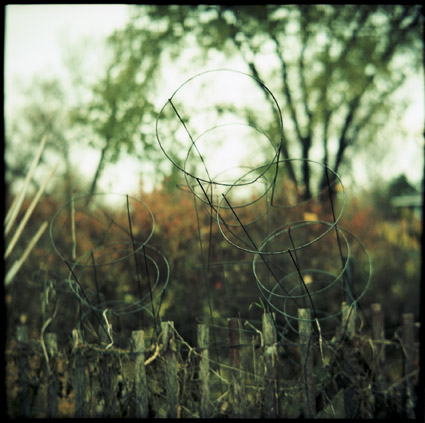
And so now that the garden season is over I am turning my attention to the way things look as the plants prepare for dormancy. I love the bare structures; tomato cages, and homemade trellises that are left behind; the look of the plants as they break down to architectural skeletons and stringy vines bearing floppy leaves. I am discovering that I had spent so much time focussing on the garden through the summer months that I had lost sight of the fact that it stays alive in it’s own way through the remaining months of the year. I am starting to see it and appreciate it in new ways.

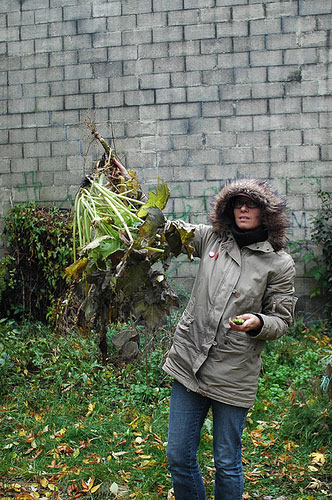
Here are a few examples:

tomatocages.jpg

sunflower_fall.jpg

tomatocages_white.jpg

garden_nov.jpg

Leave a comment

Showering Them with… Water

I closed up shop on my rooftop garden this weekend. The terra cotta containers are all brought indoors and stored away for the winter. I’ll admit that while I’m sad to see it end for another season, I have begun to realize that I really need the freed-up time and energy to focus on indoor plants. Winter’s reduced light intensity and the dry air created by electric baseboard heating make keeping plants with a delicate constitution a battle requiring strategy and commitment. While this is going to seem a little insane and labor-intensive, a big part of my strategy for combating the intensely dry air involves 1. placement and 2. showering.

Here’s how I do it:

Placement: Organize and locate your plants according to their required conditions. We keep a humidifier in our bedroom for our own sake but it just so happens to serve as a great environment for humidity-loving plants. Plants that require warm, moist conditions are kept in that room, while dry, desert plants are kept elsewhere. The bathroom is an obvious choice for humidity-loving plants however my bathroom is windowless. Because all the humidity and care in the world will not allow you to forgo rule #1: plants need light…. for photosynthesis and all that jive.

Showering: Unfortunately I have too many plants to keep everything that needs humidity in the bedroom. Despite the warm, moist air it is a bedroom, not a jungle, and a small one no-less. Additionally, some plants just can’t seem to get enough humidity in which case they are also subjected to the shower treatment. Once a month, sometimes more, I schlep the begonias, epiphytic cacti, and citrus trees into the bathroom where I place them all into the bathtub and run the shower at room-temperature for several minutes until each plant is thoroughly soaked. I then shake them gently to remove excess water and schlep them back to their permanent locations. You can choose to follow along with rainy days as a way to mimic nature and keep a cycle, however baseboard heating can be so drying the typical rules (watering only during sunny days, and avoiding night-time showers) can be thrown out the window. I often take this opportunity to inspect each plant for diseases or pests and check the soil to see if it needs topping up.

Some plants can not make it through the winter without grow lights to help them along during the dark days of winter, but I am convinced that regularly showering the citrus trees is the main reason they have made it alive through the winter months in time to go outside for the summer.

Leave a comment

The Future of Food

I recently sat down and watched, The Future of Food, a documentary that investigates the problems we face in the industrialization and corporatization of food production. Wow, I can’t say enough about this film and am sorry it took me this long to make a point to watch it. If you have any questions about what is going on in farming in North America including questions about about the history, politics, economy, and science of how your food gets to the table and what it is when it gets there, then I urge you to go out and see this film.*

The film leads carefully and clearly from one point to the next, beginning by outlining the problem of patenting life and the power of patent law over farmer’s rights. This segment makes its’ point by following the lawsuits brought on by Monsanto against several farmers including the well-known case of Percy Schmeiser a Canadian canola farmer who was charged with infringing on Monsanto’s patents by having Round-Up Ready canola in his fields, despite the fact that the seeds got there accidentally and he didn’t want them there in the first place.

The film then goes on to explain the science of genetic engineering in a clear manner that really brought home the process by which GMOs (genetically modified organisms) are made and the problems they present. As an example the film explains that genes are put into the plant by invading the cell wall with bacteria and viruses (ecoli). Antibiotic marker genes are attached as a way to test if all of that “messing about” worked. This use of an antibiotic marker has the medical community concerned as to how this will contribute to the loss of antibiotics. Beyond the unknowns of messing about with life, the film provides concrete examples of several other issues brought on by bioengineering including the threat to diversity and agricultural heritage due to what amounts to the uncontrolled spread of GMOs as we find plants located in remote areas with contaminated gene lines. This poses the further (and rather scary) question of what will happen if and when terminator technology (seeds go sterile in second season) pollutes crops around the world.

The film explains that right now the vast majority of seed farmers plant comes from a clustering of 4 companies and projects that in the next 10 years only 6 retail firms will be controlling all food on a retail level (1 of which is Walmart). This means that in the future not only will we have no control over what’s on the shelf and where it comes from, but that what is available will be dictated not by ethics, a respect for the environment, our health, how much farmers are paid, or what we want, but by what is cheapest to provide and puts the most money into the pockets of a few large corporations.

Despite the heaviness of the information presented the film ends on a positive note and serves as a call to action, presenting alternatives (CSA’s, organic farming, and farmers markets) and illustrating how the choices we make right now can have a positive influence on the future. I would say that learning to grow our own food is another positive step in moving toward fixing the problem. While most of us can’t possibly grow enough to provide for our food needs, we can not only offset the cost, but in the act of growing food gain first-hand knowledge of what food looks like when it isn’t homogenized and packaged for our convenience. It also teaches us a respect and basic understanding of what goes into good food production. An educated consumer is a more demanding consumer. As a gardener my priorities have changed in that I expect my food to have been grown ethically and healthfully but I also accept the beauty and flaws that are natural and normal. My potatoes may not be perfect, scrubed spheres but they taste great!

Before I finish I want to call attention to a panel discussion that is shown in the extras on disk 2. In this clip Michael Pollan addresses the question, Why does better food cost more? or Why is organic food expensive? He makes a great argument in turning back the question, Why is conventional food so cheap? The price is low but the cost is high in terms of the environment, public health, karma, the cost to taxpayers in subsidies, the amount of nitrogen used to fertilize which pollutes water, the obesity epidemic, food poisoning… In making his point he does not discount the fact that there are a lot of people living in poverty who can not afford to spend another cent on food but he adds that:

“We only pay 11% of our disposable income on food in the USA. That is less than anywhere else on earth and less than any other civilization that has ever been on this earth.

We have developed a food system that values quantity over quality. We need to reach into our pockets and elevate the importance of food in our lives.”

And as the film states, with food being one of the most intimate things we do, we can’t afford not to think about the consequences of our food choices and as consumers very literally put our money where our mouth is.

More:

*In Toronto, I rented a copy from Black Dog video on Queen St. W

Leave a comment

Compostable Bags

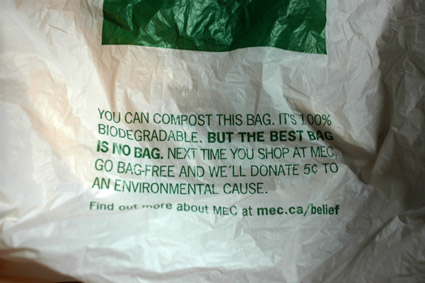
Compostable Bag

Good on Mountain Equipment Co-op in implementing the use of compostable, biodegradable bags in their stores. We use canvas bags and avoid taking plastic whenever possible, but I am really happy to see a real alternative moving into the marketplace.

From the site:

“Unlike older “biodegradable” plastic bags, BioBags are 100% compostable and biodegradable, and will disintegrate in compost in 4-12 weeks, depending on conditions. They can also be reused.

Primarily made of corn starch (made from non-GMO corn), BioBags also consist of Novamont resin and fully biodegradable polymers or polylactic acid. Production of BioBags use less energy and produce two-thirds less greenhouse gasses than the manufacture of plastic bags.”

I also like that they are using bags made of non-GMO corn.

Leave a comment

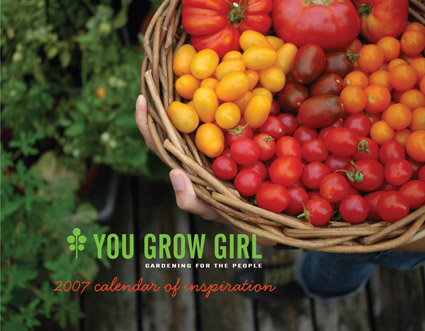
You Grow Girl 2007 Calendar

Yay, the You Grow Girl 2007 Calendar is complete and available in print.

You Grow Girl 2007 Calendar

This full color, 12 month calendar features 30 rich garden and botanical images along with an assortment of organic gardening tips, growing techniques, and creative ideas. Learn about tasty edible flowers, growing great garlic and tomatoes, fighting slugs and snails, making your own seed-starting mix and more. This is not recycled content from the book or website but new and fresh writing!

You Grow Girl 2007 Calendar

I’m proud of this little project. While I love big, beautiful botanical images as much as the next person I wanted to make a calendar that was all that and more. I took the time to provide a balance between rich imagery and inspiring information that I hope will keep you excited about turning each page through all 12 months.

See more details.

Leave a comment