Guest post by Emira Mears
This year, as I was faced with the task of starting up our veggie garden relatively from scratch, I did a bunch of research into garden design, veggie growing, etc and settled on trying the Square Foot method. I did this for two reasons really. The first being that it gave me a pretty straightforward plan that was easy to follow and had decided boundaries. That made the project of starting a veggie garden from scratch seem manageable what with the working full time and such. Second, that kind of regimented, planned gardening kind of runs counter to my entire gardening nature and I was sort of curious, in an admittedly twisted way, to see what I could learn from trying something kind of outside of my normal pattern.
I picked up the first edition of Square Foot Gardening from the library and surprised myself by reading it pretty much cover to cover. And, I continued to be compelled by all the talk of how easy it was to maintain such a systematically planned garden, once you’ve put the initial work into setting it up. And so, I pressed on. Martin (my partner) helped me build two 4×4 ft squares, I made a plan (with a schedule!) for what would go where and when I would plant it, and eventually replant as squares became available. And off I went.
As of this weekend I have four squares left to plant and have already moved onto replanting one of the radish squares that has been harvested, and so I figured the time was right to share my thoughts on this process so far.
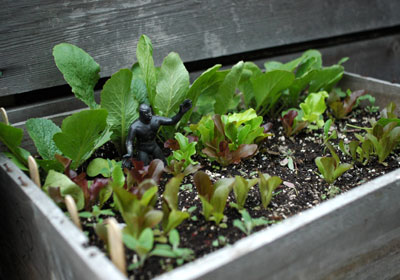
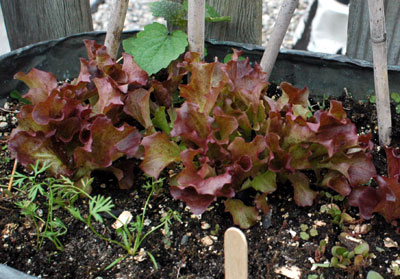
I love it. Much more than I thought I would. And primarily my reason for loving it is that it is exactly as easy as promised. On the weeks when I’ve thought that I didn’t possibly have time to go out and fuss planting vegetables that won’t really give me much return for months to come (so why not wait a few more days… weeks… oops too late), I’ve remembered that to go out and plant two squares of lettuce will take me about 5 minutes including washing up afterwards. Weeding is a breeze in the raised beds, and watering has also been pretty low maintenance (though here in Vancouver the rain has done much of that for me so far). And I have, somewhat to my surprise, stayed pretty close to my original plans. I’ve made a few shifts here and there, ditching a scallion square for extra radishes to meet the in-house radish demand, or deciding that one of the kale squares could instead be planted amongst some of my flower beds to free up a square for example. But, overall, I’ve stayed pretty close to my original plan. And that’s the other great bit: going into it with a plan has been wonderful in that I don’t have to really think about anything, I just need to remember to check my book each week (which I do every Saturday morning) and make sure I’m on track. If I don’t have time to daydream and do web research, or pour over seed catalogues I don’t need to worry. Typically any one week’s tasks (exclusive of watering) can be done in a few 10 or 20 minute stints, leaving me time to worry and fuss in the flower beds.
In fact, my only complaint so far is that I didn’t plan for enough. I should have done three boxes, and I’m regretting that now. In the planning stage I thought that 32 squares (each 4×4 ft box contains 16 squares) would be enough for our family, but I’m not sure that it really is. I had wanted to replace most of my farmer’s market produce shopping for the summer, but I’m not sure how realistic that is going to be. I may need to try growing some regularly consumed extras (like those radishes) in pots or in other beds. And now that summer is coming, I’m already regretting the fact that I definitely won’t be getting quite enough of some of the staples (tomatoes, cukes, beets) for much in the way of canning or pickling, so would need to go to the market for those which seems a bit of a shame. But really, that’s a minor complaint. And I’m already looking forward to setting up a third box next year and may even see if I can maneuver a fourth box for “production” growing of items for canning etc.
I know it is typically a method lauded for small space gardening, and I can certainly see it working well in community gardens. At this point, though I’d recommend it for many folks. It really has allowed me to be pretty utilitarian about my food growing, freeing up much needed time for more creative thoughts about the rest of the garden.


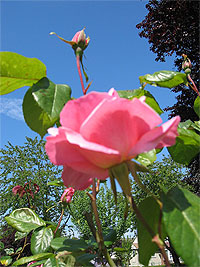
Last summer all of these plants kind of took me by surprise in terms of how very much I fell in love with them. Not that I’ve been harbouring a life long hate-on for roses or anything, but they had just never really caught my eye in gardens in the past. I think it was that each of these different roses (and I’ve already reserved a book at the library to help me identify them, and figure out just what they need in the way of care) brought back childhood garden memories. Their various scents reminded me of the hot summer days that my best friend Kate and I used to try making “perfume” from flower petals mixed with water from the garden hose in 4L ice cream pails that were then set in the sun to cure. The look of the different flowers from each bush was of such a simple, but iconic beauty that I was pretty much charmed from the get go. I also really loved how old each bush clearly was (you could see the gnarled past branches trimmed down to allow for new growth), and imagined how many years they had been tended and loved by their previous owner (I’m such a sucker for things with history, whether its a history I embellish or one that has some actual legs, give me a “heritage” seed variety any day).