Keeping Up With the Cabrals

Guest post by Zesty

I’ve decided June 1 is New Year’s Day at least when it comes to gardening. It certainly doesn’t make much sense to go with January 1. In June I can get outside, take some action and not indulge in any whimsy.

For whimsy and wishful thinking have ruled the day for far too long. It would be fair to say that since moving to my home almost three years ago, my garden has been an unmitigated, or perhaps more accurately, an ‘untended’ disaster. Granted there have been a fair share challenges the last couple of years, the kind of challenges that don’t so much knock weeding off the radar as put it into a new hemisphere altogether.

But as with most things, there is ultimately never a ‘good time’ or a ‘right time’ or ‘time’ period. There is simply the need to get things done and it’s a need that must be met or it all goes to hell in a Kate Spade basket.

If I may refer to a moment of philosophical brilliance as spoken by Edward Griffin: ‘There’s a time to fall apart and a time ta get funky. THIS is one of those funky times.’

So this weekend, it gets funky. I?m going to get out there and get the great purge done.

I made a good start two weeks ago. I purchased a Godsend of a gardening tool from Lee Valley. It’s called a dandelion digger and is the best $34.50 I have ever spent. I got done in one hour what would have taken me a half-day of hand picking on bended knee. After filling a compost bag with dandelions and their assorted compatriots, I was feeling satisfied. My paternal grandfather, who was genetically generous in giving me a talent for all things green, would be proud I thought.

The next day I came home from work and saw on my lawn an invasion of fresh yellow dandelion blooms. I thought what my grandfather would have thought.

‘Bastards.’

I’ve since discovered that dandelions are the Hulk Hogan of the garden. They never really go away.

But I digress.

The dandelions made me feel so defeated. All that work and for what? It seemed that my desire to catch up with my Portuguese neighbours would never be fulfilled. In my neighbourhood it’s not keeping up with the Jones. It’s keeping up with the Fernandes and the Cabrals. My friend Joe, who is Portuguese once told me “For some men, it’s the trophy wife or the car. For some it’s the money. But for a Portuguese man? It’s his house.”

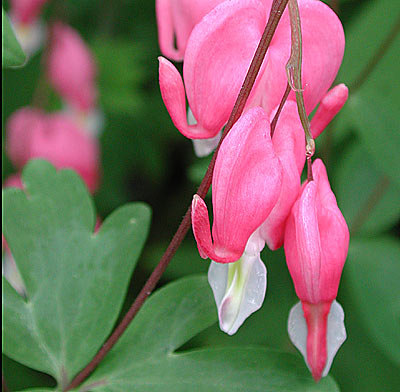
He wasn’t kidding. Being a less than diligent gardener in a predominantly Portuguese neighbourhood is a little slice of self-esteem hell. I’m willing to concede that part of my discomfort with the state of my garden is not just a matter of personal pride, it’s plain old peer pressure. Every day I walk past perfectly manicured grass so dense and richly green, you could carpet a living room with it. Top-heavy hydrangeas and bleeding hearts virtually dripping with blooms abound. I was lucky to get two buds on my Prince rose last year. There’s this awful feeling that that when folks are out on their porches in the summer, they’re looking at our place saying “Oh yeah. Nice people, but (insert multitude of gardening sins here.)”

So after a lost long weekend in soggy Huntsville where my spouse and I got pelted with rain, slept in an uncomfortable bed, saw the odd moose and canoed for all of ten minutes I now have this weekend to catch up.

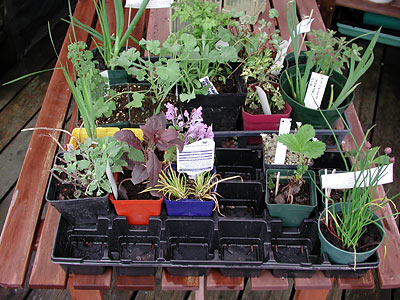
I?m not being overly ambitious. I just want to finish clearing out the weeds, prune back the roses and ground pines and lay some mulch. The next week I?m going to plant some seeds and see what happens.

Hey, ya gotta start somewhere.

Leave a comment

Seeds, Seeds, Seeds

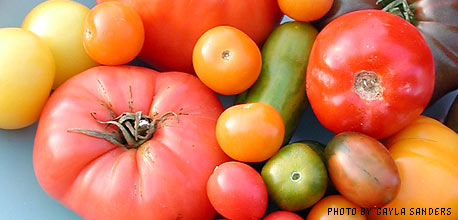
My seeds have arrived. Some are just in time for planting and some are kind-of late but manageable. Just to be clear I have done a first batch of seeds. This is a second, last-minute batch. They are all heirloom varieties purchased from Seed Savers. I’m very excited! I’ve already opened every packet and inspected all the seeds. I suspect most gardeners do this as a result of the pure excitment of it all. However, I will admit that at times I’ve purchased seeds just to see what they looked like, with no intention of growing them. That might be slightly more than a gardening quirk.

Here’s what I purchased:
Read more…

Leave a comment

Late May

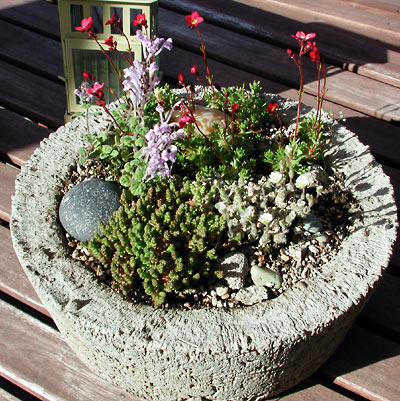
Over May 24 weekend we did more work in the side garden. After several years we have finally expanded the garden to take up all the space next to the sidewalk. Unfortunately it looks really unbalanced now. One side has lush growth and is surrounded by fencing but the other side is all new, small perennials with no fencing. Hopefully it will even out a bit as the summer progresses and the plants grow.
Read more…

Leave a comment

Shade Garden

Despite being trampled and mistreated flowers are blooming in the shade garden. Here are a few photos taken this afternoon.


Bleeding Heart – People say they are old-fashioned and boring but I disagree. Its unfurled, reddish foliage is one of the first signs of spring and the flowers look like crazy fifties bouffant hairdos or milkmaid bonnets.

Violets – A diehard anti-purple person who likes violets — go figure.

These are not from my garden but when I saw them it reminded me that spring is nearly over.

Leave a comment

My Own Private Permaculture

Guest post by Anne Boyer

I planned my first garden for ten years. I fell asleep fantasizing about what I would do with land when I finally owned some: there would be the blue room, exploding with morning glories and delphiniums, the fruit room surrounded by a thick patch of brambles, the grandmother room full of zinnias, potato plants, four o’clocks and poppies. I read everything I could about flowers and fruit. I read 1950s extension pamphlets, my mother’s 1970s Rodale organic guides, and my Better Homes and Garden New Garden Book from 1961.

Organic gardening seemed like a natural choice. My mother never sprayed; my grandmother never sprayed. But was organic “organic” enough for me, or was it just a comforting label accompanied by a discomforting price tag? Would organic alone turn my small city lot, my very first garden, into a heaven of food and flowers?

The purchase of my little city house coincided with my discovery of permaculture. The word permaculture suggested to me something heady and wild, a step beyond organic. It is a philosophy of observing and working with nature. Permaculture provided me with a big picture; organic methods became a narrow slice of it. When I finally settled into my first garden, permaculture helped me accommodate those ten years of flora fantasies in one small, stressed out city space.

Zoned Out

One of the keys to permaculture landscape planning is the “zone system.” The first winter in my city house, I looked out at my small yard and struggled to divide it into proper permaculture zones. Zone one would comprise the most visited and intensively used areas. Zone two would be a semi-intensively cultivated area. Zone three would be the farm zone, four would be a forest or pond, and five would be altogether wild.

The problem with this zone approach was a problem of proportion. I found myself struggling to find space for more than the first and second zones.

Furthermore, permaculture suggests growing intensely cultivated food right up next to the house, and the soil next to my house, as is common with houses built before 1950, was likely contaminated with lead paint dust. I couldn’t just poison my family for the sake of an ultra-permacultural landscape plan.

At this point I stepped back from my paint-by-zone-numbers approached to permaculture, took a deep yoga breath, and decided to observe what was going on rather than impose my will. A flexible approach proved very practical.

In a city, zones do not just radiate from every individual dwelling like orbits in so many solar systems. While we can create tiny pockets of wildness among the urban cultivation, those of us who aren’t large landowners have to see beyond our individual properties to find the other zones. The farms we support through our membership in CSAs become our zone three. Parks and publicly owned wild spaces become our zones four and five.

Indeed, for a small city lot with contaminated soil close to the house, a slight inversion of the zones is common sense. A bit of wildness up close to the house can rebuild and soothe the soil. A more traditional, cultivated landscaping approach can exist on the borders between neighbor and neighbor as a gesture of community good will.

Easy Now

The loveliness of the soil became a strong motivation to proceed mindfully in my garden work. “Multiple use” has become my mantra for any gardening decision. I have to be a frugal gardener in more ways than one: if a plant is going to come live at my house it should feed me, provide me materials for crafts or other activities, feed wildlife, provide shelter, and look good as well. Perennials and self-sowing annuals beat high-maintenance plants hands down. Domestic animals face the same test. We are planning for the arrival of three pullets (young hens) this spring only because the will feed us, entertain us, eat bad bugs, fertilize our soil, and look nifty. This is not just a cruel, human-centered philosophy, because I, too, am required to have multiple uses in my landscape. I am not just a consumer, but a producer and a recycler.

One of the sweetest aspects of permaculture is its philosophy of easy labor. In a permaculture garden, one composts in place through trenches and sheet mulches, one eats from perennial food sources rather than planting annual crops year after year, one plants in “guilds” of inter-related plants rather than in destructive (and high-maintenance) monocultures, and one is as water wise as possible. I didn’t want to be the one responsible for turning beautiful soil beastly, and by layering and careful planting I knew I could keep the cycle of fertility going and save myself a great deal of labor in the long run.

Being Permaculture

My garden is not Eden. I’ve been here two growing seasons, and one could never tell this place was once just lawn and four trees. Yet one still can’t tell that it is on its way to sustainable. I know that I compost less in a bin and more in place, that I water less and less, that I ate more the second year than I did the first, and will probably do less labor this third year than I did the second.

I once had a tai-chi instructor, a retired librarian named Ruth, inform me that I couldn’t just do tai-chi, I had to be tai-chi. In the same way, I’m trying to be permaculture, to move it from an intellectual realm to an emotional and behavioral one.

For example, my backyard trees (a Chinese elm and a maple) provide too much shade for me to grow much food in the back yard, so I’m moving the food production to the front and finding other uses for the shady backside of the house. I’m reading about forest gardens, thinking about ways to use the tiny slices of light between the leaves. This spring I plan to walk through the woods more, to see what is growing, and perhaps cultivate some woodland herbs and fruits (like may apple) instead of forcing my refined sunny space ideal on the land.

This year I have elderberries and currants in mind, and perennial Maxmillan sunflowers to feed my big flower cravings and the birds. I also want grape vines and hippy roses for teas.

The trick is to work through all my wants (the hippy roses, the currants) without an exhausting input of resources (nursery raised plants, commercial mulches and compost). Permaculture suggests that the faraway zones (3, 4, and5) are resources for the up-close, cultivated ones. I’ve applied my personal permacultural approach to this problem and plan to organize an exchange among my gardening acquaintances this spring.

A city garden is not a separate thing, but part of a larger community of land use. As we work together to replace the monoculture of lawn with the polyculture of multiple use plants, we are turning our private yards into stamps of a shared ecosystem. Permaculture extends beyond what we do as private individuals on private land. It reflects not just a philosophy of gardening but of life and community. It is larger than organic, an enthusiastic acceptance of nature and humanity in all our shared complexity.

Hillary Rosner, a freelance journalist and lifelong New Yorker, recently moved to Boulder, Colorado. Until last year, her only experience with gardening was studying botany in the fifth grade. She has written for many national publications and is currently working on a master’s degree in environmental studies.

Comments Off